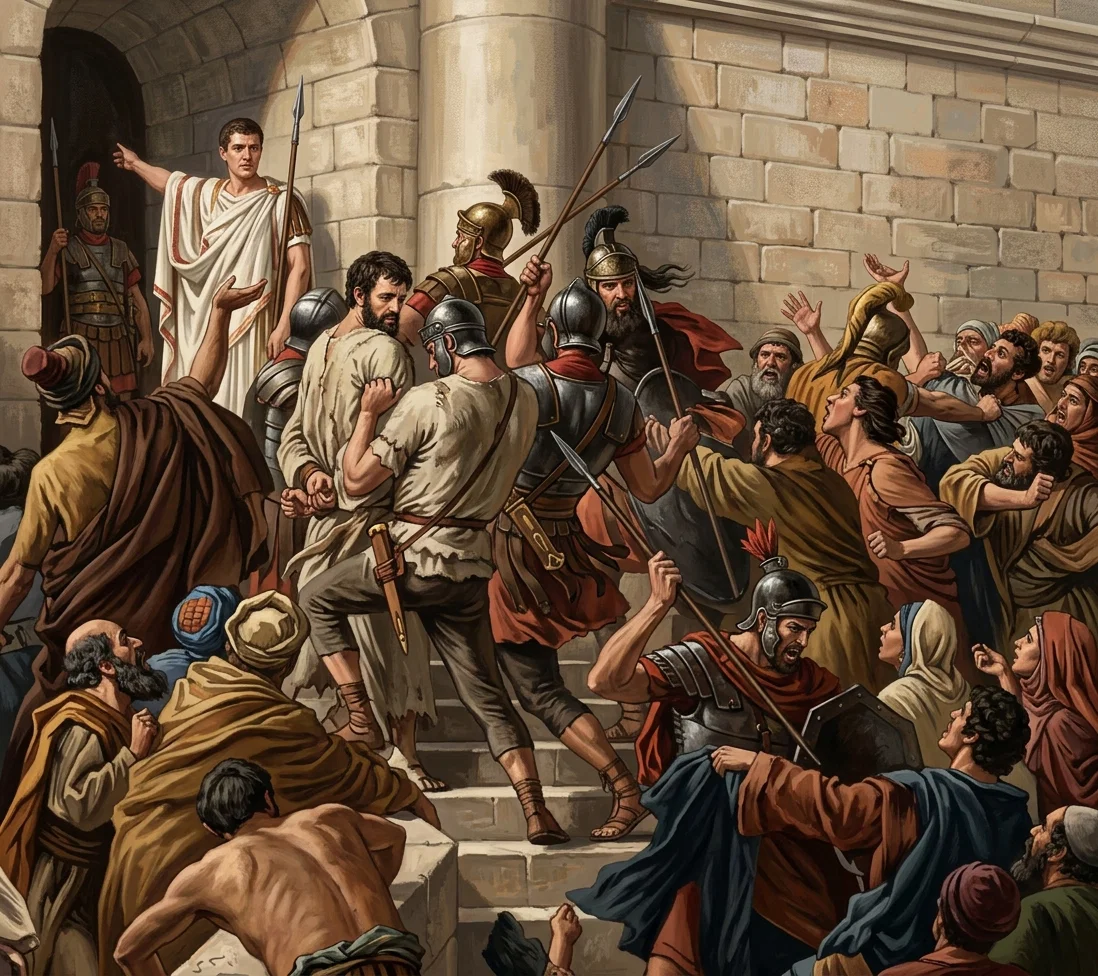
18 “And the day following Paul went in with us unto James; 19 and all the elders were present. And when he had saluted them, he rehearsed one by one the things which God had 20 wrought among the Gentiles by his ministry. And they, when they heard it, glorified God; and they said unto him, Thou seest, brother, how many thousands there are among the Jews of them which have believed; and they are all zealous for the 21 law; and they have been informed concerning thee, that thou teachest all the Jews which are among the Gentiles to forsake Moses, telling them not to circumcise their children, neither 22 to walk after the customs. What is it therefore? They will certainly hear that thou art come. Do therefore this that we say to thee: We have four men which have a vow on them; these 24 take, and purify thyself with them, and be at charges with them, that they may shave their heads; and all shall know that there is no truth in the things whereof they have been informed concerning thee; but that thou thyself also walkest orderly, 25 keeping the law. But as touching the Gentiles which have believed, we wrote, giving judgment that they should keep themselves from things sacrificed to idols, and from blood, 26 and from what is strangled, and from fornication. Then Paul took the men, and the next day purifying himself with them went into the temple, declaring the fulfilment of the days of purification, until the offering was offered for every one of them. 27 “And when the seven days were almost completed, the Jews from Asia, when they saw him in the temple, stirred up all the 28 multitude, and laid hands on him, crying out, Men of Israel, help: This is the man, that teacheth all men everywhere against the people, and the law, and this place; and moreover he brought Greeks also into the temple, and hath defiled this 29 holy place. For they had before seen with him in the city Trophimus the Ephesian, whom they supposed that Paul had 30 brought into the temple. And all the city was moved, and the people ran together; and they laid hold on Paul, and dragged him out of the temple; and straightway the doors were shut. 31 And as they were seeking to kill him, tidings came up to the chief captain of the band, that all Jerusalem was in confusion. 32 And forthwith he took soldiers and centurions, and ran down upon them; and they, when they saw the chief captain and the 33 soldiers, left off beating Paul. Then the chief captain came near, and laid hold on him, and commanded him to be bound with two chains; and inquired who he was, and what he had 34 done. And some shouted one thing, some another, among the crowd; and when he could not know the certainty for the uproar; he commanded him to be brought into the castle. And when he came upon the stairs, so it was, that he was borne of 36 the soldiers for the violence of the crowd; for the multitude of the people followed after, crying out, Away with him. 37 “And as Paul was about to be brought into the castle, he saith unto the chief captain, May I say something unto thee? 38 And he said, Dost thou know Greek? Art thou not then the Egyptian, which before these days stirred up to sedition and led out into the wilderness the four thousand men of the 39 Assassins? But Paul said, I am a Jew, of Tarsus in Cilicia, a citizen of no mean city; and I beseech thee, give me leave to 40 speak unto the people. And when he had given him leave, Paul, standing on the stairs, beckoned with the hand unto the people; and when there was made a great silence, he spake unto them in the Hebrew language, saying.
QUESTIONS.
1. How were Paul and his companions received by the brethren in Jerusalem?
2. Describe his interview with the elders. Verses 18, 19.
3. After he had finished his account of the work among the Gentiles, how did the elders address him? What did they say of the number of believing Jews in Jerusalem? For what were they all zealous? Verse 20.
4. What had these Jews been told about Paul? Verse 21.
5. What did the elders advise Paul to do in order to silence the reports concerning him? Verses 22, 24.
6. What did they say as touching the believers from the Gentiles? Verse 25.
7. What did Paul, in compliance with this advice, proceed to do? Verse 26.
8. How long a time was to be occupied in all this ceremony? What happened near the close of the period? Who were the instigators of the riot? Verse 27.
9. Upon whom did they call for assistance? With what words did they stir up the rage of the Jews against Paul? Verse 28.
10. Upon what trivial circumstance was this charge based? Verse 29.
11. What was the effect of their outcry? What did the multitude do to Paul? Verse 30.
12. What was their purpose? As they were about to kill Paul, who received news of the uproar? Verse 31.13
13. What did he at once do? What effect did the presence of the Roman soldiers have upon the mob? Verse 32.
14. What did the commanding officer do to Paul? What inquiries did he make? Verse 33.
15. What response did he receive? What command did he make in order to escape the confusion? Verse 34.
16. What was necessary in order to protect Paul from the violence of the people? Verse 35.
17. What did they cry out as they pressed around? Verse 36.
18. As Paul was about to be carried into the castle, what did he say to the captain? At what did the captain express surprise? Verse 37.
19. What did he think Paul was? Verse 38.
20. What was Paul’s reply? What request did he earnestly make? Verse 39.
21. Having received leave to speak, what did Paul do? What followed? In what language did Paul address the crowd of Jews? Verse 40.
NOTES AND QUESTIONS.
1. In verse 20, where we have “how many thousands,” the Greek has “myriads” instead of the word for thousands. A myriad is ten thousand. So what the elders really said as to the number of the believing Jews in Jerusalem, was, “Thou seest, brother, how many ten thousands of Jews there are which believe.”
2. If Paul had not heeded the advice of the elders to try to prove to the people that he was law-abiding, could he have gotten into any more difficulty than he did? What lesson may we learn as to going out of the way to do something merely to show that we are right, that is, doing a thing merely for effect?
3. What occasion is referred to in verse 25? Recall Peter’s words on that occasion which largely influenced the decision. He said, referring to the Gentiles, “God . . . put no difference between us and them.” Was the advice given to Paul by the elders (Acts 21: 24, 25) in harmony with what was said in that assembly?
4. Note that, altho Greek was the common language even among the Jews in Paul’s day, he spoke to them in Hebrew. Why was this?