The ceremonies by which the people of Israel were taught to show their faith in the atonement, are dwelt upon to some extent in the book of Hebrews. The sanctuary, in which their regular rounds of service were performed, is introduced, after which the writer says: “Now when these things were thus ordained, the priests went always into the first tabernacle, accomplishing the service of God. But into the second went the high priest alone once every year, not without blood, which he offered for himself, and for the errors of the people.” Heb. 9:6, 7.
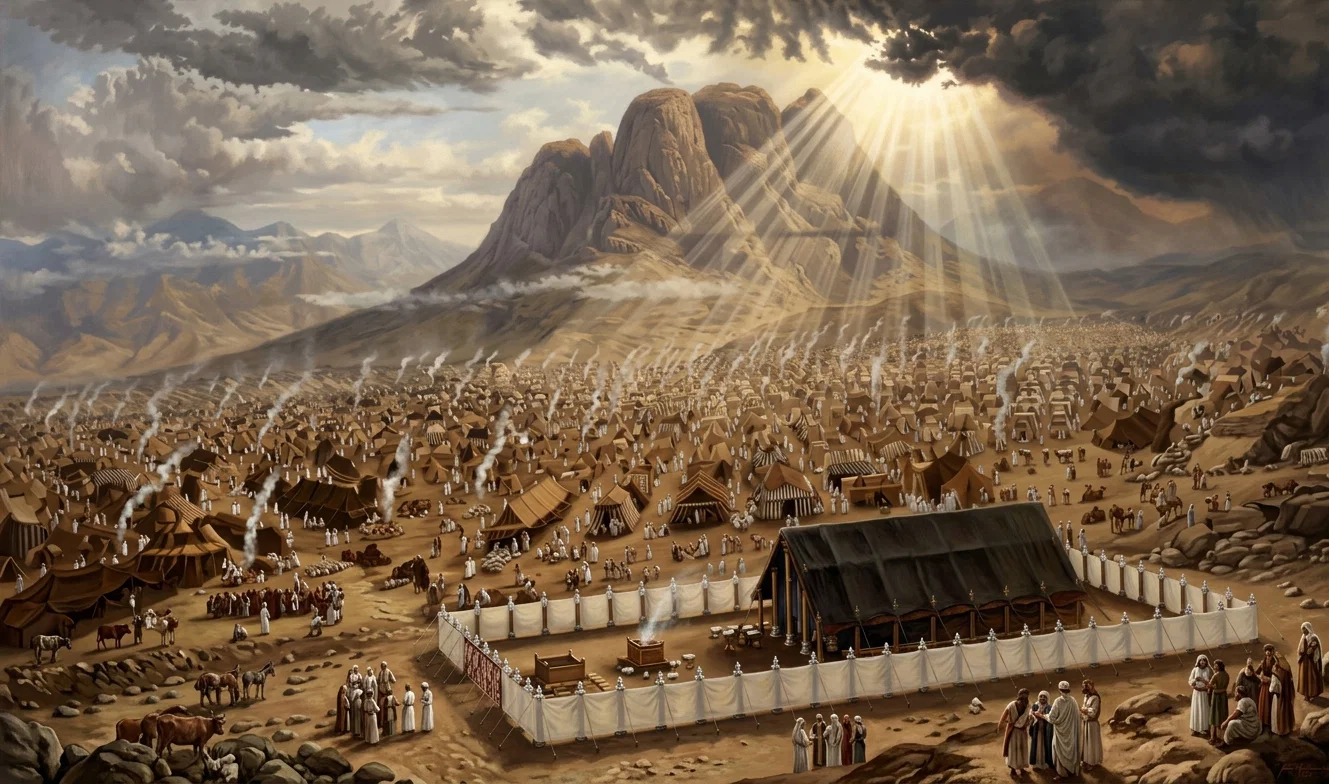
By permission of J. W. Kelchner.
MOUNT SINAI, THE CAMP OF ISRAEL, AND THE SANCTUARY.
Several things are revealed in this scripture. We learn from it: First, that the ceremonies there conducted constituted the “service of God.” Second, that these ceremonies were of two kinds, being conducted by different persons, at different times, and in separate apartments of the tabernacle. Third, that all these ceremonies were in consequence of the errors of the people, hence pointed, in some way, to a remedy for sin. But to learn the exact formula of that work, a somewhat extended description of the sanctuary and its furnishings will be required.
The full description of these is found in the book of Exodus, beginning with chapter 25, and continuing to the end of the book. A careful reading of the explanation there given shows that the sides and one end of the structure were formed of upright boards closely joined together, the lower ends of these being set in silver sockets fixed in the ground. These boards were held in position by crossing them on the outside with bars, which passed through rings placed at uniform distances apart in the boards. The building was roofed with curtains which reached to the ground on both sides, and the east end was closed by hangings of fine-twined linen, which were brushed aside for passage into the building. Another curtain divided the whole into two apartments, giving the first, or outer apartment, twice as much space as the other. Ex. 26:31–33.
The inner walls of the building were overlaid with fine gold, which shone with the greatest brilliancy, thus representing the reflected light of God’s glory in the New Jerusalem. Rev. 21:11, 18. That part of the curtains which formed the ceiling was of the finest and purest linen, having wrought upon its surface in beautiful needlework the forms of many angels, which were designed to represent the angels of heaven in waiting upon the bidding of Jehovah.
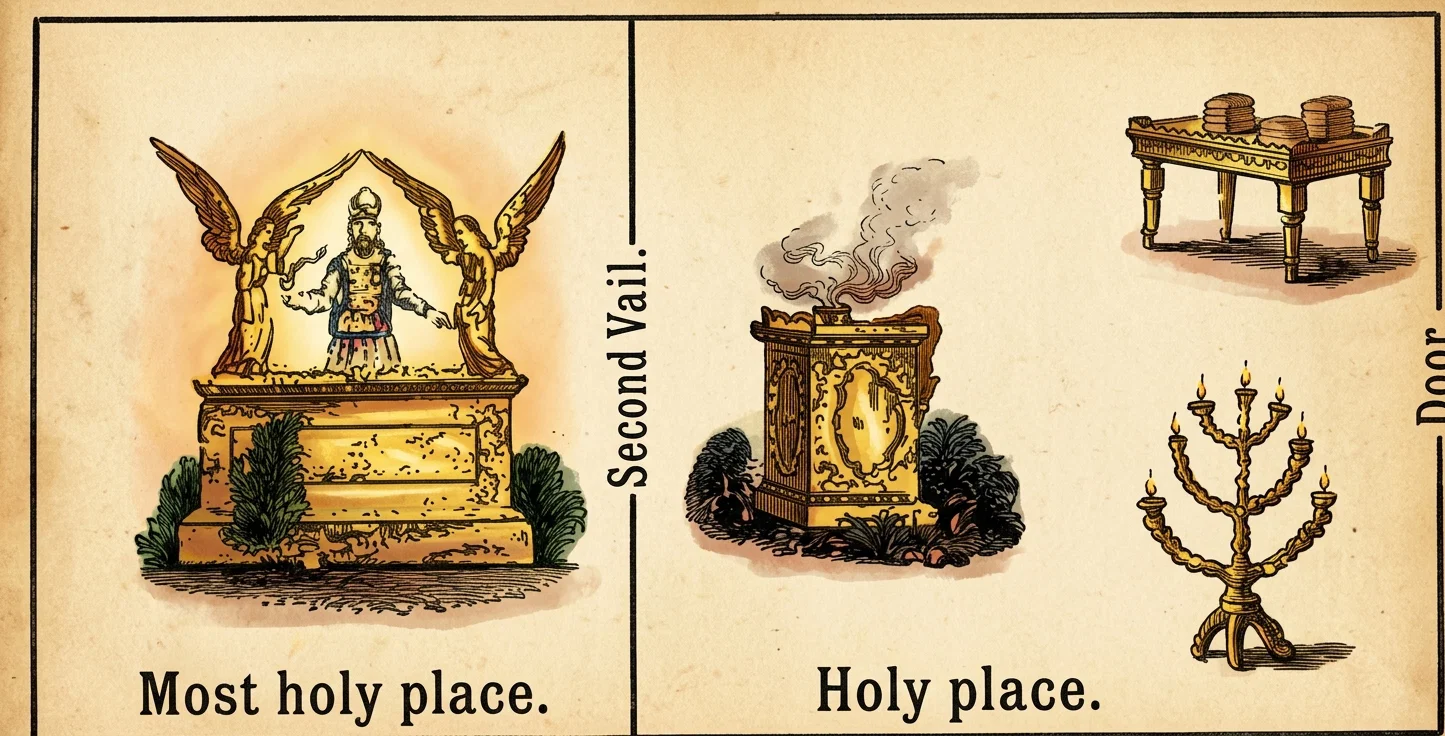
The first apartment contained a table, a seven-branched, golden candlestick, and an altar.Ex. 40:22–27. On this table were placed each Sabbath morning twelve fresh loaves of bread, one for each tribe of Israel, to represent the living Bread of heaven upon which their souls might feed, through faith in Him who was to come down from heaven as their Life-giver. John 6:33–35. The constant light reflected from the seven branches of the candlestick, was to call their minds to the great and true Light who was to light “every man that cometh into the world.” John 1:9. From the altar was sent up incense of sweet-smelling savor, as a reminder of how pleasant to God is the penitent prayer of the reconciled sinner.
Beyond the second curtain, in the most holy apartment, was an ark, or chest, built of wood and overlaid with gold. This held the two tables of stone on which were graven the Ten Commandments. The golden cover of the ark, called the mercy-seat, was crowned with two cherubim, one standing on each end with extended wings, the tips meeting over the center. From under the shadow of these spreading wings shone forth the shekinah, the symbol of God’s presence. This was the “mercy-seat,”—the typical throne of God, from whence His mercy was dispensed to the people of Israel, in the atonement made for them by the high priest. Beneath this throne and mercy-seat were the Ten Commandments, which have ever stood as the ten pillars of his eternal government. The violation of one of these was counted rebellion against the throne of heaven.
As already learned, the priests performed services in the first apartment every day. Into the second apartment, however, the high priest2went alone but once each year, where he offered blood for himself and for the errors of his people. On this last point we are particularly interested, because we wish to learn the nature and process of that figurative work which betokened the faith of Israel in the Messiah’s atonement for the world.
The Lord’s instruction to that people reveals the first step of the transgressor toward reconciliation with heaven. “If any of the common people sin through ignorance, while he doeth somewhat against any of the commandments of the Lord concerning things which ought not to be done, and be guilty; or if his sin, which he hath sinned, come to his knowledge; then he shall bring his offering, a kid of the goats, a female without blemish, for his sin which he hath sinned. And he shall lay his hand upon the head of the sin-offering, and slay the sin-offering in the place of the burnt-offering.” Lev. 4:27–29.
The place of the burnt-offering was an altar at the east end, but just outside of the tabernacle. When any person was seen going thither carrying a young goat, it was well known that he was a sinner desirous of being reconciled to God. Having transgressed one or more of the Ten Commandments that were under the typical throne of God, he was a rebel against the government of heaven, and was therefore counted a sinner. 1 John 3:4. The wages of sin, then, as it is now, was death, because it is contrary to the life of God. Rom. 6:23. In order, however, that the sinner might be released from the death penalty of the broken law, he was permitted, by the mercy of God, to bring an innocent substitute, upon whose head he might figuratively transfer his sin by confession, and then kill the victim, so that a stay of the death penalty might be secured for himself. This was an appropriate expression of faith in the work Christ was expected to do for a guilty race. The blood of the goat having been spilt at the base of the altar, his fat was burned upon it, and his body, bearing the sin, was conveyed into the first apartment of the sanctuary, there to be disposed of by the priests. Lev. 27:30, 31; 6:25–27; 10:16–18. Thus the sin of the sinner was brought into the tabernacle of God, there to await the great day of atonement for its final disposition.
At the close of the religious year, when the sins of the people had been confessed and brought into the sanctuary, came the day of atonement. “This shall be a statute forever unto you; that in the seventh month, on the tenth day of the month, ye shall afflict your souls; . . . for on that day shall the priest make an atonement for you, to clean you, that ye may be clean from all your sins before the Lord.” Lev. 16:29, 30.
With all the offerings and services of the year, the people could not be clean from sin until the day of atonement had performed this service for them. The sins of each were forgiven at the time he confessed them outside of the door of the sanctuary upon the head of his voluntary offering, and this act foreshadowed the privilege of every sinner to lay hold on Christ as the sacrifice for each individual sin. As the body of that typical offering bore the sin of the guilty one into the sacred inclosure, there to be atoned for, so Christ not only bore our sins in His body on the cross (1 Peter 2:24), but He also in that body took them into the presence of God, for their atonement. But as in the type a further ceremony was necessary by which to dispose of a nation’s accumulated sins, so in the antitype there must be a time set apart for the final blotting out of the sins previously confessed and forgiven. Acts 3:19–21. The religious year of the Levitical system was therefore typical of the entire history of the atonement, from the time sin entered the world until Christ shall, in the end of His dispensation of grace, complete His work for the accumulated sins of His people.
On that great day of atonement in the type, the high priest cast lots upon two goats at the door of the tabernacle. The one upon which the lot fell to become the sin-offering was slain, and his blood was taken within the most holy place, to be sprinkled upon and before the mercy-seat. Lev. 16:7, 8, 15. This service, it will be noticed, was altogether different from that held daily in the outer apartment by the under-priests; for while the blood of those daily offerings was spilled at the base of the altar of burnt-offerings, and the body bearing the individual sin was carried into the first apartment of the sanctuary, in this service the blood only was used, and the principal part of the ceremony was held in the most holy place.
Following the high priest in that day’s work, we see him take the blood of the slain goat, and, passing through the outer apartment of the sanctuary toward the holy place, he takes upon himself the sins accumulated there, and bears them in before God. By so doing he fulfilled the directions received by which he was to accomplish the work of the day: “He shall make an atonement for the holy place, because of the uncleanness of the children of Israel, and because of their transgressions in all their sins; and so shall he do for the tabernacle of the congregation, that remaineth among them in the midst of their uncleanness.” Verse 16.
Most holy place. Holy place.
By taking the sins upon himself that were in the sanctuary, the priest cleansed it from its moral pollution, and it was, therefore, in a figure, again reconciled, or brought into harmony with the purity of heaven. This being done, he came out to the door of the sanctuary, where the other goat had been kept alive, and there laid his hands upon the head of the goat, confessing over him all the sins of Israel, thus transferring from himself to the goat the sins which he had brought out from before God. This done, the goat was then sent out into the uninhabited wilderness, bearing all the sins which had been recognized in the atonement.
We say recognized in the atonement; for it is clear that in the work of the high priest in cleansing the sanctuary from the sins transferred to it through the confessions made at its door from day to day, no sins were included which were not confessed, since they still rested upon the sinner. As the atonement work was the separating of sin from the people of God, and inasmuch as the scapegoat upon receiving the sins atoned for was sent from the camp, it follows that those who took no steps toward reconciliation with God, but chose instead to retain their sins to the close of that day’s services, received no atonement, and were also banished from the camp and people of Israel. This was virtually a day of judgment,—a time when sin was banished from the entire people of God, thus pointing to the final work of Christ in separating sin from His people, preparatory to His coming to earth to take them into His eternal presence. But this matter will be carried further in the next study of the subject.