However much one may read about Eastern Asia and its people, when he first visits the country he finds many surprises awaiting him. He realizes more than ever the truth of the old saw that says, “One-half the world does not know how the other half lives.” The conditions as well as habits of life differ widely from those of western nations.
The Government of Japan is a monarchy with a titled nobility that rank socially above all other classes. Next to them are those who are the possessors of great wealth, followed by the professional classes, of whom those who have studied abroad take precedence, everything else being equal. Then come the common people in the following order: tradesmen, mechanics, farmers, and coolies. The last two embrace a large majority of the people.
Caste as it exists in India has no footing in Japan, but social distinctions here are probably as marked as they are among the nations of the West.
The nobility and men of great wealth usually live in houses of European style, and partially furnished after western models. They ride in fine carriages and keep liveried servants; wear foreign clothes, and in fact very generally imitate foreign ways. Altho few in number, their influence in governmental affairs predominates. Aside from the popular brands of the Legislature, they constitute the government, for it is from there that the emperor selects his cabinet, governors of provinces, and chief military and naval officers. It must be said to their credit that there are many broad-minded men among them, who, under the direction of a liberal-minded ruler, have done much for the civilization of Japan. A great revolution has taken place within the last thirty years, and that such a thing should occur among a semi-civilized people in so short a time without bloodshed and without any serious social disturbance, is a marvel to the world, and speaks volumes in praise of the natural intelligence and patience of the people.
Thirty years ago Japan was what China is to-day. Robbery and murder were of common occurrence, but now life and property are as secure as in any other country in the world. A new system of government has been adopted. Every department has been reorganized, educational, military, naval, legislative, and judicial. Railroads, telegraphs, and telephones connect all parts of the country, and are well patronized.
The postal system of Japan is excellent.11The service is better than that of our own country. In this city mail is delivered every hour from 6 A.M. to 10 P.M., excepting from 12 to 1 and from 6 to 7 P.M. There is no part of the country in which there is not free delivery at least once a day.
The emperor sent intelligent men abroad to study different features of foreign governments, with a view of selecting the best from all. Some gave special attention to the social life of other nations; others studied their educational systems, etc. The outcome has been that France furnished the model after which the army was organized, England the navy, and America the present system of education.
In adopting the English system of railroad engineering and service, I think they made a mistake, for to my mind the American is superior in many respects.
Excepting the upper classes very little change has taken place in the social customs of the people. Their houses and their dress are distinctly Japanese. Those in government service and those attending government high schools, when on duty are required to wear a uniform made in foreign style. When off duty they generally don their native dress. The only advantage the native costume has over the European, that I can see, is its cheapness—an ordinary suit costing less than half as much as a foreign suit would cost. The people in many things practise close economy, and well they may, for with the masses incomes are very meager when compared with that of Americans. Of late years the cost of living has increased very materially, while the advance in wages has been little or nothing. This has so affected the laboring classes that it is with difficulty that they support themselves and families. It is here as it is in America. Men in striving to become rich do not always consider the rights of those who labor for them. For the last month the papers have been publishing financial reports of manufacturing establishments and other corporate bodies. As far as I have observed, all declared annual dividends of from twenty to forty per cent. Considering the great advance in the cost of living—many things have advanced fifty per cent. within the last year—a part of these large dividends ought to have been distributed among their employes in the form of increased wages.
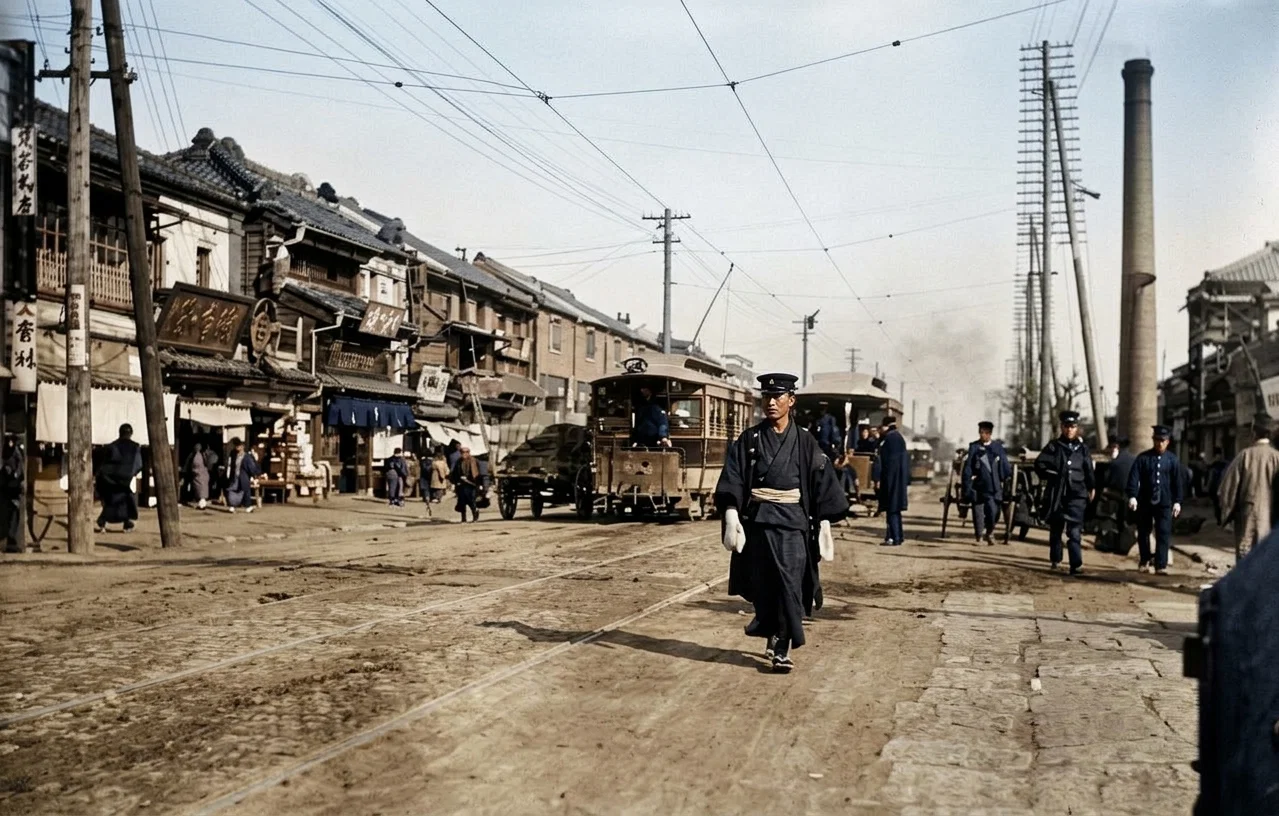
Ginza Street, the best in the city of Tokyo, Japan, from the north end of Shimbashi Bridge, looking northward.
While the number of large establishments increases from year to year, doubtless a majority of those engaged in manufacturing still pursue their work in their own houses very much as our own people did a hundred years ago. Here in this city almost every house that has a street frontage is a shop of some kind, the majority of the houses being two-story structures. The lower front room is commonly occupied by the business of the family. Weaving, carpentering, blacksmithing, manufacturing jinrikishas and articles of bamboo, are the most common lines of work.
The Japanese are not averse to work, but they seem to have a great preference for a kind that they can perform in a sitting posture. They never do anything standing that they can possibly do sitting. They neither use chairs nor stools, but sit on the floor in a position peculiar to themselves. They assume the position by dropping on their knees and sitting backward on their feet. They are trained to this from childhood. To my mind this habit in a measure accounts for their diminutive stature. I have observed that in many of them the lower limbs are proportionately small, which must be due to this restriction. It has become so natural to them that they seldom sit in any other position. Even in the railroad cars, which are provided with seats, I have often seen them sit on the seats with their feet folded under them. At first it seemed very strange to me to see blacksmiths and carpenters hammering away at their trade in a sitting posture. It is astonishing how soon one becomes accustomed to the ways and manners of a strange people. Should I remain away ten years, this land doubtless will seem more like home to me than my own native land. My attachment for this people grows stronger every day.
Excepting the residences of the nobility, and the very wealthy, houses are very small when compared to our American houses. Even business houses on Ginza Street, the best street in the city, are scarcely equal to those of a second-rate American village. Houses are usually constructed of wood and plaster. The framework is put together in a very substantial manner, so as to resist the shock of earthquakes, and the tile roofs are excellent; everything else is of very light material. They are as a rule either painted black or left unpainted, which gives everything a very dingy appearance.
The arrangement of rooms and furnishings is peculiarly Japanese. Floors are all covered with thick mats three feet by six feet, closely fitted together. Partitions made of wooden frames covered with opaque paper separate the different rooms. These slide back and forth in grooves above and below, and can be taken down at any time. To throw the entire floor into one room is but the work of a moment. The outer walls of the rooms consist of wooden frames covered with translucent paper, which serve for windows. These also slide in grooves and can be removed at pleasure. Outside of these is the veranda, with its board floor, which is kept so clean and is polished so smooth as to almost reflect your image. Board screens sliding in grooves constitute the outer walls of the house. At night these are closed and fastened. In the morning they are slidden to one end of the porch, where there is a kind of box or recess to receive them.
Commodious closets are found in connection with every room, in which are stored away the belongings of the family. A low table, about two feet square, or a low writing-desk, a brazier filled with ashes, in the center of which are a few pieces of burning charcoal, and a small teapot, are all the visible furnishings of the house. Everything else is stowed away in the closets, to be brought out only when needed. Their beds are only heavy comforters spread upon the floor-mats, and their pillows cushioned blocks of wood shaped to fit the neck. Their manner of living makes housekeeping very easy. The women are good housekeepers and take great pride in keeping everything scrupulously clean. The woodwork of the interior and the veranda would scarcely soil a pocket-handkerchief at any time. At the first entrance is a small court in which all foot gear is left by those who enter. To enter a Japanese house with shoes on would be a gross act of impoliteness. Instead of counting the hats in the hall, the number of persons in any house may be known by the number of shoes in the court.