THE LAW OF KINDNESS

4%

Pacific Press Publishing Company · Oakland, California · Mar 17, 1898

FromSigns of the Times, Vol. 24, No. 11.

Read the full edition
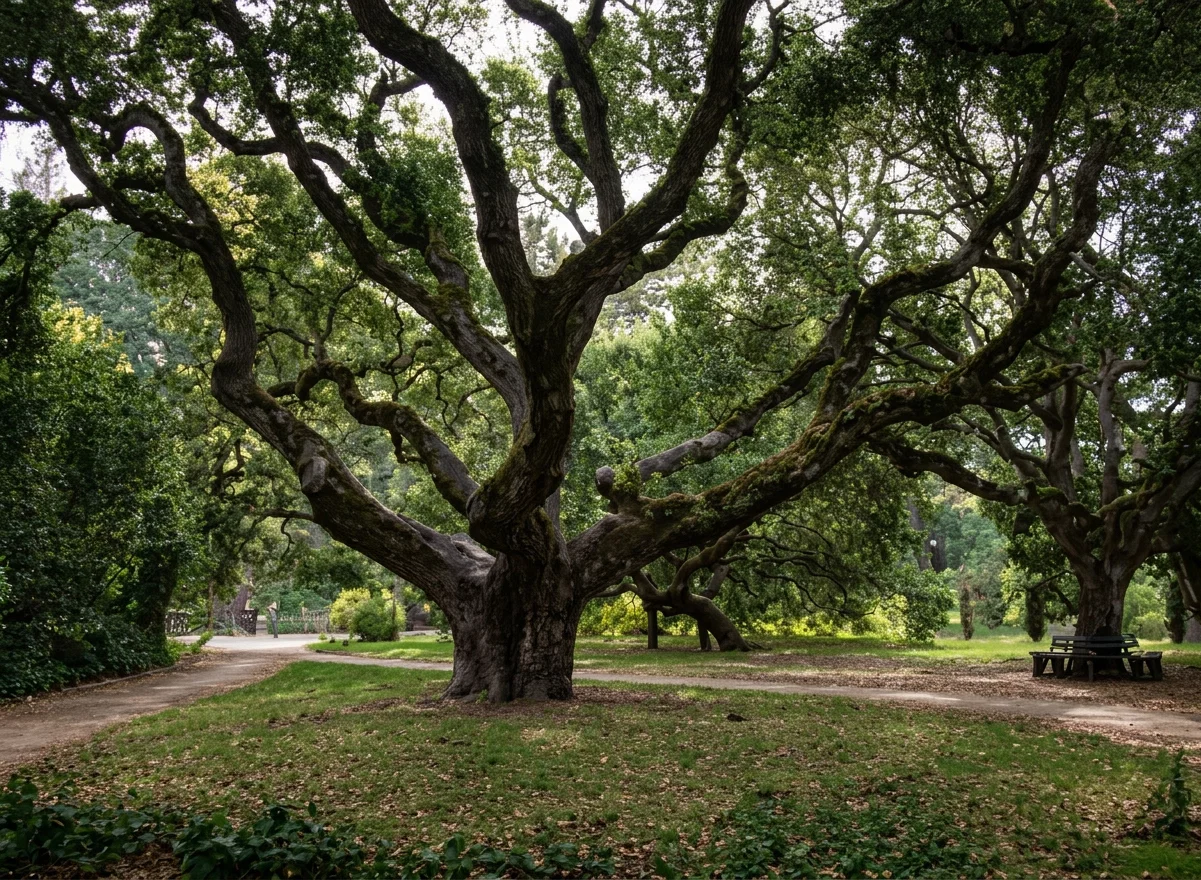
CALIFORNIA SCENERY, NO. 11:—We present herewith an illustration of a fine specimen of the Coast Live Oak, quercus agrifolia. This evergreen oak is peculiar to California and Mexico. Its wood is brittle and worthless except for firewood; but it makes indeed a dignified and noble shade tree. The large center tree in the picture above is in the grounds of the University of California, Berkeley, and is called “The Noblest Roman.” Specimens of the Coast Live Oak are often found with a trunk measuring from 6 to 8 feet in diameter, the branches outreaching 50 to 60 feet from the trunk. Oakland is so named because of the prevalence of this tree.

THE LAW OF KINDNESS.

“A PENNY for your thoughts, Elinor,” spoke Jenet McNaughten.
“Yes, a penny for your thoughts,” added three girlish voices in a chorus.
“I was thinking of that little Hester Waters at Mrs. Brown’s last summer. What a patient girl she was, when we girls must have vexed and tried her so often!”
The five girls—dearest friends to each other—were sitting in Elinor Treadwell’s room. They had met together after school hours to “brush up” for examination week. Lessons having been declared off for the rest of the afternoon, they had settled down in a sort of thoughtful mood, rather unusual for “the jolly five,” as Elinor’s and Jenet’s elder brothers called them.
“Yes, wasn’t she a model?” said Alice Huntington. “How she ran upstairs and down to find our rubbers or handkerchiefs!”
“And yet I never saw a frown on her face, or heard a hasty word from her lips. And what a life she led all that summer! Such a lot of dishes to wash, such quantities of berries and peas and things to pick in the hot sun!” And Elinor leaned her head upon her hand, and her face had a sad expression upon it as she added: “Girls, how much easier and happier we might have made that girl last summer, if we had only been more thoughtful!”
“It was a very fortunate circumstance, indeed, that we five girls could all be together in one house, and have that glorious outing during the summer vacation,” said Clara Greenlee. “We were so happy ourselves that we did not think of how weary Hester must have been waiting on us, and how many times when she was hard at work, she must have thought, with Glory McQuirk, what a good time we had, and she not in it!”
“I don’t know why I have been thinking of Hester so often of late,” rejoined Elinor; “but whenever I think of her, my conscience troubles me, and her sweet, patient, kind ways are a reproach to my hasty speech. Girls, ‘our wits have been wool-gathering;’ why didn’t we think of her at holiday time, and send her a box?”
“Yes, why didn’t we?” exclaimed the girls in a chorus. “Why didn’t we? That is the question.”
“Better late than never,” spoke up Jenet. Let us send her a box now.”
A week from that day, in a small house on the mountain road, a young girl sat at a window facing the snow-covered by-way. She had been a “shut in” for weeks. “Overwork,” the physician said. “Too hard a place for so young a girl, Mrs. Brown’s had been, with all her summer boarders.”
She had begun to get stronger, and her mother had resumed her place at the mill, at the foot of the mountain. Hester had been alone all day, and naturally was very busy with her thoughts. She wondered if the young ladies who were at Mrs. Brown’s during the summer, ever thought of her. Probably they did not. What good times they always had! How nice it must be to have pretty clothes to wear, and an opportunity to learn everything, and go anywhere! If her mother only had the money those girls’ mother had, she would not have to work so hard at the mill, and take the walk to and from, which was a long one, through the cold winter nights and mornings. But what troubled Hester the most was the thought that she could not earn anything to help the dear mother. A snow-bird hopped on the gate post just then, and turned its head toward Hester, and then began some sweet twitterings.
“I wonder what the little fellow is telling me. They say the birds carry messages.”
Some sleigh bells jingling along the by-road frightened the snow-bird away.
“It is old Samuel Stevens coming home from delivering his milk, but I wonder why he is coming here?”
“A box for you, Hester. I left my milk at the station, and Jim Allen asked me if I’d drive around and bring you this box.”
“Thank you, Mr. Stevens.”
“Hope you are getting better fast now, Hester,” the old man said, as he went back to his sleigh.
On top in the box were the five photographs of the young ladies, and this delighted Hester’s eyes and heart. Then she took out the warm flannel wrapper she needed so much, and all the pretty things, which were just what she wanted. In the pocket of the wrapper she found a pocket-book with new silver moneypieces in it. But best of all to Hester was the Oxford Bible. Surely the young ladies must have heard her that Sunday morning in summer-time, wishing for just such a one. On the fly-leaf was written her name, and under it this text: “In her tongue is the law of kindness.”
And there, surrounded by all those sweet remembrances of those young lady summer boarders, whom she waited on at Mrs. Brown’s, stood Hester, with tears rolling down her cheeks, when mother came home from the mill.
“What! crying, Hester?” her mother asked in surprise.
“Tears of joy, mother dear, tears of joy. The young ladies remembered me with all these nice presents. And see, mother, what they wrote in this Bible: ‘In her tongue is the law of kindness.’ I’m so glad I did try to please them, and I shall always remember to try to be always patient and kind, so the text will prove to belong, really and truly, to me.”
—Anonymous.