THE MARQUESAS ISLANDS

10%

Pacific Press Publishing Company · Oakland, California · Mar 17, 1898

FromSigns of the Times, Vol. 24, No. 11.

Read the full edition

THE MARQUESAS ISLANDS.

The group of islands which bears the name Marquesas, was discovered and named by Mendana in 1595, while on his cruise in quest of the Solomon Islands. They lie between 7° 50′ and 10° 34′ south latitude, and 138° to 140° west longitude. The group comprises twelve principal islands, and several smaller ones. In 1842 the islands were ceded to France, and a colony was established, which, not proving a success, was given up after seventeen years of unprofitable experience. A representative of the French Government still remains in the group, but the natives are at present allowed to govern themselves about as they see fit.
The rugged cliffs of these picturesque islands tower high above the sea, with no encircling belt of lowland about their base. There are many small valleys along the streams, and in the productive lowlands of these fertile regions the natives have their homes. To travel in the Marquesas one must climb steep hills or go by the sea.
The Marquesas Islands possess a healthful climate, as do most of the groups of the eastern Pacific, while their proximity to the equator insures them perfect immunity from frosts and snow. The excessive heat is not so overwhelming as might be imagined, because of the trade winds which blow a welcome breeze from the southeast during twelve months of the year.
When the islands were discovered, the natives were, like all the other Polynesians, deep in heathenism, tho they were as fine in appearance as any race to be found in the southern seas. They much resemble the Tahitians in appearance, tho their language is more closely allied to the Hawaiian than to the southern dialects. The various valleys of the islands have long been ruled by chiefs, and among the tribes might has usually been considered the standard of right. The experience of the Marquesans has been a sad chapter in native history, and the many mistakes and vices of the whites have only tended to confirm the natives in their heathenism. When discovered, the Marquesans were no more degraded than the natives in many of the other islands who are vastly in advance of these people to-day; and there is no evidence that the Marquesan natives are any nearer being a Christian people to-day than when the Spanish explorers first sighted the islands, three centuries ago. Their numbers have greatly decreased in the past one hundred years, and most of those who remain are confirmed drunkards. A sad picture it is that they present in the face of the people of the more enlightened lands. Opium has been imported into the group, and given to the natives in large quantities. Traders who have had occasion to employ the natives have found that rum or opium would often secure laborers when money would not; and so these deadly poisons have been extensively used in the dealings of the whites with the natives.
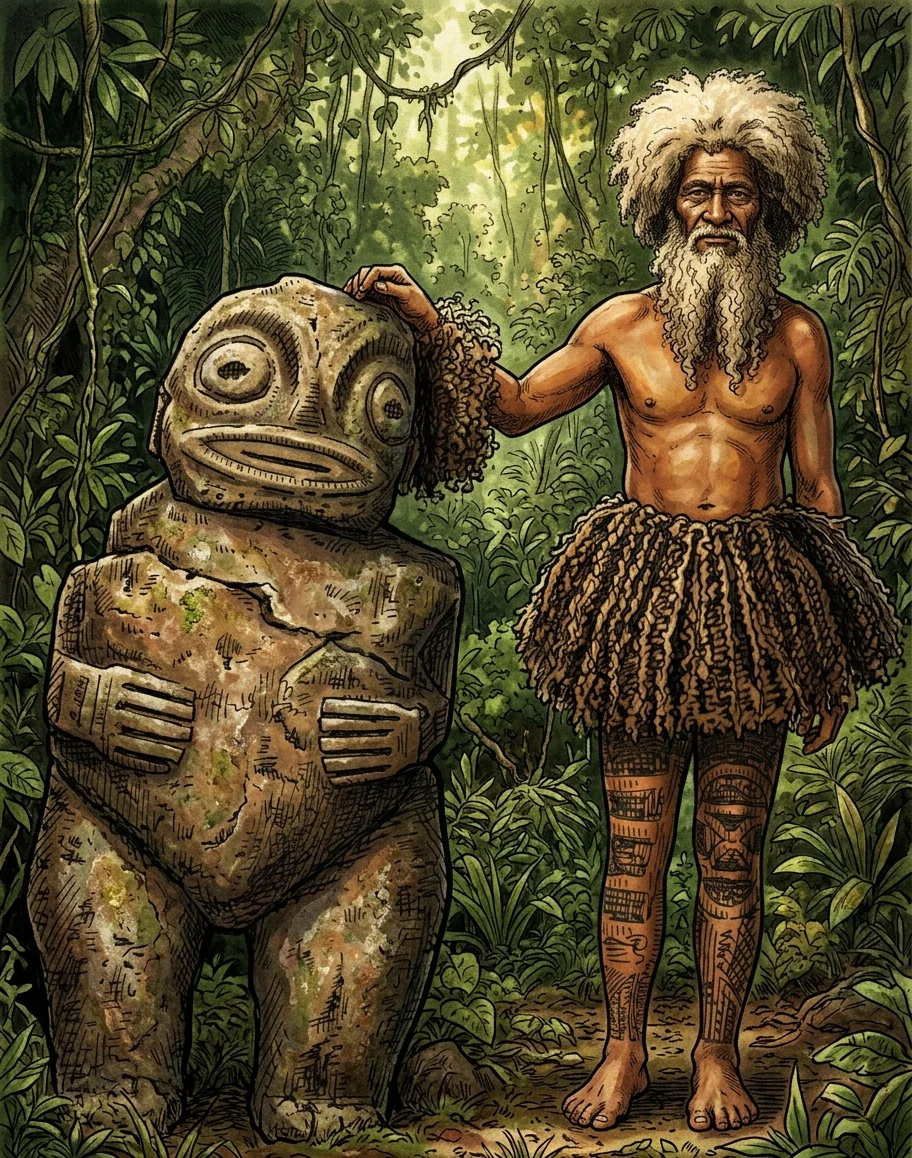
The Stone Image of Marquesas Islands, and a Marquesan Chief.
The following paragraph from the South Pacific directory shows the present condition of the inhabitants:—
The French have no settlement on Dominica (an island of the Marquesas), but there are two or three priests on the island, one of which stated that they had entirely failed in making converts, and that in his opinion there was not a native Christian. He also described the inhabitants as being inveterate cannibals, always at war with each other, and much addicted to drunkenness and other bad habits. The priest had succeeded in cultivating cotton, and had lately sold their produce for £2,000 ($10,000). It was extremely difficult to arrive at any correct estimate of the number of inhabitants, but they are said to have numbered about 2,500 in 1880. The men are tall and able-bodied, but the women are degraded and ill-looking.
Dark tho the picture may be, they are not all bad, and tho the priest of Rome does not know one Christian Marquesan, the writer does. When last heard from, Tahia was a devout member of our church at Arue, Tahiti. She is a Marquesan by birth. The Lord doubtless has many more precious souls amid the beautiful valleys of waving palms in the sin-cursed Marquesas. The people of this group are among our nearest neighbors of the South Pacific, while their spiritual condition is by far the most deplorable of any of the tribes east of the New Hebrides. It may well be called the darkest stronghold of the enemy in Polynesia.
May God work for these poor souls is my prayer, and is there not some one to work with God for their salvation? E. C. CHAPMAN.