THE ATONEMENT IN FACT

7%

Pacific Press Publishing Company · Oakland, California · Mar 17, 1898

FromSigns of the Times, Vol. 24, No. 11.

Read the full edition

THE ATONEMENT IN FACT.

THE typical atonement, conducted by the Jewish high priest on the tenth day of the seventh month, was the closing ceremony of the Jewish religious year, and had to do only with the sins of the year just closing. Prospective sins did not come into the account, because they could not. From our last paper on this subject, it was learned that the atonement work consisted of cleansing the sanctuary from sin which had been carried in there through confessions of sinners, and which had made that building unclean in God’s sight. That atonement covered nothing more. If any of the people refused to bring an offering for sins committed, so that they might be conveyed into the sanctuary, where they could be included in the cleansing of the atonement day, the sins still rested on the individuals who committed them, and the cleansing of the sanctuary could not reach their sins to atone for them.
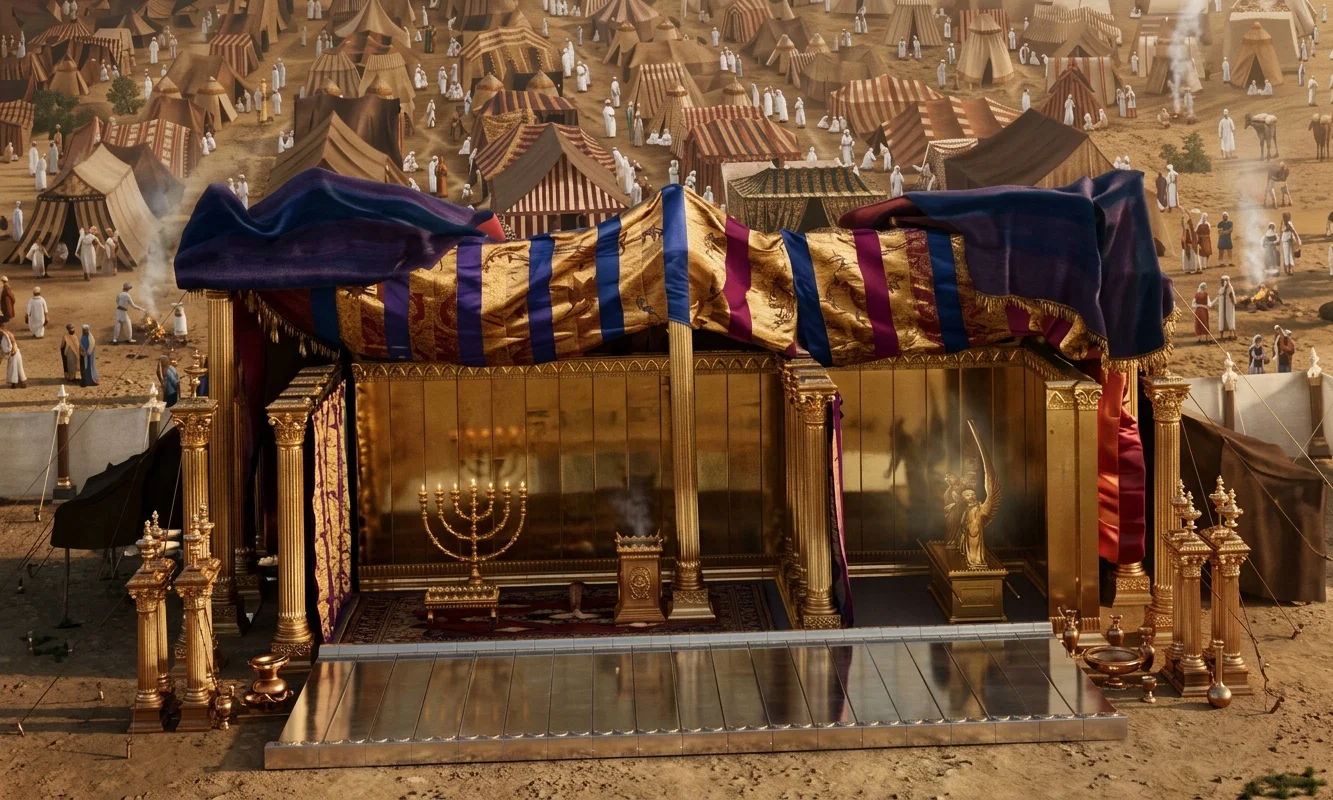
By permission of J. W. Kelchner. The sanctuary of the Lord, with a part of the camp of Israel in the background. One side of the sanctuary is let down, that the Holy and Most Holy Places may be seen. In the first apartment is the Table of Showbread, the seven-branched Golden Candlestick, and the Altar of Incense. In the second apartment, or Most Holy Place, is the Ark of the Covenant, in which were the Tables of the Law, over which was the Mercy-seat, where shone the Shekinah, God's visible Presence. A view of the entire camp and Mount Sinai was given last week.
No compulsion was used to make men give up their sins. If any chose to retain his own sins, they were not borne from the camp by the scapegoat, and the sinner consequently bore his own shame and disgrace, because he refused to be reconciled to the law of God which he had transgressed, which constituted him an open opponent of God’s government.
But the atonement of that time was only typical and shadowy. It was not then possible, any more than now, for the blood of bulls and goats to take away sins. Heb. 10:4. Could this sort of service have relieved the guilty conscience, it would have continued, and the death of Christ would not have been necessary. Those yearly atonements in figure were performed only to keep in mind the fact that the people were sinners, and needed a Saviour. Verses 2, 3. All its services, therefore, but pointed to the real atonement to be completed by the Lord Himself. When the blood of the divine sacrifice was offered on Calvary,—that blood which the Jewish sanctuary substitute foreshadowed,—the typical services of the earthly atonement were no longer necessary. The priesthood in behalf of sin was not to cease, but its service was to be transferred from an earthly, typical sanctuary to a sanctuary not made with hands, eternal in the heavens.
Just prior to His death the Saviour made a most significant statement concerning the temple, the place of the earthly ministrations. Looking upon Jerusalem, the devoted city, from the crest of an adjacent hill, He wept at the thought that the people, who had so scrupulously carried out the typical ceremonies of the temple, had rejected Him, who was the substance of all their shadowy services. Giving further vent to His pent-up sorrow, He cried out, “O Jerusalem, Jerusalem. . . . Behold, your house is left unto you desolate.”
The fulfilment of this saying was soon to follow. When hanging on the cross in His expiring agony, the divine Sufferer closed His eyes in death with the piercing cry, “It is finished.” At that instant, the vail of the temple was “rent in twain from the top to the bottom” (Mark 15:38), indicating that the two apartments of that earthly sanctuary were now both alike abandoned by the symbol of God’s presence, the work in them having been finished. There the typical service ended, and the priesthood passed from the Aaronic to the Melchizedek order, Christ Himself becoming the high priest of His people forever. Heb. 6:20; 7:11–17.
After dwelling at some length in the seventh chapter of Hebrews on various phases of the Levitical priesthood, especially the work of the high priest, the apostle then says, “Now of the things which we have spoken this is the sum: We have such an high priest, who is set on the right hand of the throne of the Majesty in the heavens; a minister of the sanctuary, and of the true tabernacle, which the Lord pitched, and not man.” Heb. 8:1, 2. From this we learn that Christ is the minister and high priest of a sanctuary; not of one made by man, but of one erected by the Lord. This is the true, real tabernacle, of which the Jewish one was but the shadow. But where is that sanctuary? and what is it like? The apostle answers: “For Christ is not entered into the holy places made with hands, which are the figures of the true; but into heaven itself, now to appear in the presence of God for us.” Chapter 9:24.
This reveals the matter clearly. The sanctuary of which Christ is minister, is in heaven. The holy places, that is, the two apartments of the earthly sanctuary, were figures of this true one. This means that the inside arrangement of the earthly sanctuary had the form, shape, or outline of the heavenly. Indeed, we learn that when Moses was commanded to build the earthly tabernacle, God showed him one already in existence, charging him to follow fully its pattern in making the temporary one. Ex. 25:40; 26:30; Acts 7:44; Heb. 8:5.
Comparing type and antitype still further, it must be admitted that, inasmuch as the two apartments of the earthly sanctuary, with their furniture, were made and placed according to the arrangement of the heavenly sanctuary, it is consistent to assume that the services in the earthly apartments, as ordained by God, must correspond to those of the heavenly as nearly as the shadow can represent the substance. Looking at the sanctuary services of the Levitical priesthood as expressive of faith in the atonement work of Christ, we can come fairly to no other conclusion.
Let us review a little. Did the earthly sanctuary have two apartments? So does the heavenly. Heb. 9:24. Did the earthly have a golden altar before which incense was offered? So does the heavenly. Ex. 30:1–10; Rev. 8:3, 4. Did the earthly have an ark, in which was kept God’s testimony of His righteousness,—the law of Ten Commandments? The heavenly shows the same. Ex. 25:10–22; Rev. 11:19. As the earthly sanctuary had service in both apartments, so must the heavenly, in order to be the true heavenly substance of the earthly shadow. As the atonement in figure was performed by a high priest in the most holy place of the typical tabernacle, so the real atonement must also be made by an actual High Priest in the most holy place of the heavenly sanctuary.
The real atonement could not have been completed by Christ while He was on earth, because He could not act as high priest while the Levitical priesthood continued, which was to cease only upon the offering of the divine sacrifice, of which their offerings were the shadow. This fact is plainly stated as follows: “For if He were on earth, He should not be a priest, seeing that there are priests that offer gifts according to the law; who serve unto the example and shadow of heavenly things.” Heb. 8:4, 5. He could not, therefore, become high priest, and as such make an atonement for sin, until the shadow work ceased, and the real work was inaugurated by the death of the true offering for sin.
In fact, the apostle tells us plainly that the way into the “holiest of all,” that is, the heavenly sanctuary, was not made manifest while the first tabernacle was standing. Heb. 9:8. This intimates that at the expiration of the shadowy service in the earthly sanctuary, the real work which that foreshadowed would begin in the heavenly temple. This was to be a “new and living way,” consecrated for men through the body of Christ. Heb. 10:19, 20.
Thus through the sacrifice of Christ a system was established by which the world’s atonement would be accomplished, just as foreshadowed by the priesthood and service of the earthly sanctuary, in all its appointments. But we will look further into this matter in a following article. JOHN ORR.