Of the many holidays observed by the Japanese, New Year’s day is the most important. Until a few years ago the Japanese reckoned time by the Chinese calendar, but, to be in harmony with western nations, they now begin the year with January 1. From about the middle of December, apparently the all-absorbing thought is the approaching holiday. The first step in preparing for the event is house-cleaning, a universal custom that had its origin a long, long time ago, no man knows when. What little furniture the house may contain is removed, the floor mats are carried out and beaten, the walls, screens, and closets are carefully dusted, and the floors, pillars, and other woodwork polished bright with a scrubbing cloth. Among the nobility and the wealthy, house-cleaning is said to be conducted with considerable ceremony.
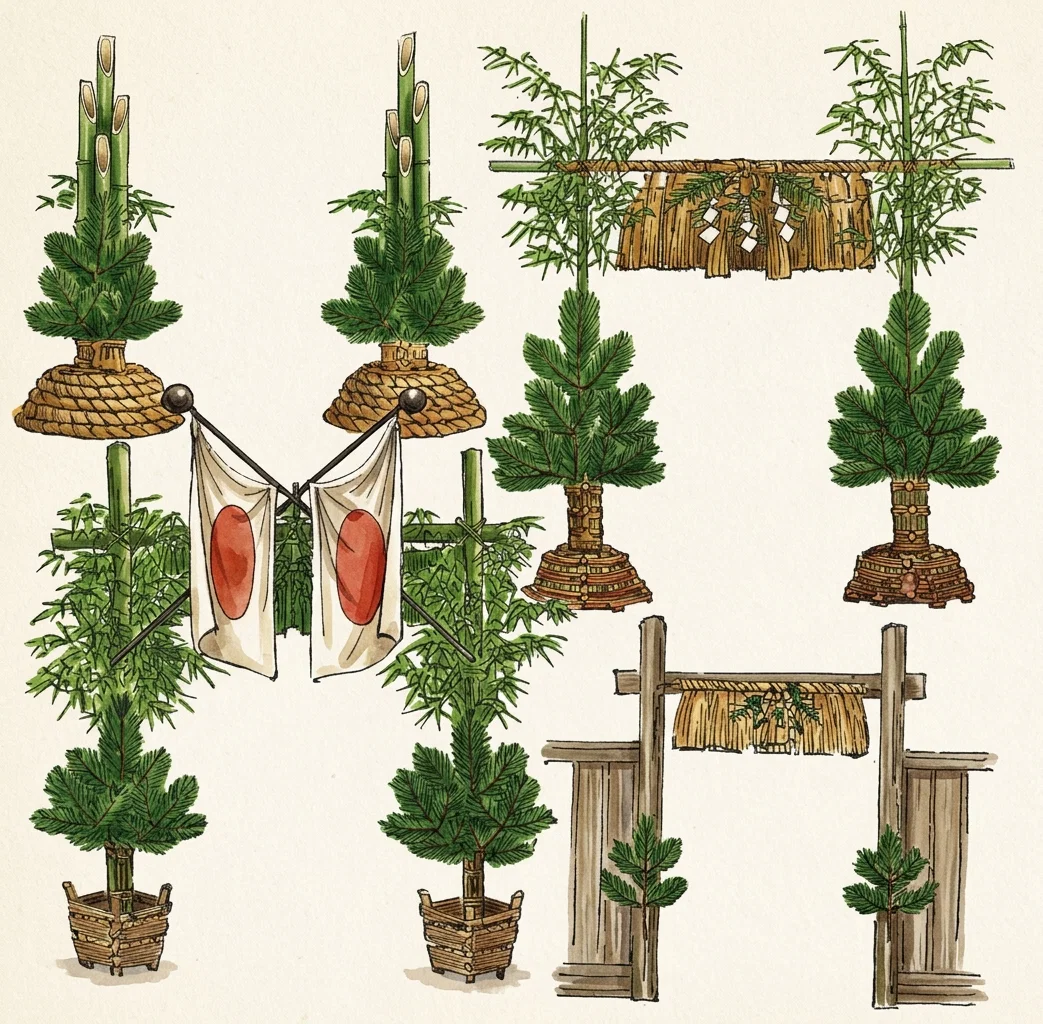
After the house-cleaning comes the decorating, which is a matter of tradition also. The outside kazari (decorations) consist of a heavy rope made of rice straw, stretched above the front door or gate, to which is appended a fringe of the same material. To this rope are attached an orange, a lobster (or crayfish), some leaves of fern, a few leaves of an indigenous evergreen called yuzuriha, a strip of edible seaweed named kombu, a string of dried persimmons, and above all some strips of white paper. On each side of the entrance are placed a young pine tree and a bamboo. The two pines must be, according to the rules governing such things, of about equal proportions, the one (the male), somewhat rough and prickly, and the other (the female), smoother and more graceful. The former is placed on the left side of the entrance and the other on the right. These are said to be emblematical of constancy and endurance. The inside kazari is made up in a way similar to that outside, with the addition of potted plum trees, anemones, etc., according to the taste of the family. These are all supposed to greet the visitor in his own peculiar dialect. The language of the orange is, “May your family be prosperous from generation to generation,” and that of the crayfish, “May you live so long that your back becomes bent like mine, and that your whiskers grow so long as mine.”
For two or three weeks previous, at certain privileged places fairs are held for the sale of decorating material. Booths are erected in the streets where these and many other things are sold, especially such as are supposed to invite prosperity or to keep off evil spirits.
Rich or poor, every family must have mochi11for New Year’s day. What is mochi? It is boiled rice pounded into a stiff dough, and a more unpalatable mess I have never tasted. It is heavy, insipid, and indigestible. In olden times each family prepared their own mochi, but of recent years nearly all obtain it from the confectioners. It must be custom that impels people to eat it, for to my mind nothing but a perverted taste could relish it. The origin of this custom is unknown, and I have so far been unable to ascertain its significance.
The evening of the last day of each month, and especially the evening of the last day of the year, it is the custom for each family to gather around the family board and partake of soba, a kind of macaroni made from buckwheat flour, and put up in bunches that resemble skeins of thread or bunches of shoestrings. It is rather more agreeable to the taste than mochi, but is an article that an American can do without very well. The origin and significance of this custom are uncertain, but were probably at some time and in some way connected with the religious superstitions of the country, for those of the Shinto religion still, at times, offer soba to their tutelar deities.
While speaking of the customs connected with New Year’s eve, it is well to mention that of squaring accounts between creditor and debtor. It is considered a disgrace for a man to pass into the new year with debts hanging over his head, consequently the last day of the year is a very busy one to the merchant; but all are expected to settle before 10 o’clock P.M. that he may have opportunity to eat soba with his family.
JAPANESE NEW YEAR DECORATIONS. The upper one at the right is the most common; the lower frequently seen; the upper at the left rarely seen; and the lower not numerous.
The custom of making presents prevails among all classes, but, unlike Americans, as far as I have observed, the utilitarian idea governs in the bestowal of gifts. Among the middle and upper classes, boxes of eggs, baskets of fruit, salted salmon, boxes of cake, and papers of sugar are the most common articles used. The value of the present rarely exceeds fifty cents, and is always put up in a certain way,—baskets, boxes, and papers of certain designs, and always tied with a bunch of paper twine, one half red and the other white. There is also attached to the package a bit of red and white paper folded in a way similar to a school-boy’s thumb paper. The strings and paper are accessories of all presents. If they have any significance other than to indicate that the package is intended for a present, I have not been able to find it out. Packages for presents are always kept on hand by dealers, for the Japanese are much given to bestowing gifts at all seasons of the year. All of our visitors brought presents with them the first time they called to see us. When a man moves into a new neighborhood, he is expected to make presents to his new neighbors if he desires to cultivate their acquaintance. A mess of soba must be sent to each family, with his compliments, otherwise they will always remain strangers to him. The giving of presents is carried to such an extreme that the faculty of the Imperial University a few years ago declared against it, and have since used their influence to break up the custom; but so far they have met with little if any success.
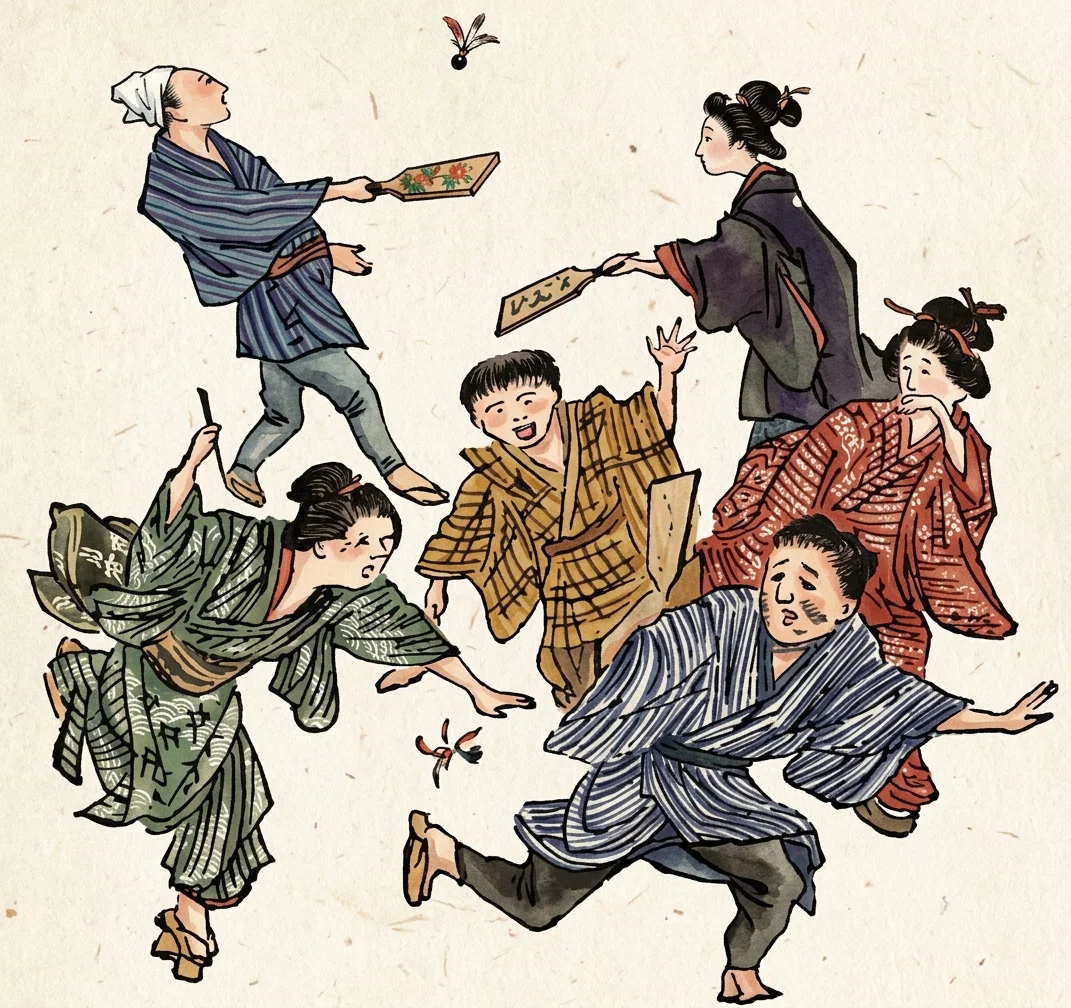
Japanese Children Playing Shuttlecock.
Children are not neglected in the distribution of presents at the beginning of the new year. The boys usually receive kites, and the girls handballs, or shuttlecocks and battledores. New Year’s day the streets were full of boys and girls, the former flying kites and the latter playing shuttlecock. The Japanese kite is in its way a thing of beauty, and to see the sky filled with them is a very pretty sight. In playing shuttlecock whoever fails to catch the shuttlecock with his battledore must have a spot of ink daubed on his face. The game is a very exciting one, and is sometimes played by both sexes. These two games, when the weather is fair, will be all the rage for the next three months. To all appearances the new year brings joy and happiness to everybody.