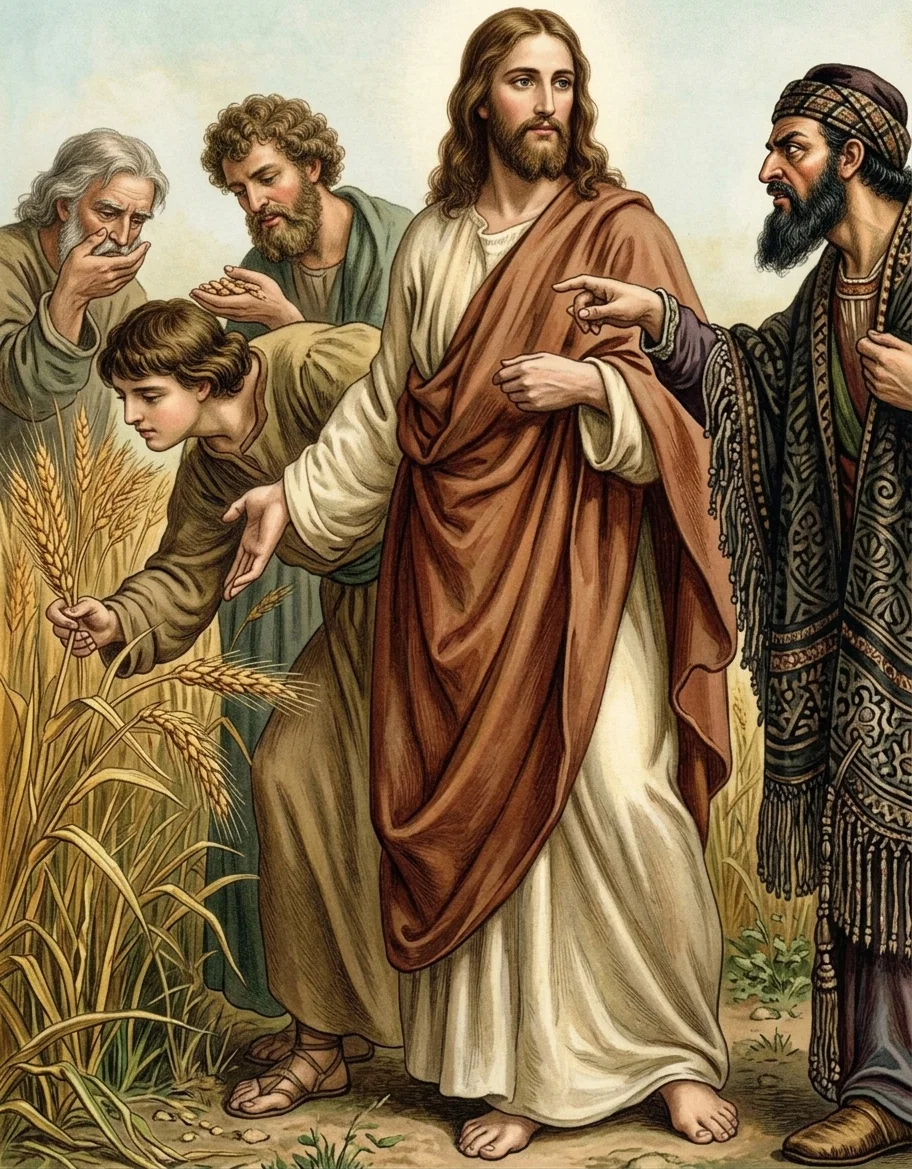
NOTE.—The observance of the Sabbath is one of the most important duties of the followers of Christ. Man shows his homage and loyalty to his Creator by yielding obedience to this divine command. The Sabbath command is placed in the very bosom of the law of God, that man could not tamper with it without doing violence to the ten great Words—rending them asunder. The Sabbath command is the seal of God’s law, for it is the only portion of that law which tells by whom it was given, the reason for its establishment, and the authority of the Giver. It is God’s own appointed memorial of completed creation. Being such, its only true observance is on the particular day upon which God Himself appointed it. Any change of the day which God ordained for that memorial would be as unreasonable as to celebrate the signing of the Declaration of Independence upon the 22d of February. Man has said, “All that the commandment expressly requires is to observe a day of sacred rest after six days of labor.” But let the student read carefully the fourth commandment (Ex. 20:8–11), and Gen. 2:2, 3; also Isa. 58:13, 14; Ex. 16:4, 5, 19–30. Had any of the Israelites attempted while in the wilderness (Exodus 16) to use the cunning sophistries of men and begin the numbering of their days so as to bring their rest day on some other than the seventh day appointed by the Lord, the miracle of the manna would have brought them very quickly to their senses. Let not the teacher or student accept such illogical reasoning as shown in the sentence quoted above, in order to avoid one of God’s most emphatic commands. If any should be tempted to do so and to teach others so to do, let them save their own souls by heeding the Saviour’s warning in Matt. 5:19. The lesson section includes the lesson scripture and the parallels given in Mark 2:23–28; 3:1–5; and Luke 6:1–10.
1 “At that season Jesus went on the Sabbath day through the corn fields; and His disciples were an hungred, and began to 2 pluck ears of corn, and to eat. But the Pharisees, when they saw it, said unto Him, Behold, Thy disciples do that which is 3 not lawful to do upon the Sabbath. But He said unto them, 4 Have ye not read what David did, when he was an hungred, and they that were with him; how he entered into the house of God, and did eat the showbread, which it was not lawful for him 5 to eat, neither for them that were with him, but only for the priests? Or have ye not read in the law, how that on the Sabbath day the priests in the temple profane the Sabbath, and are guiltless? 6 But I say unto you, that One greater than the temple is here. 7 But if ye had known what this meaneth, I desire mercy, and not sacrifice, ye would not have condemned the guiltless. 8 For the Son of man is Lord of the Sabbath. 9 “And He departed thence, and went into their synagogue; and 10 behold, a man having a withered hand. And they asked Him, saying, Is it lawful to heal on the Sabbath day? that they might accuse Him. 11 And He said unto them, What man shall there be of you, that shall have one sheep, and if this fall into a pit on the Sabbath day, will he not lay hold on it, and lift it out? 12 How much then is a man of more value than a sheep! Wherefore it is lawful to do good on the Sabbath day. 13 Then saith He to the man, Stretch forth thy hand. And he stretched it forth; and it was restored whole, as the other.
Golden Text: “The Son of man is Lord even of the Sabbath day.” Matt. 12:8.
SUGGESTIVE QUESTIONS.
(1) On what day did the incident of to-day’s lesson occur? Verse 1. (2) Where were Jesus and His disciples at the time? Same verse. (3) What did the disciples do? Same verse. Note 1. (4) What complaint was made to Jesus on account of this? Verse 2. Note 2. (5) What pointed question did Jesus ask the Pharisees? Verse 3. (6) What particular thing had David done which was contrary to law? Verse 4. Note 3. (7) Who only were allowed to eat the showbread? Same verse. (8) What other fact did He call to their mind which was also familiar to them? Verse 5. Note 4. (9) What did Christ say of the relative greatness of Himself and the temple? Verse 6. Note 5. (10) In condemning the disciples, what had the Pharisees done? Verse 7, last part. (11) What knowledge would have saved them from such a blunder? Same verse. (12) What relation does Christ sustain to the Sabbath? Verse 8. Note 6. (13) After leaving the corn field, where did Jesus go? Verse 9. (14) Whom did He see there that needed His healing power? Verse 10. (15) What question did the Jews ask the Saviour? Same verse. (16) What was their reason in asking this? Same verse. (17) What pointed question did Christ ask them in reply? Verse 11. (18) What was their evident custom in a matter of this kind? (19) What would they have to concede in regard to the worth of a man and a sheep? Verse 12. (20) Reasoning, then, from their own custom, what would be the conclusion? Same verse. (21) What did Christ say to the man with the withered hand? Verse 13. (22) What was the result? Same verse.
NOTES.
1. Plucked the ears of corn.—Evidently the heads of wheat or barley, for we see by Luke 1:6 that the kernels of grain were rubbed out in their hands. “The word ‘corn,’ as used in our translation of the Bible, has no reference to maize, or Indian corn, as it has with us. Indian corn was unknown till the discovery of America. . . . The word was applied, as it is still in England, to wheat, rye, oats, and barley.”—Barnes.
2. Not lawful to do on the Sabbath day.—There was nothing unlawful in the act itself, for it was sanctioned by the custom of the country, and is practised till this day. It was also permitted by the Mosaic law. See Deut. 23:25. But the Jewish leaders had woven about the Sabbath law a network of frivolous prohibitions, and claimed that the disregarding of these hair-splitting interpretations and prohibitions of their own was an infraction of the law of God. It was a part of Christ’s mission to sweep away these cobwebs and let the law shine forth in its purity, as it came from the mouth of God, but not to alter it in the slightest detail. Matt. 5:17–19; Luke 16:17.
3. The showbread.—A symbol of Christ, the Bread of life. Its continual presence in the temple would seem to indicate the continual presence of Christ himself in the spiritual temple of the soul that is dedicated to Him. 1 Cor. 6:19. The showbread was renewed every Sabbath day, a striking illustration of the blessing which the Sabbath is designed to bring. Each weekly cycle should work an upward step in the divine life.
4. Profane the Sabbath.—On the Sabbath the priests were engaged in killing beasts for sacrifice, in preparing fires for burning the offerings, and in other work connected with the temple service. It was work, bodily labor, which, if done for any other purpose, or by other persons on that day, would have been sin. But they were blameless, and the law regarded them so. Christ was showing them the inconsistencies of their own requirements, and establishing the fact that “it is lawful to do well on the Sabbath days.”
5. One greater than the temple.—Christ was greater than the temple, for it existed only because of Him and His work. The services of the temple all pointed to Christ.
6. The Son of man is Lord of the Sabbath.—He made it. John 1:1–3; Gen. 2:2, 3. He Himself had designated the manner in which it should be observed, and was the One best able to interpret the Sabbath law, of which He was the Author. This He did by precept and example. To change it was farthest from His purpose, as is shown by Matt. 5:17–19. Had He designed “to ennoble it by merging it” into some other day, He would have left us His own example in that regard by observing that other day Himself as He did in instituting the ordinances. John 13:15. His example and His custom in regard to Sabbath observance are recorded in Luke 4:16. The duty, in this respect, of the one who would follow Christ is plainly shown in 1 John 2:6. To say we can not tell which day is the seventh, will not release us from obedience to the Sabbath law. We have only to go back to the time of Christ for a starting-point from which to reckon; for none can deny that Christ during His earthly ministry kept the Sabbath which He had given, on the day which He had set apart for its observance; and the Jews in every quarter of the globe have kept that same recurring Sabbath from then till now. In addition to this, we have the witness of the historical fact that through the Dark Ages the Sabbath of the Lord, the seventh day, the only day the Bible recognizes as the Lord’s day (Rev. 10:1; Ex. 20:8–11; Matt. 12:8), was being observed by the Waldenses, Albigenses, the Petrobruyans, the Cathari, the Passaginians, the Armenians of the East Indies, and the Church of Abyssinia, which kept, and does still keep, both Saturday and Sunday, as it was taught to do by missionaries who visited Abyssinia in the fifth century.