In the Scriptures a horn is used as a symbol of power or exaltation, either temporal or spiritual. The “ten horns” of the “fourth beast” brought to view in this chapter represent kings, or kingdoms (verse 24), of a secular nature, and in Luke 1:68, 69 we read: “Blessed be the Lord God of Israel; for He hath visited and redeemed His people, and hath raised up an horn of salvation for us in the house of His servant David.” See also Ps. 75:4, 5, 10.
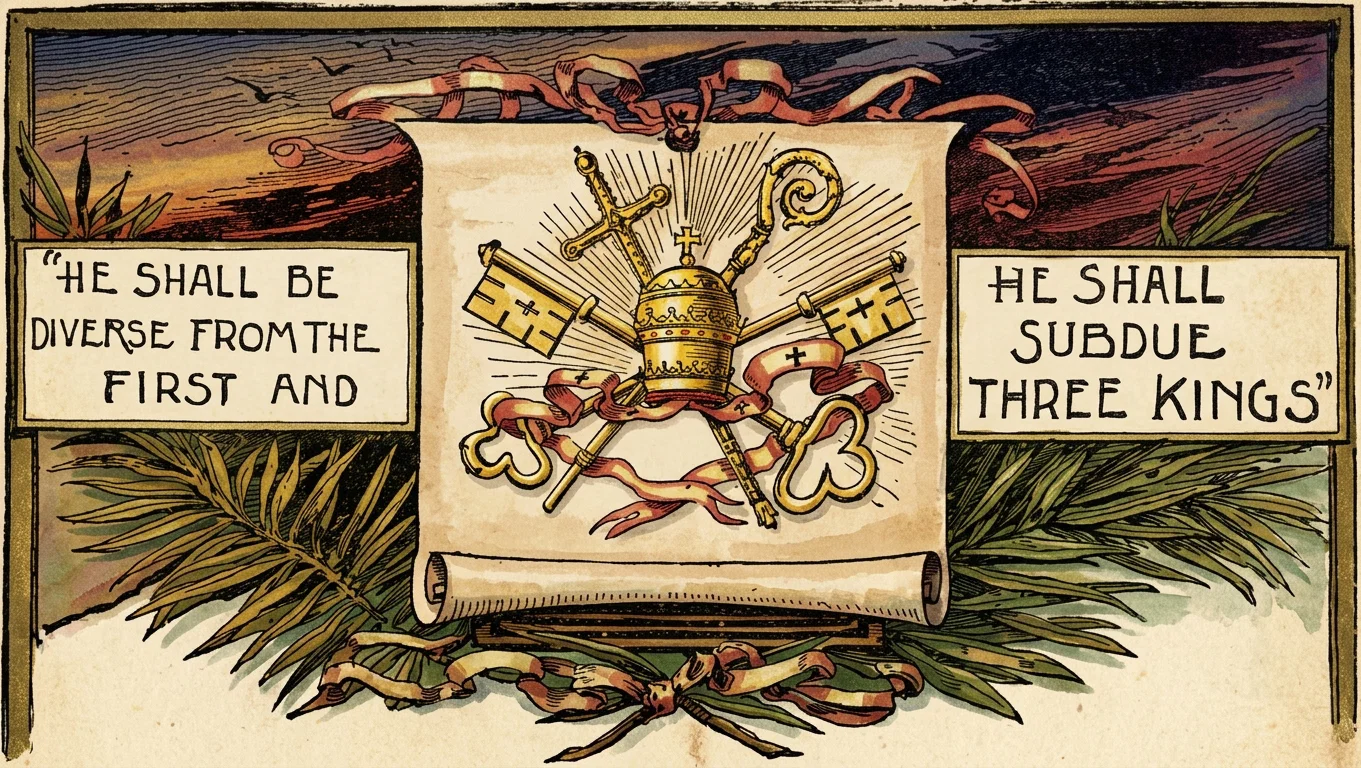
Among the ten horns on this fourth beast, which we have shown in a former article represents the Roman Government, it is said that “another shall rise after them; and he shall be diverse from the first, and he shall subdue three kings.” Note that he shall rise after the ten. We have found that the ten horns on the beast stand for ten parts or kingdoms into which the beast-kingdom was divided, and we have shown from history that Rome was so divided, the division having been completed in the year A.D. 476. Then it must be after this time that the horn arose which was “diverse” from the others. The ten horns represented temporal kingdoms, therefore that one which was “diverse” must be of a different nature; and in looking for its counterpart in history, we must seek a power in Rome, other than a secular power, that was capable of destroying secular kingdoms.
This “little horn” is described in verse 8 as having “eyes like the eyes of a man, and a mouth speaking great things.” That the prophet saw a power which rose gradually is shown in the fact that he saw the horn when it was “little,” yet it became “more stout” than the others. It was able to pluck up three of them, and of course it had previously brought the others under its control.
Now what power ever arose in the Roman Empire, other than secular power, that had such influence? Every one who knows anything of history at all, knows that the papal power alone fills the specification. Other characteristics of this little horn are, “He shall speak great words against the Most High, and shall wear out the saints of the Most High, and think to change times and laws [‘the law,’ R. V.]; and they shall be given into His hand until a time and times and the dividing of time.” Verse 25.
How would one speak against the Most High?—The most common way is to make light of His Word, or to place some other authority over it. The apostle Paul prophesied of a power whom he called the “man of sin,” the “son of perdition.” Of him he said, “Who opposeth and exalteth himself above all that is called God, or that is worshiped; so that he as God sitteth in the temple of God, showing himself that he is God.” 2 Thess. 2:3, 4. Continuing, he said, “For the mystery of iniquity doth already work. . . . And then shall that wicked be revealed, whom the Lord shall consume with the spirit of His mouth, and shall destroy with the brightness of His coming.” Verses 7, 8. This is evidently the same power shown to Daniel in the symbol of the little horn, for each continues till the coming of the Lord.
The papal power has spoken against the Most High by setting up the traditions of the church and the decrees of the popes above the authority of the Scriptures. Not only so, but it has introduced the worship of images into the church in the face of the second commandment of the Decalog, and established the observance of the first day of the week instead of the seventh, which is the Sabbath day according to the fourth commandment. Specifications might easily be introduced to sustain the charge that flagrant violation of every commandment is included in the doctrines of that church, but let the following partial list of presumptive titles of the popes suffice for the charge of posing as above God: “His Holiness,” “Lord God the Pope,” “Key-bearer of the Kingdom of Heaven,” “Most Powerful Word,” “Supreme Chief,” “Lion of the Tribe of Judah,” “Ruler of the House of the Lord,” “King of kings and Lord of lords,” “Infallible Pope.” Especially in setting up the Sunday-sabbath institution has this power fulfilled the words of the prophecy that he shall “think to change times and laws.”5
That the growth of the Papacy, or Papal Church-and-State principle, was a gradual work, is aptly expressed by Dr. Killen, in the preface to a work entitled “The Ancient Church”:—
In the interval between the days of the apostles and the conversion of Constantine, the Christian commonwealth changed its aspect. The bishop of Rome—a personage unknown to the writers of the New Testament—meanwhile rose into prominence, and at length took precedence of all other churchmen. Rites and ceremonies of which neither Paul nor Peter ever heard, crept silently into use, and then claimed the rank of divine institutions. Officers for whom the primitive disciples could have found no place, and titles which to them would have been altogether unintelligible, began to challenge attention, and to be named apostolic.
But this power was to pluck up three of the ten horns, or kingdoms; did the Papacy do this? If so, when, and how? and which were the three? In answer to these queries, let it be remembered that the ascendency of the Roman Catholic Church—the outgrowth of the Church-and-State principle—was not attained without a struggle. The Arians, or followers of Arius, a learned presbyter of Alexandria, were for a long time formidable opponents of the Catholics, altho the Council of Nicaea, called by the Emperor Constantine in A.D. 325, decided against Arius and he was banished to Illyria.
In a Church-and-State government like that of Rome, an extensive religious controversy would naturally involve political complications, and in the breaking up of the empire, the bishop of Rome, whoever he might be, took advantage of every possible occasion to further his ambition to be recognized as the head of all the churches. Being at the seat of empire, he had the advantage of extraordinary prestige and influence. But this ambition was bitterly opposed by three of the ten kingdoms, in which the Arian influence predominated. At last, however, they were in turn overwhelmingly defeated—their horns were plucked up. These kingdoms were (1) the Heruli, defeated in A.D. 493, (2) the Vandals, “plucked up” in 534, and (3) the Ostrogoths, who were overcome in 538.
In 533 the Emperor Justinian issued a decree that the bishop of Rome should be the head of all the churches, and true and only corrector of heretics. But this decree could not go into effect until the last of the opposing powers were put out of the way, which occurred in 538. This accomplished, the Papacy, with all the civil powers of the western empire behind it, entered upon its terrible work of “correcting heretics,” or, in the words of the prophecy, wearing out the saints. For how long?—“Until a time and times and the dividing of time.” We have not space to work out this problem in detail; in brief, it is literally three and a half years, a time being a year. It is the same period that is spoken of in Rev. 13:5 as forty and two months, and in chapter 11:3 and 12:6 as “a thousand two hundred and three-score days.” In prophetic time a day stands for a year. See Num. 14:34; Eze. 4:1–7. In Jewish time a year was 360 days—twelve months of thirty days each. Then 1,260 days would be that number of years for the Papacy to carry on its work of wearing out the saints.
How zealously it did the work of “correcting heretics” (those opposed to its doctrines and methods) is told in the history of what is known as the Dark Ages. The victims of her “correction,” by one means or another, are estimated at 50,000,000 or more—much more than by all the Jewish and pagan persecutions combined. The 1,260 years of the prophecy would reach to A.D. 1798. What occurred then to mark a limit to the devastating work?—The work of the Reformation had wielded its influence, together with the religious liberty decree of the empress of Austria, and the coming up of the republic of the United States. These influences had put a stop to the actual persecutions in the more enlightened countries, and the crowning act was the taking of the pope prisoner by French troops in the year 1798. He was kept in exile until he died some two years later. The persecution actually stopped because of unpopularity some twenty years before the power to persecute was taken away, thus agreeing with the words of Christ, when, speaking of this “great tribulation,” he said, “Except those days should be shortened, there should no flesh be saved; but for the elect’s sake those days shall be shortened.” Matt. 24:22.
“But the judgment shall sit, and they shall take away his dominion, to consume and to destroy it unto the end.” To the end of what?—To the end of the kingdom symbolized by the beast of which the little horn is an adjunct. This is shown by the following verse: “And the kingdom and dominion, and the greatness of the kingdom under the whole heaven, shall be given to the people of the saints of the Most High, whose kingdom is an everlasting kingdom, and all dominions shall serve and obey Him.” The same thought is expressed in verses 21, 22: “I beheld, and the same horn made war with the saints, and prevailed against them; until the Ancient of Days came, and judgment was given to the saints of the Most High; and the time came that the saints possessed the kingdom.”
It will be said that Rome is not making war on the saints now, and the end has not come; nor has the kingdom been given to the saints. There is a point in connection with this matter that is not brought out in this prophecy. This same power is mentioned in Revelation 13, where it is said to have been “wounded to death,” and “his deadly wound was healed; and all the world wondered after the beast.” Verses 3. “And all that dwell upon the earth shall worship him, whose names are not written in the book of life of the Lamb slain from the foundation of the world.” Verse 8. Then that power is yet to fulfil the remainder of the prophecy, persecuting the saints until the time comes for them to possess the kingdom, and the Lord shall come to give it to them. Then, as with the image of Nebuchadnezzar’s vision, the God of heaven will set up a kingdom that will destroy all earthly powers, and stand forever. Then, as in Paul’s prophecy, “that man of sin” will be “destroyed by the brightness of His coming” who will set up the everlasting kingdom.
Is it not patent that Rome is fast recovering her prestige and political influence among the nations? And is it not her boast that “Rome never changes”? What, then, may we expect when the “deadly wound” is healed? The “sure word of prophecy” will never fail.