THE GOSPEL AT CORINTH

3%

Pacific Press Publishing Company · Oakland, California · Feb 3, 1898

FromSigns of the Times, Vol. 24, No. 5.

Read the full edition

THE GOSPEL AT CORINTH

Lesson VIII.—Sabbath, February 19, 1898.

THE GOSPEL AT CORINTH.

Lesson Scripture, Acts 18:1-23, R. V.

1 “After these things he departed from Athens, and came to 2 Corinth. And he found a certain Jew named Aquila, a man of Pontus by race, lately come from Italy, with his wife Priscilla, because Claudius had commanded all the Jews to depart from 3 Rome; and he came unto them; and because he was of the same trade, he abode with them, and they wrought; for by 4 their trade they were tent-makers. And he reasoned in the synagogue every Sabbath, and persuaded Jews and Greeks. 5 “But when Silas and Timothy came down from Macedonia, Paul was constrained by the Word, testifying to the Jews that 6 Jesus was the Christ. And when they opposed themselves, and blasphemed, he shook out his raiment, and said unto them, Your blood be upon your own heads; I am clean; from henceforth I will go unto the Gentiles. 7 And he departed thence, and went into the house of a certain man named Titus Justus, one that worshiped God, whose house joined hard to the synagogue. 8 And Crispus, the ruler of the synagogue, believed in the Lord with all his house; and many of the Corinthians hearing believed, and were baptized. 9 And the Lord said unto Paul in the night by a vision, Be not afraid, but speak, and hold not 10 thy peace; for I am with thee, and no man shall set on thee to harm thee; for I have much people in this city. And he dwelt there a year and six months, teaching the Word of God among them. 12 “But when Gallio was proconsul of Achaia, the Jews with one accord rose up against Paul, and brought him before the judgment-seat, saying, This man persuadeth men to worship 14 God contrary to the law. But when Paul was about to open his mouth, Gallio said unto the Jews, If indeed it were a matter of wrong or of wicked villainy, O ye Jews, reason would that I 15 should bear with you; but if they are questions about words and names and your own law, look to it yourselves; I am not minded to be a judge of these matters. 16 And he drave them from the judgment-seat. And they all laid hold on Sosthenes, the ruler of the synagogue, and beat him before the judgment-seat. And Gallio cared for none of these things. 18 “And Paul, having tarried after this yet many days, took his leave of the brethren, and sailed thence for Syria, and with him Priscilla and Aquila; having shorn his head in Cenchreae; for 19 he had a vow. And they came to Ephesus, and he left them there; but he himself entered into the synagogue, and reasoned 20 with the Jews. And when they asked him to abide a longer 21 time, he consented not; but taking his leave of them, and saying, I will return again unto you, if God will, he set sail from 22 Ephesus. And when he had landed at Caesarea, he went up 23 and saluted the church, and went down to Antioch. And having spent some time there, he departed, and went through the region of Galatia and Phrygia in order, establishing all the disciples.”

QUESTIONS.

1. Tell what led to Paul’s preaching at Athens.
2. Give the substance of his discourse.
3. When he left Athens, to what place did he come? Verse 1.
4. Whom did he find there? Verse 2.
5. What connection did he form with this family? What was their occupation? Verse 3.
6. What did he do every Sabbath day? Verse 4.
7. When Silas and Timothy had come to him (compare chapter 17:15), how was Paul affected? Verse 5.
8. What did the Jews do as Paul preached thus? What was Paul’s reply to their blasphemous opposition? What did he say that he should thenceforth do? Verse 6.
9. In what place did he then begin to teach? Verse 7.
10. What results of his labors were soon seen? Verse 8.
11. What comforting assurance and encouragement in the work did Paul receive at this time? Give the exact words. Verses 9, 10.
12. How long did he therefore continue there teaching the Word of God? Verse 11.
13. What took place while Paul was laboring there? Who was the governor before whom Paul was brought? Verse 12.
14. What was the charge against Paul? Verse 13.
15. What made it necessary for Paul to reply to this charge? What did the governor say about the case? Verse 14.
16. What shows that he knew that Paul was not guilty of any misconduct? Verse 15.
17. How did he treat Paul’s accusers? Verse 16.
18. How was Ps. 7:15, 16 fulfilled in this case? How did the governor regard this conduct? V. 17.
19. What did Paul do? When he finally took leave of the brethren, where did he go? Who accompanied him? Verse 18.
20. Where did he first land? What did he do while there? Verse 19.
21. What encouragement did Paul receive to continue laboring in that place? Verse 20.
22. Why would he not remain? What promise did he make to the friends there? Verse 21.
23. To what place did he then sail? Where did he immediately go on reaching the land of Palestine? After saluting the church, where did he go? V. 22.
24. After spending a time in Antioch, where did Paul go? What did he do in this journey? V. 23.

NOTES AND QUESTIONS.

1. “And when they opposed themselves.” The student must not make the mistake of playing upon the words “opposed themselves,” as is sometimes done in the case of 2 Tim. 2:25, and saying that the writer means to teach that those who oppose the truth oppose themselves. The single Greek word from which the words “oppose themselves” are rendered, will by no means bear such a construction as is often put upon these words. It means simply, “set themselves in opposition.” A reference to Rom. 13:2; James 4:6; 5:6, and 1 Peter 5:5, where the same Greek word is rendered “resist,” “resisteth,” will show that it could not possibly be used in the sense of making opposition to one’s self.
2. Gallio, deputy of Achaia, was brother of the philosopher Seneca, the tutor of the emperor Nero.
3. Verse 22. Paul landed at Caesarea, and “went up and saluted the church.” Altho Jerusalem is not mentioned, it is generally accepted that the “going up” was to that city. The expression is literally correct, as applied to a journey from Caesarea to Jerusalem.
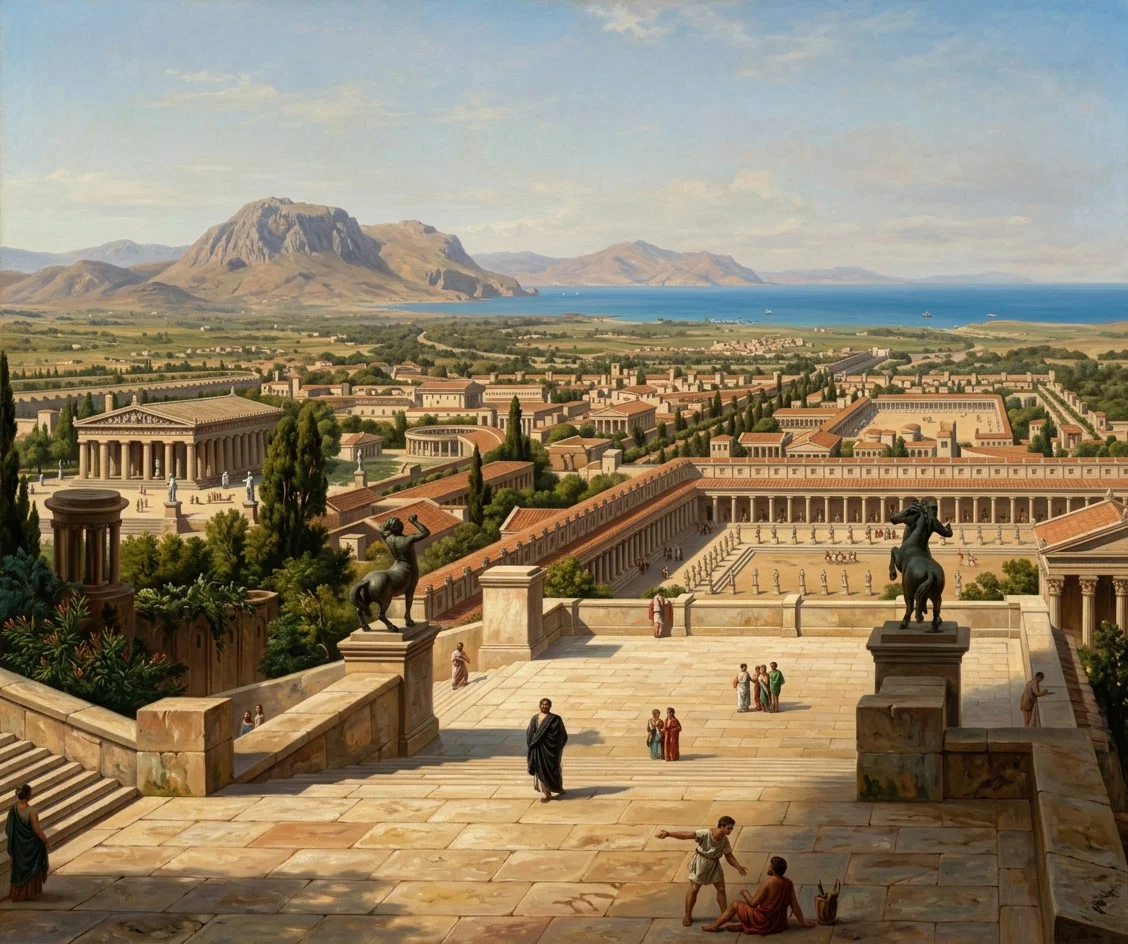
Corinth was the ancient capital of Achaia, a voluptuous city of Greece, about forty miles west of Athens. It was five miles in circuit. On the south was a rocky mountain, rising abruptly to the height of 2,000 feet, on the summit of which was a temple of Venus. Corinth had an extensive commerce, and was celebrated for its wealth, magnificence, and learning. Here the Isthmian games, referred to by Paul (1 Cor. 9:24, 25), were celebrated every four years.