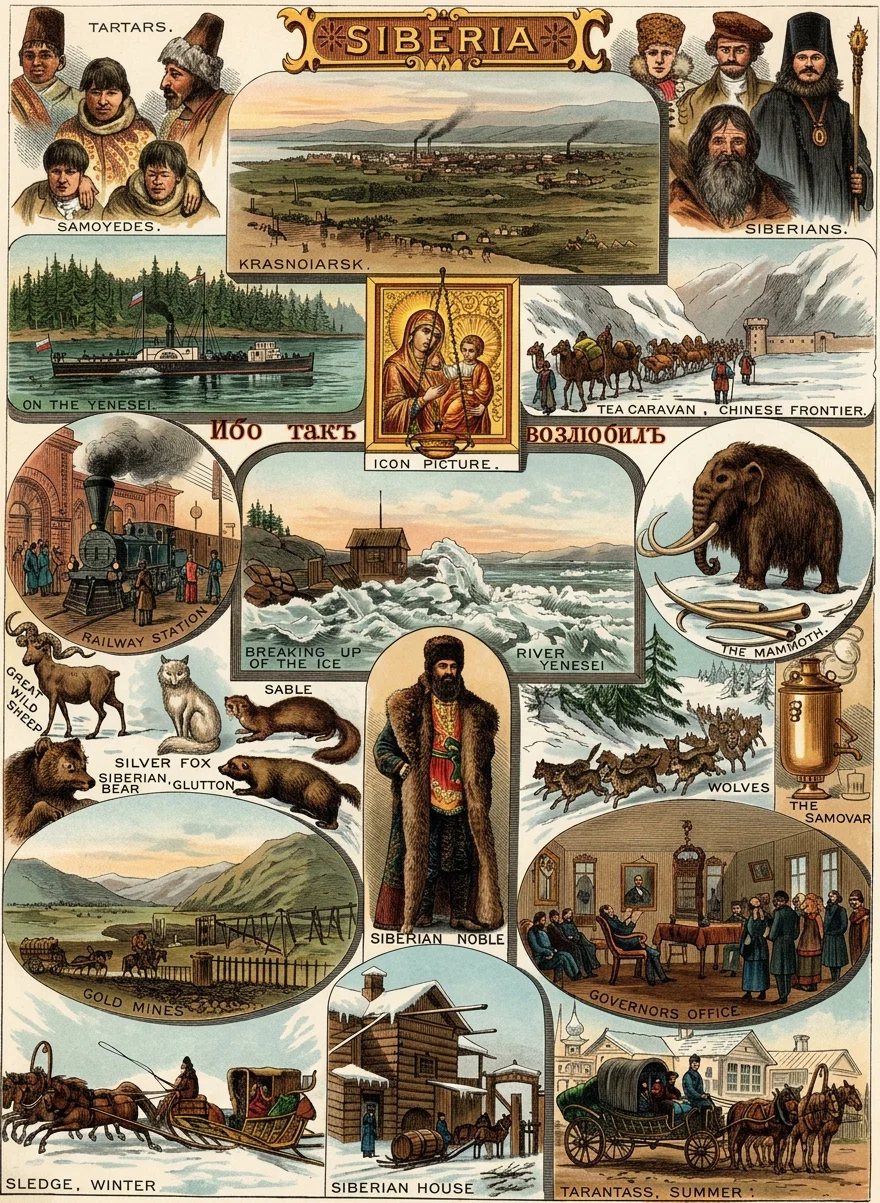
Siberia is the northern division of Asia, and forms the eastern part of the great Russian Empire. From east to west it is not less than 4,142 miles in extent, and at its widest part 2,170 miles from north to south. Its area is greater than that of the United States, but its population is but from ten to fifteen millions. Its extreme cold and lack of traveling facilities has prevented a rapid settlement of a section of the earth extremely rich in mineral resources, and capable of supporting a large population.
As the railways are few, the traveler is dependent upon horse-power; in the summer he uses a boat-like carriage, drawn by three horses abreast, called a “tarantass;” in the winter, a sledge with skates and outriggers. Pursuit by packs of half-starved wolves, or attacks by robbers, who are often escaped convicts, are incidents of travel. The stopping places are post-houses, fifteen to twenty miles apart, under government control. If one is warmly clad, traveling in the cold, clear air is delightful and healthful.
All Siberian travelers, at least those who view the situation from the human standpoint that this world has yet a long life before it, agree that the possibilities and prospects are for a great nation. Aside from untold natural resources, the people are robust and vigorous; and with a greater measure of freedom and a higher state of civilization in methods of material progress, there would be a great influx of energetic immigrants. The extension of the great Trans-Siberian Railroad will add very materially to the increase of population and the development of the country.
The gold mines on the Lena are reputed to be the most extensive in the world, and the government buys all the gold and platinum that is found. Most of the trade of the country is in the hands of a few merchant princes, whose wealth is fabulous.
The animal life of the country is varied. In the north are reindeer, polar bears, and white11foxes; in the central forests, packs of fierce wolves, brown bears, elks, and deer abound. Of the fur-bearing animals the rarest is the silver fox; the best of these are reserved for the czar. Sables, ermine, and lynx abound. Great flocks of geese and swans come south in winter, and in summer the steppes abound with game. The mammoth, now supposed to be extinct, once existed in such quantities that mines of their ivory tusks are exhumed. This ivory is a very valuable article of commerce. The rivers are full of fish, and from the roe of the sturgeon the great national dainty of caviare is made. The cities are supplied by markets, and in winter, fish and meats are frozen as hard as stones, while milk is solid and has to be broken up with an ax.
The cold of winter in the northern parts is terrible. Your ink freezes into a little black bullet as you write. A teamster has frequently to break away the icicles from the noses of his horses to keep them from stifling. When awakening from a doze, one may expect to find his eyelids frozen together, or the beard glued to the fur of his great coat by his frozen breath.
Siberians are very hospitable. They give frequent feasts. In summer, midnight picnics are common, and in the winter, these give place to dances and surprise parties. Every house has its icon, or holy picture (see illustration). On entering, each visitor salutes it before he wishes his host good-day. He will then be offered either vodka or tea. Vodka is a fiery, spirituous liquor, the curse of all Russia and Siberia. The samovar, or tea urn, is always ready. The tea is brought from China on camel back, and is very costly. The poorer classes use brick tea, a preparation made first into small bricks and used as money until it begins to crumble; then they are cut into small pieces and made into tea broth.
In our picture on the right is a Siberian pope, an old wandering pilgrim, and a moojik and wife. At the left are Tartars of the steppes, and Samoyedes from the Arctic region. In the center at the top is one of the great cities of Siberia on the mighty Yenesei, a river 2,500 miles in length, and ten miles wide at the mouth. Most of the other pictures are self-explanatory. At the governor’s office is transacted all public business. The large frame in the center of the table represents the czar, and when that is uncovered, the emperor is supposed to be present.
The religion of the country is that of the Eastern, or Orthodox Church; that is, the State religion of Russia. The clergy are called popes, or papas. Drink is a great failing of these papas. The service is largely musical, is very long, and the people stand through the whole of it. The Siberian chants, which are in a sweet, sad minor key, seem to last for hours. The convict sings in his chains, the post-driver sings to his horses, and the timber-cutter sings while working in the forest.
The Christian religion as held and practised by those who “keep the commandments of God and the faith of Jesus,” has been carried to some parts of the country by Seventh-day Adventists, who were banished from Russia on account of their faith. And these have found other souls waiting for the freedom which Jesus Christ alone can give.