Various countries claim the credit of having made the earliest practical application of steam-power, but, judging by facts gathered from the most authentic sources, it was in Spain that the movement of machinery by steam was first brought under public notice. At Barcelona, in the year 1543, a mechanic named Blasco de Garay, after many persistent efforts, succeeded in impressing the Emperor Charles V. of Austria and I. of Spain with the value of his new invention of driving ships by steam. The trial which took place was considered a success by the public, but the chief of the Royal Commission—Ravago, the treasure-keeper of the kingdom—for certain sinister reasons persuaded the emperor that the discovery was of no practical value, and so ruined the hopes of Blasco de Garay.
Later on, about the beginning of the seventeenth century, Giovanna Branca, an Italian, invented a steam-engine, and his machine is the first of which we have any descriptive or pictorial record. About this same period, too, France produced a claimant for the glory of having invented the steam-engine, and Marion DeLorme, in a letter to M. de Cinq Mars, dated Paris, 1641, gives an account of him in a visit to the Bicetre with the Marquis of Worcester: “We were crossing the court of the madhouse, and I, more dead than alive with fright, kept close to my companion’s side, when a frightful face appeared behind some immense bars, and a hoarse voice exclaimed, ‘I am not mad! I am not mad! I have made a discovery which would enrich the country that adopted it.’ ‘What has he discovered?’ I asked of our guide. ‘O,’ he answered, shrugging his shoulders, ‘something trifling enough; you would never guess it; it is the use of the steam of boiling water!’ I began to laugh. ‘This man,’ continued the keeper, ‘is Salomon de Caus; he came from Normandy four years ago to present to the king a statement of the wonderful effects that might be produced from his invention. The cardinal sent the madman away without listening to him. Salomon de Caus, far from being discouraged, followed the cardinal wherever he went, with the most determined perseverance, who, tired to death with his folly, ordered him to be shut up in the Bicetre, where he has now been for three years and a half.’”
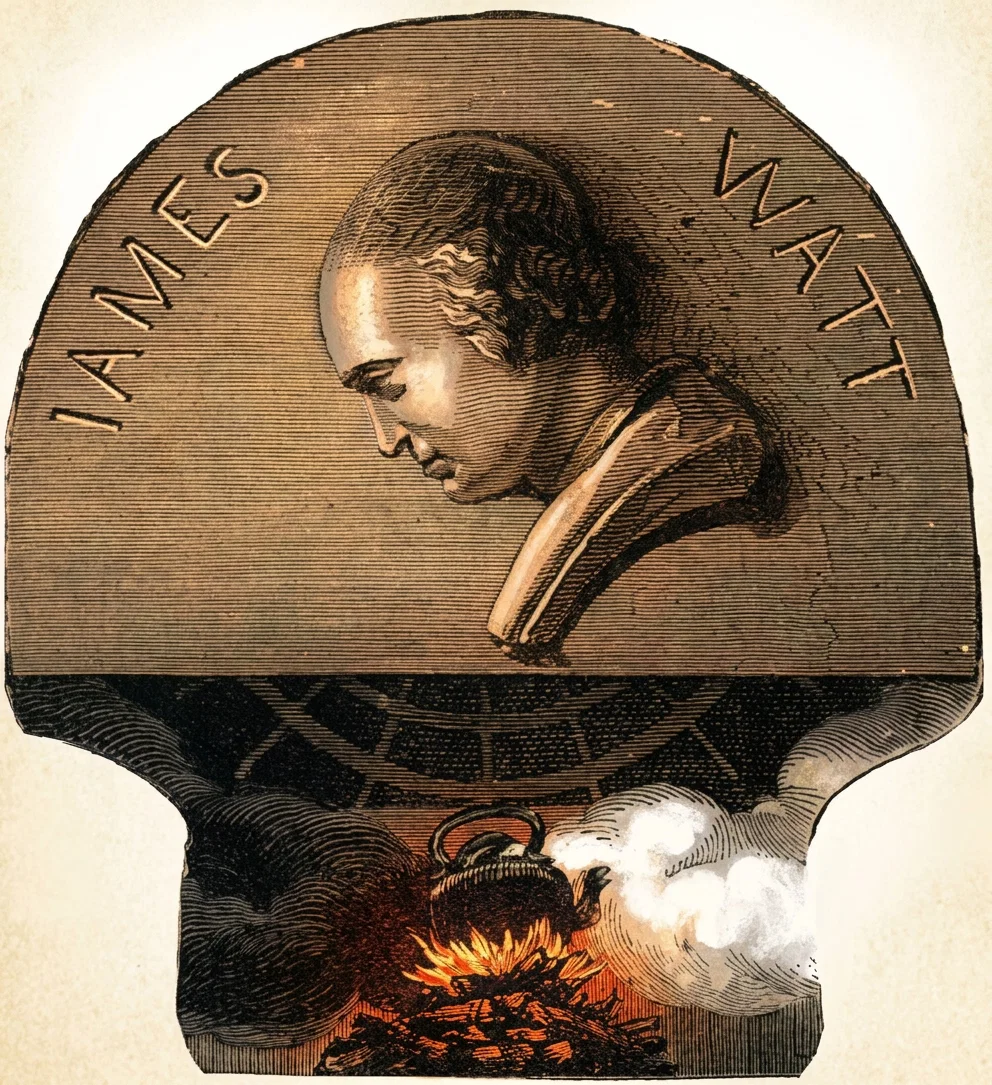
James Watt, the Supposed Discoverer of Steam Power.
Lord Worcester was conducted to his (De Caus’) cell, and came back sad and thoughtful. “He is indeed mad now,” said he. “Misfortune and captivity have alienated his reason, but it is you who have to answer for his madness. When you cast him into the cell, you confined the greatest genius of the age.” Twenty-two years after the above incident, in 1663, in a work of his called “Century of Inventions,” the Marquis of Worcester described a steam apparatus of his own. Papin followed with his invention in 1681. Captain Savery’s engine for water-raising was made in 1698, and in 1712 Thomas Newcomen constructed the first self-acting steam-engine (which worked successfully for over a century), and with it the age of steam may be said to have been inaugurated.—Lloyd’s Weekly.