The Lord has said, “If there be a prophet among you, I the Lord will make Myself known unto him in a vision, and will speak unto him in a dream.” Num. 12:6. He does not say that every dreamer is a prophet, but that He will speak to His prophets through that means. Now the Lord recognized Daniel as a prophet (Matt. 24:15), and gave him “understanding in all visions and dreams” (Dan. 1:17). Therefore the visions and dreams of Daniel, as well as his interpretations of the dreams and visions of others, are to be received as prophetic revelations. In the second chapter of Daniel we have found in his interpretation of Nebuchadnezzar’s dream, an outline history of this world’s government from Babylon to the setting up of the kingdom of Christ.
In the seventh chapter we come to visions given to the prophet himself. The date is given as the first year of Belshazzar, who was the last king of Babylon.
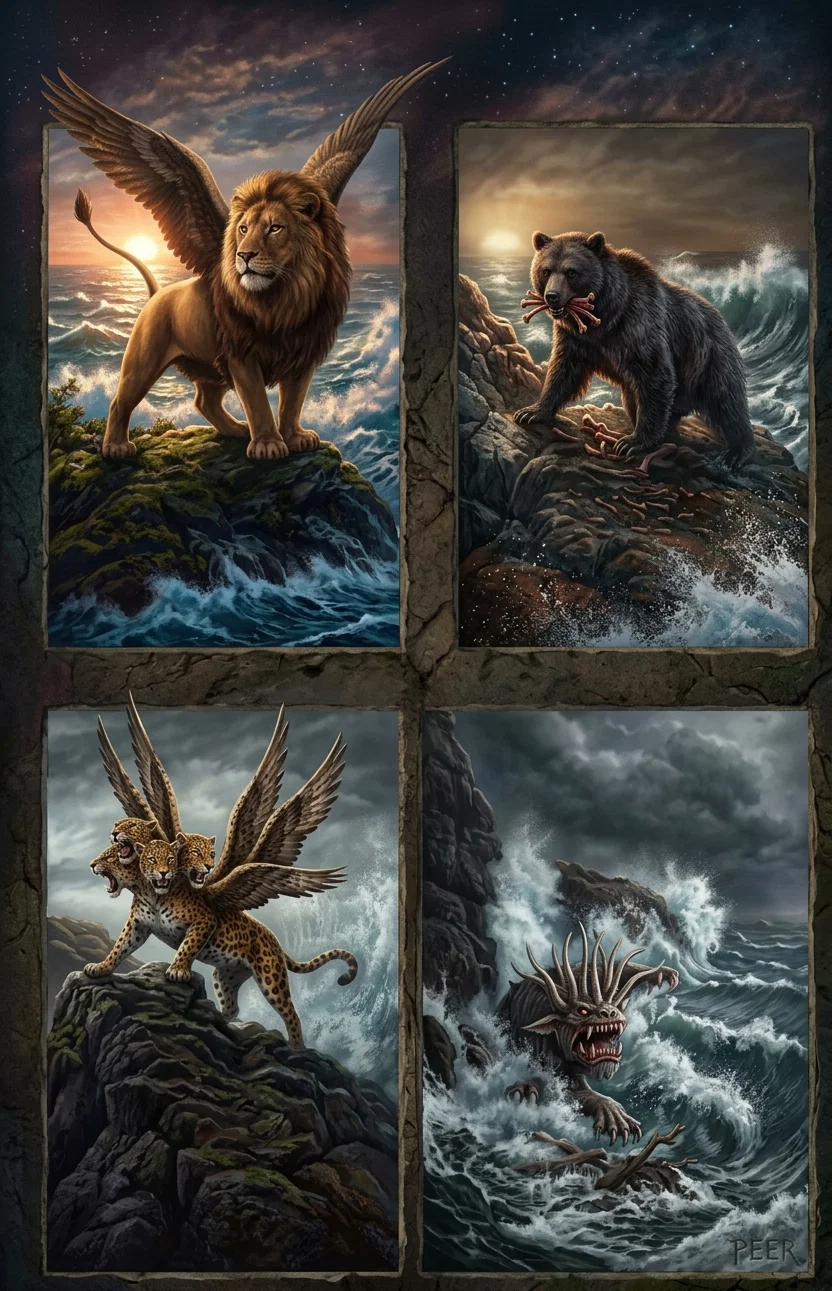
“Daniel spake and said, I saw in my vision by night, and, behold, the four winds of the heaven strove upon the great sea. And four great beasts came up from the sea, diverse one from another. The first was like a lion, and had eagle’s wings: I beheld till the wings thereof were plucked, and it was lifted up from the earth, and made stand upon the feet as a man, and a man’s heart was given to it. And behold another beast, a second, like to a bear, and it raised up itself on one side, and it had three ribs in the mouth of it between the teeth of it; and they said thus unto it, Arise, devour much flesh. After this I beheld, and lo another, like a leopard, which had upon the back of it four wings of a fowl; the beast had also four heads; and dominion was given to it. After this I saw in the night visions, and behold a fourth beast, dreadful and terrible, and strong exceedingly; and it had great iron teeth: it devoured and brake in pieces, and stamped the residue with the feet of it; and it was diverse from all the beasts that were before it; and it had ten horns.” Verses 2–7.
Space will not permit elaborate exposition; the object of this article is merely to give a general idea of the meaning of the symbols used, hoping that the reader will be sufficiently interested to pursue the study more at length. By reference to Jer. 25:31–33, it will be seen that the wind is a symbol of tumult, strife, war. And in Rev. 17:15 it is stated that the sea, or waters, refer to “multitudes, and nations, and tongues.” See also Isa. 8:7. Thus the four winds striving upon the sea would indicate wars affecting all quarters of the earth, and consequently working great national changes.
But what about the “beasts” which “came up from the sea,” or people of the earth? Verse 17 of this seventh chapter of Daniel states plainly that they stand for kings; and verses 18 and 23, as well as chapter 2:37–40, show that the words “kings” and “kingdoms” are used interchangeably. The conclusion is therefore inevitable that the “four great beasts” of Daniel’s vision, coming up in succession, indicate four successive kingdoms. We are also forced to the conclusion that they mean the same four kingdoms that are outlined in Nebuchadnezzar’s dream of the great image given and interpreted in Daniel 2. We are shut up to this latter conclusion by the fact that in both instances the series of four kingdoms reaches to and closes with the everlasting kingdom of God, which shall fill the whole earth. See chapter 2:44 and chapter 7:27. The lesson is the same in both instances, namely, that human government is a temporary arrangement, and sooner or later will come to an end, giving place to a kingdom of righteousness with Christ Himself as king. As everything at all opposed to the righteous rule of the Most High is to be consumed and destroyed, it follows that all wickedness and every dependence of man of a human character will be utterly annihilated.” “For all they that take the sword shall perish with the sword.” Matt. 26:52. “For, behold, the day cometh that shall burn as an oven; and all the proud, yea, and all that do wickedly, shall be stubble; and the day that cometh shall burn them up, saith the Lord of hosts, that it shall leave them neither root nor branch.” Mal. 4:1.4
Nebuchadnezzar was an idolater, a worshiper of images; therefore an image would be the most striking form in which a vision of the future could be presented to his mind. He was anxious to know concerning the future of his kingdom, or his dynasty, and was shown by this image in a dream that it would come to an end; and that not only Babylon, but all other human governments, would likewise perish. Now the Lord shows the same thing to Daniel in a vision of beasts, in which the characteristics of these kingdoms while in existence are manifested. Thus the Lord shows to His prophet, and through him to His believing people, more than was shown to the heathen king. This principle is set forth in the words of our Saviour, “Unto you it is given to know the mystery of the kingdom of God; but unto them that are without, all these things are done in parables.” Mark 4:11.
“The first beast was like a lion, and had eagle’s wings.” This beast represented the kingdom of Babylon. In the image, Babylon was symbolized by the head of gold. But gold could only indicate wealth, grandeur, and the power that such attributes could command. The innate characteristics of the kingdom, the manifest means by which it obtained this wealth and glorious dominion, are shown in the character of the lion with wings. The lion is bold, strong, alert; and the addition of wings indicates unusual rapidity of motion. Such was Babylon in the many military conquests in which Nebuchadnezzar figured. But after he passed away, the kingdom degenerated through the profligate inactivity and indulgence that characterized the later kings, especially Belshazzar. For some years there were no strong foes to encounter, and the head of the kingdom gave himself up to easy luxury and debauchery. The consequence was the downfall of the kingdom.
The second beast was like a bear. As Medo-Persia succeeded Babylon in universal empire, the bear was the symbol of that kingdom. In the image this kingdom was represented by the breast and arms of silver. But silver would only indicate a measure of wealth inferior to the head of gold. The bear reveals the character of the kingdom. By this the kingdom is shown to have been not only strong but cruel and rapacious. It was a devourer. “They said thus unto it, Arise, devour much flesh,” and it did. It had three ribs in its mouth, denoting that they had been stripped of the flesh. It was a despoiler, and these three ribs, no doubt, symbolize the three provinces that were especially robbed and oppressed, namely, Babylon, Lydia, and Egypt. It raised itself up on one side. Media and Persia were combined in the conquest of Babylon, but eventually the Persian element in the kingdom became the more prominent, thus fulfilling the symbol. This is further shown by the fact that in the time of Ahasuerus the two names Media and Persia were transposed, and the kingdom was known as Persia and Media. See Esther 1:3, 14, 18, 19.
The third beast was like a leopard. In the image the third kingdom was represented by the belly and sides of brass. This symbol could show only an inferiority in point of wealth—a further deterioration from the glory of Babylon. But the leopard denoted the characteristics of cruelty, cunning, and celerity of motion. The kingdom that overcame and succeeded Persia, was Grecia, and it fulfilled the symbol in every particular. The leopard is naturally very fleet-footed, but the leopard of Daniel’s vision had also four wings, showing extraordinary fleetness. Alexander the Great led his conquering hosts over five thousand miles in less than eight years, including many battles and sieges. In all this there were no steamboat or railroad facilities, and the mode of fighting was hand-to-hand conflict. The leopard of the vision had four heads, which specification was also fulfilled in the history of Grecia. Within fifteen years after the full conquest of Persia, which took place in the year B.C. 331, Alexander had died and the kingdom was governed by four of his leading generals, each having jurisdiction over a specific territory; yet the empire was reckoned as one.
The fourth beast could not be symbolized by any beast in nature. No animal could compare with its diabolical character. It was different from all the others; was exceeding dreadful; had teeth of iron and nails of brass; it “devoured, brake in pieces, and stamped the residue with his feet.” In the image of Daniel 2 the fourth kingdom was symbolized by the legs of iron and feet and toes of iron and clay. That denoted strength at first, but division afterward. It was also said of it, that it should “break in pieces and bruise.” Evidently the iron part of the image, which was “the fourth kingdom,” is the same as “the fourth beast” or kingdom of Daniel’s vision. This fourth kingdom, succeeding Grecia in universal empire, was Rome, as no other kingdom fulfils the specifications. Rome, and Rome only, held world-wide jurisdiction after Grecia.
This fourth beast had ten horns, three of which were plucked up by a “little horn;” but these points must be left for another article.