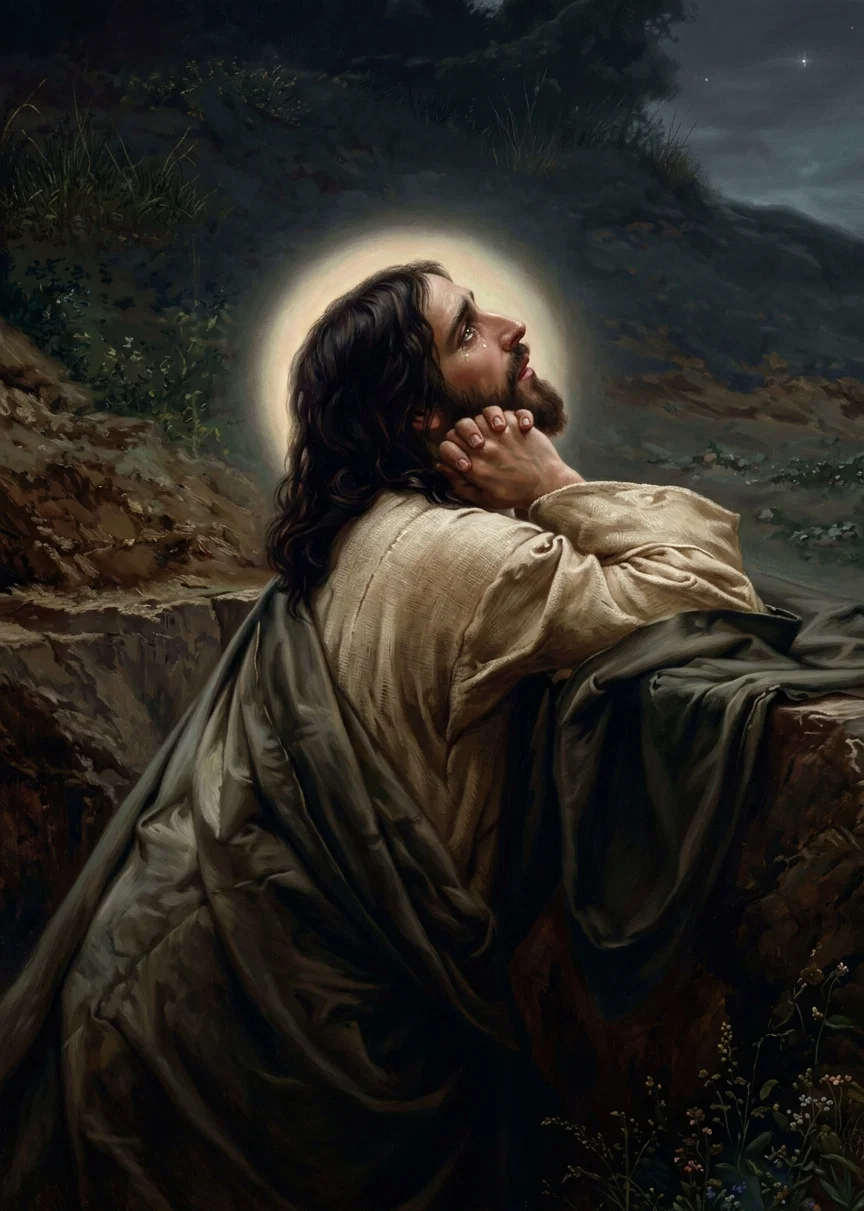
THE MAN OF SORROWS

8%

Pacific Press Publishing Company · Oakland, California · Jan 13, 1898

FromSigns of the Times, Vol. 24, No. 2.

Read the full edition

THE MAN OF SORROWS.

With exultant joy we contemplate the life of God made manifest in the flesh. We see how the Redeemer came to earth, bringing good gifts to man,—healing, light, love, and tenderest compassion, the promise of eternal life, and joy in His presence forevermore. Do all these tender proffers of infinite love awaken an answering response in the soul of man? We look to see the divine Benefactor enshrined in all hearts, loved above all others. How sadly then do we turn the page of Inspiration and contemplate the closing chapters of this sacred life on earth!
Jesus, the Way, the Truth, the Life, “who gave Himself for us;” who “offered up prayers and supplications with strong crying and tears unto Him that was able to save,” who was wounded for our transgressions, “that He might redeem us from all iniquity, and purify unto Himself a peculiar people, zealous of good works.”
Our Saviour was “a Man of sorrows, and acquainted with grief.” Isa. 53:3. We fail to comprehend the love which impelled the Saviour to leave the shining courts of heaven and to abide in this sin-cursed earth for the sinner’s salvation; neither can we measure the grief that oppressed His loving heart when “He came unto His own, and His own received Him not.” John 1:11.
Into the brief three years of our Lord’s public ministry were crowded the sorrows of the whole world. He passed from city to city throughout the land of Israel, healing, teaching, and preaching. He had no abiding-place, no home. His shelter seemed to Him even more precarious than that of the dumb creatures: “Foxes have holes, and birds of the air have nests, but the Son of man hath not where to lay His head.” Luke 9:58. He was forsaken by friends, and persecuted by enemies who constantly sought to catch some word out of His mouth whereby they might accuse and put Him to death. And yet the tears of the Man of sorrows were not shed for self. Those compassionate drops at the grave of Lazarus bespoke not alone His personal loss of a friend, nor sympathy for only the sisters at Bethany; they were for all the heart-broken mourners of earth who have laid their loved ones low beneath the sod to await the Archangel’s trump. Lonely one, bereaved and desolate, “Jesus wept” for you. He wept over the holy city, and the blind infatuation of His own people: “O Jerusalem, Jerusalem, thou that killest the prophets, and stonest them which are sent unto thee, how often would I have gathered thy children together, even as a hen gathered her chickens under her wings, and ye would not!” Matt. 23:37. “If thou hadst known, even thou, at least in this thy day, the things which belong unto thy peace! but now they are hid from thine eyes.” Luke 14:42. Even when toiling under the weight of the cross up the ascent of Calvary the pitiful women bewailed and lamented Him, He, ever forgetful of self, looked forward to the terrible judgments so soon to be poured out upon the Jewish nation, and exclaimed, “Daughters of Jerusalem, weep not for Me, but weep for yourselves, and for your children.” Luke 23:28.
Behold the Man of sorrows on the bleak mountain-side, the starry heavens his only canopy; there through the cold, dark night He prayed for you and for me, and through His intercession our poor petitions are accepted at the throne of grace. Behold Him in the Garden of Gethsemane bowing beneath the olive shade! There He bore the sins of a guilty world, and in His dreadful agony the life-blood oozed from each pore and fell in crimson drops to the ground. His soul was “exceeding sorrowful;” He seemed about to die, and, falling prostrate, He prayed, “O My Father, if it be possible, let this cup pass from Me!” and yet, with most complete submission to the Father’s will, He adds, “Nevertheless, not as I will, but as Thou wilt” (Matt. 26:39); and an angel was sent from heaven to strengthen Him for the final conflict. How truly spake the prophet Isaiah: “Surely He hath borne our griefs and carried our sorrows.” “The chastisement of our peace was upon Him; and with His stripes we are healed.” Isa. 53:4, 5. Every line in this dark, prophetic page met its exact fulfilment. Pontius Pilate, the Roman governor, “marveled greatly” when Jesus answered not one word to the malignant accusations of the chief priests and elders, but centuries before it was written, “He is brought as a lamb to the slaughter, and as a sheep before her shearers is dumb, so He opened not His mouth.” Isa. 53:7. The mock trial, the crown of thorns, the cruel scourging, the shameful cross, the bitter draught, the wounded side, all went to fulfil the prophetic Word, even to the parting of His garments, and the raffle for the seamless robe. Luke 23:34. Two notorious thieves were crucified one oneither side that He might be “numbered with the transgressors” and the dying prayer for those who crucified Him, “Father, forgive them; for they know not what they do,” was but the fulfilling of Isaiah’s words, He “made intercession for the transgressors.” Isa. 53:12; Luke 23:34.
In the words of another: “Our Lord was unjustly condemned; He was hurried from tribunal to tribunal by night; a Herod mocked Him, saying, ‘He called Himself a King; let Him save Himself.’ They put on Him an old purple robe of scorn, and crowned Him with a crown of thorns. They even spat in the face of the Lord of glory, He whom angels delighted to honor. . . . Then they placed on Him the heavy cross, and He fainted beneath the burden. Afterward they drove the nails into His hands and feet, and, lifting the cross, it fell with a thud into its place, and the Saviour of man hung between earth and heaven.”
The jeering multitude passed by, railing and “wagging their heads,” and saying, “If Thou be the Son of God, come down from the cross,” and “we will believe.” Matt. 27:40, 46. Then came the last bitter hour, when, in the sinner’s place, He suffered the sense of God’s displeasure. Even the Father’s presence was hidden from Him, and an agonizing cry rent the air, “My God, My God, why hast Thou forsaken Me?” Matt. 27:46. All was now finished, and, commending His spirit to God, the blessed Saviour died, not from the usual pangs of crucifixion, but literally of a broken heart. Then the rich Joseph of Arimathea, who had worshiped Jesus in secret, came boldly and begged the body and laid it in his own new tomb, which was hewn out of a rock, and “he rolled a great stone to the door of the sepulcher and departed.” Matt. 27:60.
Was this costly sacrifice needed? God is omnipotent; could He not save the sinners without shedding the blood of the gentle Jesus? Yes, it was necessary; the Son of God alone could satisfy the demands of the law. “Neither is there salvation in any other; for there is none other name under heaven given among men, whereby we must be saved.” Acts 4:12.
“The Father loveth the Son” (John 5:20), but He also loves the sinner. He accepts the costly sacrifice in man’s behalf, and Jesus Christ becomes the sinner’s only atonement. “He that believeth on the Son hath everlasting life; and he that believeth not the Son, shall not see life, but the wrath of God abideth on him forever.” John 3:36.
“A Pilgrim through this lonely world, The blessed Saviour passed; A Mourner all His life was He, A dying Lamb at last.”
AUGUSTA W. HEALD.