Did the Bible Days Begin in the Evening, or the Morning?
I notice your statement that the Bible days begin and end with sunset, and you quote the passage, “The evening and the morning were the first day,” as your authority. I submit that it does not substantiate that statement. We might truthfully say that “the afternoon and the forenoon together make up the working day,” but it would not follow that the afternoon was the first part of the day, or the forenoon the latter part. Nor does it follow from the passage you quote, that the evening was the first, and the morning the latter part of the day in Bible times. Indeed, we have scriptural evidence that it was not so.
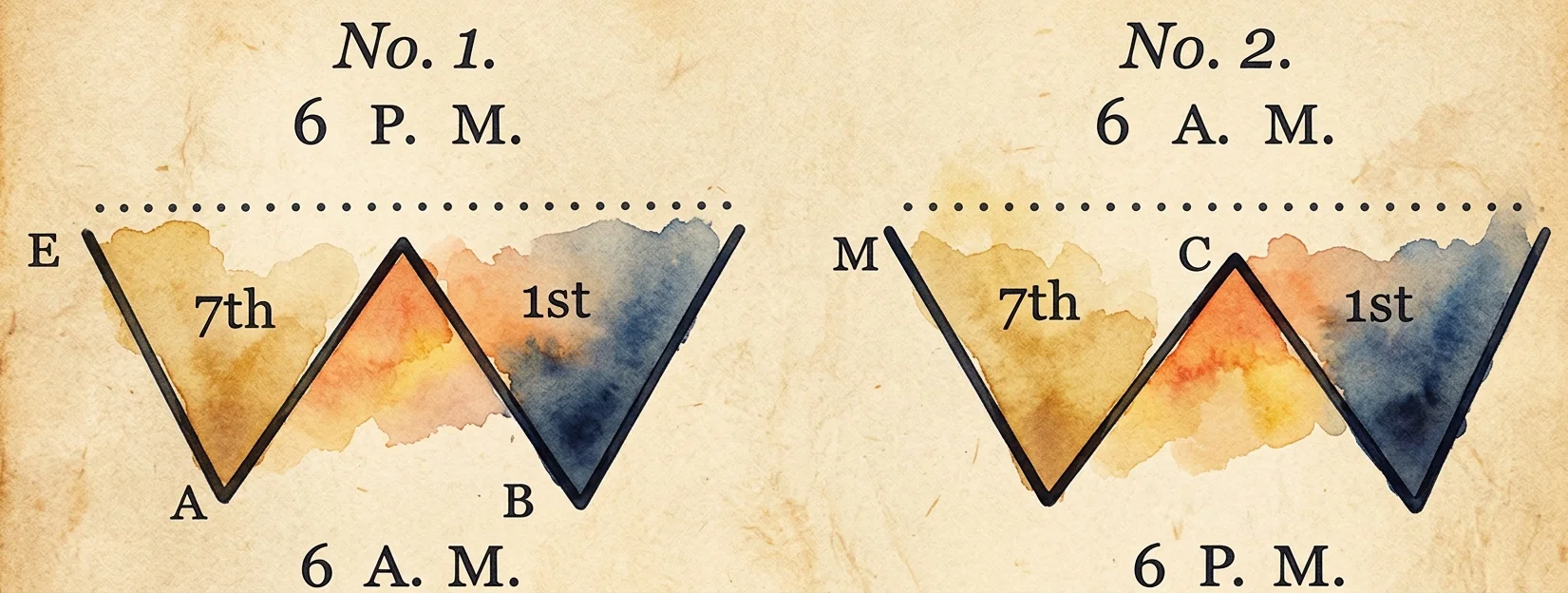
We are told in the account of the resurrection of Jesus (Matt. 28:1) that certain persons went to the tomb and found that the body was gone; and the time was stated to be, “In the end of the Sabbath, as it began to dawn toward the first day of the week.” I send a sketch to illustrate that passage, which will show it to be impossible that the days could begin with the morning. It consists of straight lines, each representing twelve hours of time, arranged in the form of a letter V, to represent the twenty-four hours of a day.
Supposing their upper ends, in No. 1, to represent sunset, at 6 P.M., their lower ends would be 6 A.M., and the two lines beginning at A would represent the seventh day, beginning at 6 P.M. and ending at 6 P.M. on the next day. The two similar lines joined on would represent the first day of the week.
Then the time when it began to dawn would be at the points marked A and B, on the two days. It is evident that the time referred to could not have been at A, because the Sabbath was not half gone then, and that would not be “in the end of the Sabbath.” Besides, it was still twenty-four hours from A to B, before it would begin to dawn towards the first day. So that a day beginning with sunset could not harmonize with that passage, either as to the end of the Sabbath or the dawn of the first day of the week.
Now let us look at sketch No. 2, in which the upper ends of the lines come at 6 A.M. and their lower ends at 6 P.M. In this case, the day begins at M, in the morning, and near the end of the Sabbath would come about at the point marked C; it would also be dawning towards the first day of the week at that same time. Does not that represent the times stated in that passage more correctly than sketch No. 1? It shows that the Bible days must have begun and ended in the morning not in the evening.
Moreover, the very words of that passage, rightly construed, say that the end of the Sabbath coincided with the dawning or morning of the first day of the week. Could language express it more positively or clearly? And does it not agree better with all notions of propriety and necessity? It also renders it certain that the Saviour did not rise on the first day of the week, as many have believed (and as might have occurred, if sketch No. 1 had truly represented the times), because the body was gone before the first day began. He rose on the Sabbath or seventh day of the week. Does not this clear up some of the points which have been discussed so long? I will not dwell upon them now, but leave them for you to bring before your readers as you think proper.
C. E. F.
Comments.
1. The expression, “The evening and the morning were the first day,” is not the only evidence God has given as to the beginning of the days; yet to an absolutely unprejudiced reader the obvious meaning of Gen. 1:5, 8, 13, 19, etc., is that the evening of the day came first. “And there was evening and there was morning, one day,” is the way the Revised Version reads. “And it was evening and it was morning, the first day.”—Rabbi Leeser’s version. “And the evening with the morning were the first day.”—Spurrell. And similarly all others we have consulted. The order in each and all places is the evening, the night, the dark part, first.
2. Ex. 12:14–18, where the feast of unleavened bread is enjoined, shows that the days began “at even.” See also Lev. 23:5, 32. “From even unto even, shall ye celebrate your Sabbath.” Compare also Judges 14:12, 17, 18. The seven days of the feast ended when “the sun went down” on the seventh day. Neh. 13:15–22 shows that the Sabbath—the day in respect to which all the other days were numbered—began with the sunset. “And it came to pass, that when the gates of Jerusalem began to be dark before the Sabbath, I commanded that the gates should be shut, and charged that they should not be opened till after the Sabbath,” etc.
3. In the Gospels the same thing is taught. Jesus healed on the Sabbath day, because it was lawful—according to the Sabbath law—to do good on that day. But the people, bound by tradition and fearing the priests, would not bring their sick on that day. They waited till evening, when the Sabbath was over, and then brought their sick. Thus the evangelists express it: “When the even was come” (Matt. 8:16), “And at even, when the sun did set” (Mark 1:32), “Now when the sun was setting, all they that had any sick with divers diseases brought them unto him” (Luke 4:40).
4. These texts are so plain, the custom among the Jews is so positive, that there is no question, so far as we are aware, among the best authorities. “The Jewish day was reckoned from evening to evening, probably because of a lunar calendar. The Sabbath was the only day with a name; the others were simply numbered.” See Schaff-Herzog Encyclopedia, Schaff’s Bible Dictionary, Smith’s Bible Dictionary, et al. Says Hales (Analysis of Chronology, vol. I, pp. 11, 12):—
It is remarkable that the evening, or natural night, precedes the morning, or natural day, in the Mosaic account. Hence the Hebrew compound evening-morning is used by the prophet Daniel to denote a civil day, in his famous chronological prophecy of the 2,300 days. Dan. 8:14. And also the Greek compound nuchthēmeron to denote the same. And hence Hesiod, the eldest of the Greek poets that have reached us, represents the occultation of the Pleiades as lasting nuktas te kai hēmata tessarakonta, forty nights and days, i. e., calendar days. [He also cites the ancient Gauls and Germans, and concludes] Thus is sacred history verified by primitive tradition, handed down to the present times, “the night seeming to usher in the day.”
The Egyptians, the Babylonians, and other sun-worshiping nations, began the day at sunrise, and worshiped toward the east. As the natural order of time, and as against this idolatry, the Lord placed the beginning of the day at sunset.
5. But what of Matt. 28:1? The text reads in our common version, “In the end of the Sabbath, as it began to dawn toward the first day of the week.” The expression, Opse de Sabbatōn, rendered “in the end of the Sabbath” (common version), may be translated “after the Sabbath.” Liddell and Scott’s Standard Lexicon defines opse as “after a long time, at length, late.” So Hales declares (“Analysis of Chronology,” vol. I, p. 16). Opse sabbaton is a phrase signifying “a good while after the Sabbath-day had expired, at the evening twilight on our Saturday, i. e., when the natural night was now far advanced.” So Philostratus uses Opse Trōikōn to denote “long after the Trojan [times].” Rotherham renders, “And late in the week, when it was on the point of dawning into the first of the week.” “The rendering ‘after the Sabbath,’ or ‘at a late hour after the Sabbath,’ is fully justified by quotations from Hellenistic writers, and is adopted by Fritzsche, Ewald, and De Wette.”—Bible Commentary. “In the end of the Sabbath,” or “after that the Sabbath was ended.”—Scott’s Bible. “In the end of the Sabbath. Opse de Sabbatōn. After the end of the week; this is the translation given by several eminent critics; and in this way the word opse is used by the most eminent Greek writers.”—Clarke on Matt. 28:1.
6. The above is sufficient to show that the Bible day began at sunset, and that Matt. 28:1 is not out of harmony with the uniform testimony of Scripture. But what of the claim that Jesus did not arise on the first day of the week? Well, it seems to us he did arise on that day. “Now when he was risen early on the first day of the week.” Mark 16:9, R. V. “And in the morning of the first day of the week, he arose.”—Syriac. “And, arising early on a first day of a week.”—Rotherham. “And having risen early on the first day of the week.”—Diaglott. “Now when Jesus had risen early on the first day of the week.”—Anderson. See also Mark 16:1, 2.
7. The resurrection on a first day or on a seventh day gives no foundation for a Sabbath or holy day whatever. God gives no ground for such a conclusion. Nowhere is first-day observance commanded, while on the other hand the Sabbath of the Lord is backed up by God’s eternal and immutable law and the example of Jesus Christ. The truth of God is not a matter of “notions of propriety and necessity” as men look upon it. To us there is no inharmon[y?] nor any necessity of discussion, unless men desire to establish a theory rather than to ascertain facts. This we trust our correspondent does not desire. May God lead him and all our readers into the simple truth as in Jesus.