CHRIST taught us to keep the Sabbath, both by precept and example.
“And, behold, there was a man which had his hand withered. And they asked him, saying, Is it lawful to heal on the Sabbath days? that they might accuse him. And he said unto them, What man shall there be among you, that shall have one sheep, and if it fall into a pit on the Sabbath day, will he not lay hold on it, and lift it out? How much then is a man better than a sheep? Wherefore it is lawful to do well on the Sabbath days.” Matt. 12:10–12.
What day is referred to in this text? It can not be Sunday, for why should Jesus ask the Jews, “Is it lawful to heal?” and why should they become angry because he did heal, if it was Sunday? They then kept the seventh day, or Saturday, and do yet, when they keep any day. It is evident that what Jesus says in this text is about the seventh-day Sabbath. He recognizes the Sabbath, and the Sabbath law, by saying “It is lawful to do well on the Sabbath days.” The Sabbath law says, “The seventh day is the Sabbath,” then if we are to hear him in “all things,” will we not recognize the Sabbath, and do well on that day? Let us hear him from another text:—
“And he said unto them, The Sabbath was made for man, and not man for the Sabbath; therefore the Son of man is Lord also of the Sabbath.” Mark 2:27, 28.
What Sabbath day does Jesus refer to, and why does he claim to be Lord of it? The Sabbath referred to is the one that was made or had been made before he uttered these words. We have a record of this making of the Sabbath in Gen. 2:1–3. In this there were just four steps taken. The first step, and the foundation of the Sabbath institution, was six days’ work. The second step was God resting upon that day, and thus it became God’s rest day. The third step was the blessing of the day, by which act it became his blessed rest day. The fourth step was its sanctification. And thus it became holy, separated from the other six days, that it might be devoted to a sacred and holy use. God through Isaiah has told us how it should be used. “If thou turn away thy foot from the Sabbath, from doing thy pleasure on my holy day; and call the Sabbath a delight, the holy of the Lord, honorable; and shalt honor him, not doing thine own ways, nor finding thine own pleasure, nor speaking thine own words; then shalt thou delight thyself in the Lord.” God came down upon Mount Sinai and spake his holy law. Concerning the Sabbath he said:—
“Remember the Sabbath day, to keep it holy. Six days shalt thou labor, and do all thy work; but the seventh day is the Sabbath of the Lord thy God; in it thou shalt not do any work, thou, nor thy son, nor thy daughter, thy man servant, nor thy maid servant, nor thy cattle, nor thy stranger that is within thy gates; for in six days the Lord made heaven and earth, the sea, and all that in them is; and rested the seventh day; wherefore the Lord blessed the Sabbath day, and hallowed it.” Ex. 20:8–11.
The Sabbath that “was made” at creation, blessed and sanctified by God, enjoined in the fourth commandment of the Decalog, kept by the Jewish nation, is the one made for man, and the one of which Christ claimed to be Lord; and that was the seventh day, or Saturday. The Jews thought that they were lord of the Sabbath, and so added much to the Sabbath law. Many now think they are lord of the Sabbath, and can choose a day to suit themselves. Christ is still the Lord of the Sabbath, and so the Sabbath is the Lord’s day. Rev. 1:10.
In speaking of the destruction of Jerusalem Jesus says to his disciples, “But pray ye that your flight be not in the winter, neither on the Sabbath day.” Jesus knew Jerusalem would be destroyed, and he knew the time. Jerusalem was destroyed in A.D. 70, and at this time he recognized the existence of the Sabbath day. Jesus certainly referred to the seventh day, for no other day was kept as a Sabbath when he uttered these words. He never recognized any other day as the Sabbath. The disciples understood that he referred to the Sabbath in existence at the time he uttered these words. Some have claimed that Jesus told them to pray that their flight be not on the Sabbath day, because the Jews would have the gates of the city closed. If this were true, Jesus told them to pray that they should not flee when they could not. They were to flee from Judea, and there were no gates around Judea.
In the teachings of Christ, he recognized the Sabbath, and gave instructions how it should be kept.
“Is it lawful on the Sabbath days to do good, or to do evil? to save life, or to destroy it?” Luke 6:9.
“It is lawful to do well on the Sabbath days.” Matt. 12:12.
“Is it lawful to heal on the Sabbath day?” “Which of you shall have an ass or an ox fallen into a pit, and will not straightway pull him out on the Sabbath day?” Luke 14:3, 5.
The Jews had made the Sabbath burdensome by human restrictions and traditions. Jesus was acquainted with the Sabbath law, and knew the purpose and object of the Sabbath. He looked upon the Sabbath in its proper light, and we should look at it as he did. He always called the seventh day the Sabbath. His teachings respecting the Sabbath are all concerning that day. “Hear ye him in all things.”
Christ Kept the Seventh Day.
It is always safe to do as Jesus did. When in perplexity, it is well to inquire, “What would Jesus do under the circumstances?” Part of the world keeps the seventh day, or Saturday, and a part keeps the first day, or8Sunday. As God only blessed and sanctified one day, only one day can be the holy Sabbath, and that day must be the one Jesus kept. What day did he keep?
Jesus kept the Sabbath of the law, for sin is the transgression of the law, and Christ did no sin. If he had broken the Sabbath, he would have been a law-breaker, and thus a sinner. The law says, “The seventh day is the Sabbath.” Christ kept the law, therefore he kept the seventh day.
“And he came to Nazareth, where he had been brought up; and, as his custom was, he went into the synagog on the Sabbath day, and stood up for to read.” Luke 4:16.
“And came down to Capernaum, a city of Galilee, and taught them on the Sabbath days.” Verse 31.
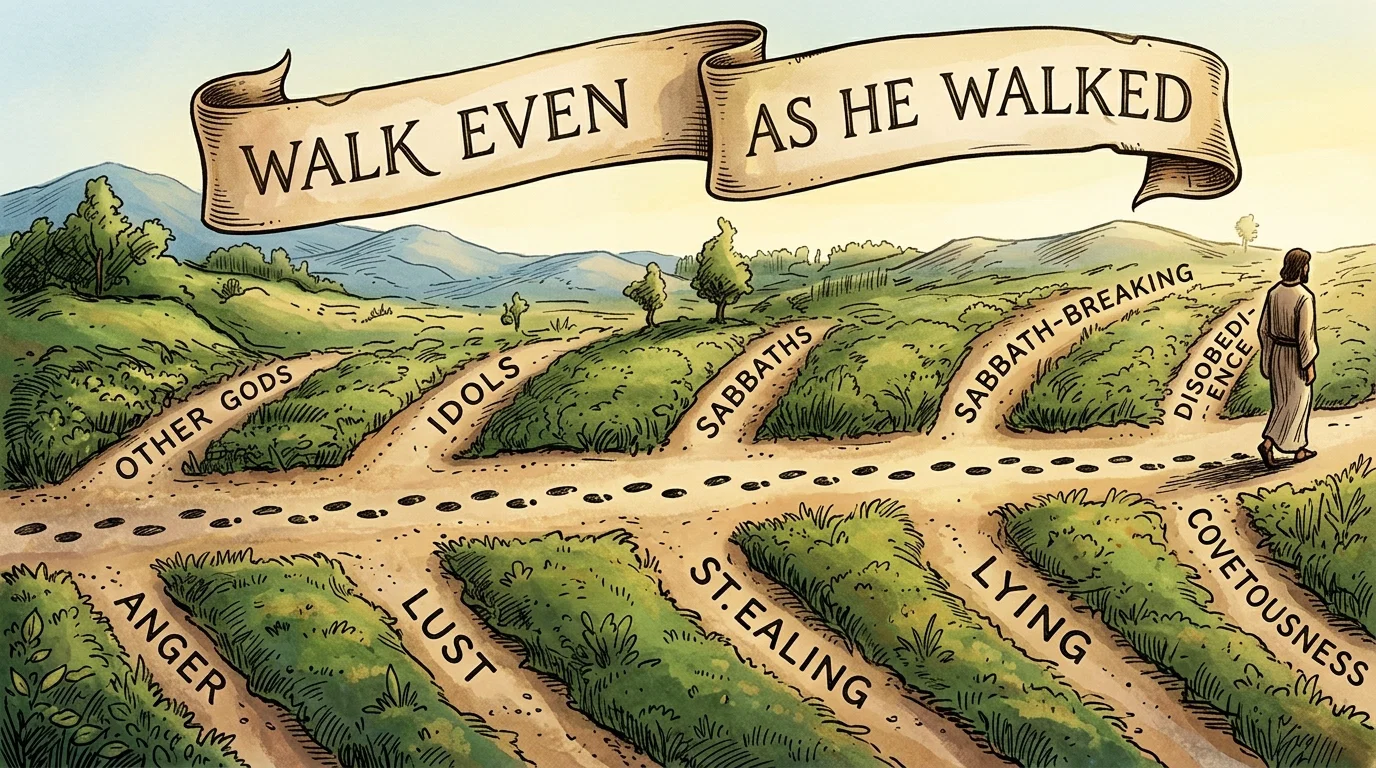
It was the custom of Jesus to go into the synagog and teach the people on the Sabbath day. This day was Saturday, for it was the day kept by the Jews. Christ came to this world to set an example of righteousness and holiness. In his life appeared just what God desires to see in every Christian, and the power is provided in the Gospel. He desires that we should follow in his steps, step as he stepped, and walk as he walked. 1 Peter 2:21–24; 1 John 2:6. If he kept the Sabbath, we should do the same.
The Jews had one standard of Sabbath-keeping, and Christ had another. Their minds were corrupted with the commandments of men, and tradition. Christ had the mind of God, and therefore he had the true idea of Sabbath-keeping. But as the Jews had the wrong idea, they accused Jesus of Sabbath-breaking. “Therefore said some of the Pharisees, This man is not of God, because he keepeth not the Sabbath day.” John 9:16. This accusation was made against Jesus because he had healed a blind man on the Sabbath. Christ had proved it was lawful to heal on the Sabbath day, therefore he was not a Sabbath-breaker, only in the mind of the Jews. “And therefore did the Jews persecute Jesus, and sought to slay him, because he had done these things on the Sabbath day.” “Therefore the Jews sought the more to kill him, because he not only had broken the Sabbath, but said also that God was his Father, making himself equal with God.” John 5:16, 18.
Christ was persecuted for supposed Sabbath-breaking, while all the time he was keeping the Sabbath perfectly. As in the days of Christ, there are now two ideas of what constitute true Sabbath-keeping. One thinks he is keeping the Sabbath by resting upon the first day of the week, and working upon the seventh. Others believe it is Sabbath-keeping to observe the seventh day, and work upon the first. Those who keep the true Sabbath may expect to be persecuted the same as Jesus was. Persecution is always wrong, and it may be stated as a general truth that he who persecutes is in the wrong.
Second Proposition.
The teachings of Christ and his actions were in harmony. “Thou therefore which teachest another, teachest thou not thyself? thou that preachest a man should not steal, dost thou steal? thou that sayest a man should not commit adultery, dost thou commit adultery? thou that abhorrest idols, dost thou commit sacrilege?” Rom. 2:21, 22.
Christ would be a poor example for us if he did not obey his own teachings. The above proposition is self-evident. Christ never said to any one, “Do as I say, and not as I do.”
All agree that Christ kept the seventh day, or Saturday. His actions were in harmony with his teachings. Therefore Jesus taught the observance of the seventh day, for he kept it. “Hear ye him.” In our next we will consider the teachings of the apostles relative to the law of God. W. L. Iles.