THE TEMPLE OF GOD

6%

Pacific Press Publishing Company · Oakland, California · Sep 2, 1897

FromSigns of the Times, Vol. 23, No. 34.

Read the full edition

“THE TEMPLE OF GOD.”

“Let us make man in Our image.” “Male and female created He them.”
In our last paper it was suggested it might be well to study to know something of this wonderful mechanism, which in this paper we will call “woman,” because we will deal particularly with the feminine portion of the human race. In this brief study we may find, not only many interesting facts, but also be able to discover some of the “whys,” which are supposed to be especially dear to the daughters of Eve.
In the physiologies we studied perhaps a long time ago, we learned that the trunk of the body is divided into the chest cavity and the abdomen by a dome-shaped muscle called the “diaphragm.” The chest cavity is a box formed by the spinal column at the back, the sternum in front, and the ribs at the sides, joining these two. In this compartment are found the heart, lungs, and large blood-vessels. Immediately below the diaphragm is the body’s workshop, where are located the stomach, liver, spleen, kidneys, etc.—all the appliances necessary to the manufacture of living tissue from the “raw material”—the food and drink taken—a work of no mean proportions, and certainly not of small importance, when we consider the ultimate results,—the works of men’s hands.
We will stop here a little and consider. The process by which the food we eat becomes incorporated into our living tissue is the mystery of our physical life, and can not be understood any more than is the mystery of our spiritual life. It is one of the things we know by faith. As we look the various parts of the machinery over, we must be forcibly impressed with several thoughts,—the wonderful adaptability of each portion, however small, to its peculiar use. There is no flaw anywhere. “Perfection,” in this particular, expresses it. Then the nicety, the exactness of the whole arrangement; nothing might have been a little longer, or a little smaller; its proportions are exactly adequate to the volume of work it is meant to do. If it were possible for us to look into this wonderful mechanism as it lives and moves, we would find not a particle of extra space; there is just enough, and none to spare. Each organ has its particular position also, and is so exactly fitted into it that it can not be moved in the least without crowding its neighbor.
In fact, the main supports of the abdominal viscera are the abdominal muscles and the juxtaposition of the organs themselves. We quote from “Influence of Dress,” by Dr. Kellogg:—
“How are all these important organs held in place? Altho fitted together with the nicety of an articulation, the viscera are certainly not held together by anything corresponding to the firm ligamentous bands which unite the osseous elements of a joint. . . . The so-called ligaments which hold in place the liver, stomach, spleen, and bowels, can not properly be called ligaments, as very little ligamentous tissue enters into its composition. . . . I think the idea is gaining ground among those who have made a special study of this subject, that the chief factors in the support of the pelvic viscera, as well as other of the organs of the lower trunk cavity, are the tone of the muscular walls of the abdomen and the juxtaposition of the organs themselves.”
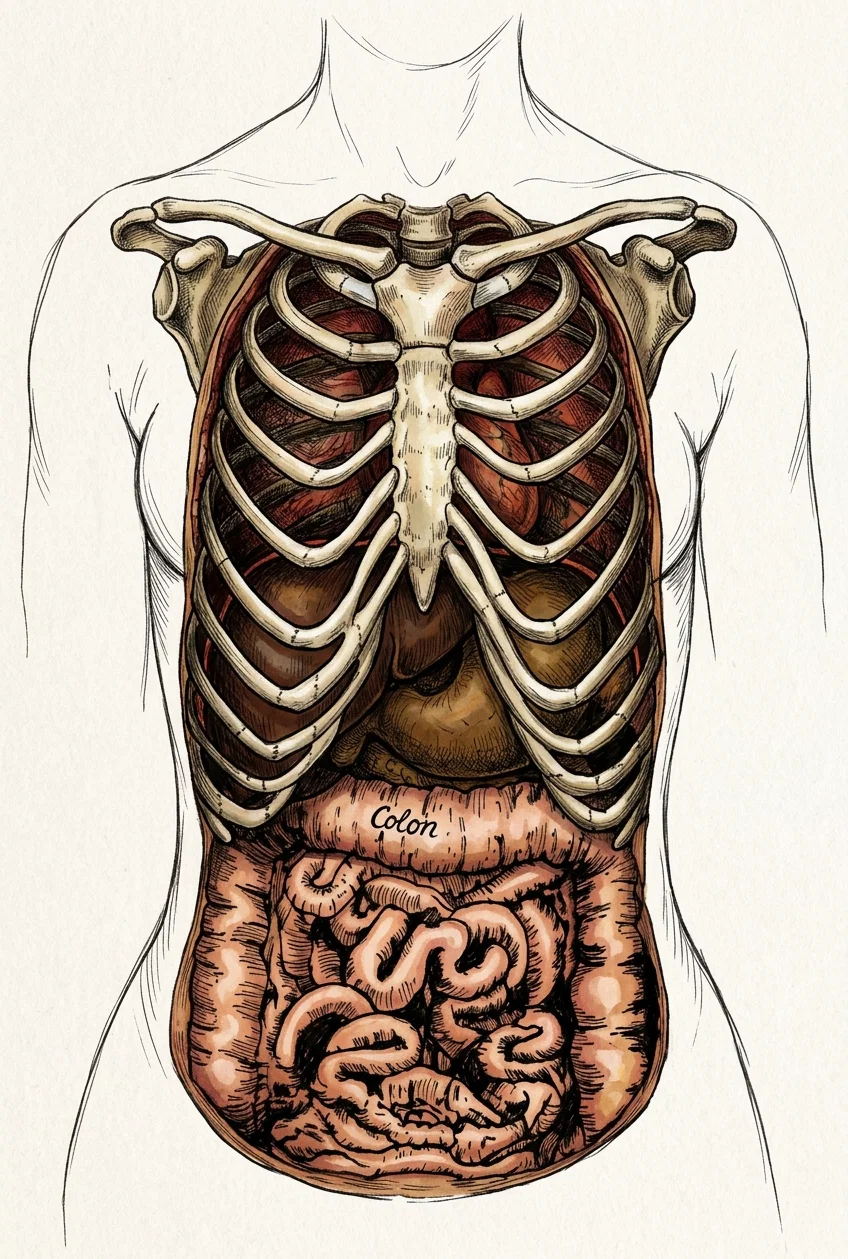
We will leave this for the present, and consider the contour of this portion of the “human form divine.” The most noticeable features are the shape of the waist (which is elliptical), and the outline of the front abdominal wall (which describes a convex curved line), the curve being very slight at the top, gradually increasing toward the lower end. We also notice this wall is of soft, yielding tissue, unlike the bony protection placed around the chest cavity. (Let us keep in mind that the spleen, liver, stomach, pancreas, etc., are placed above or at the waist line.) From the foregoing the reason for the contour of the body as described, must be apparent. We must also recognize the fact that the external shape is an index of the internal condition. By this we mean that if the contour of the body is destroyed, there has been a corresponding change in size or position of the various organs, and this must result in impaired action, and consequent loss of power.
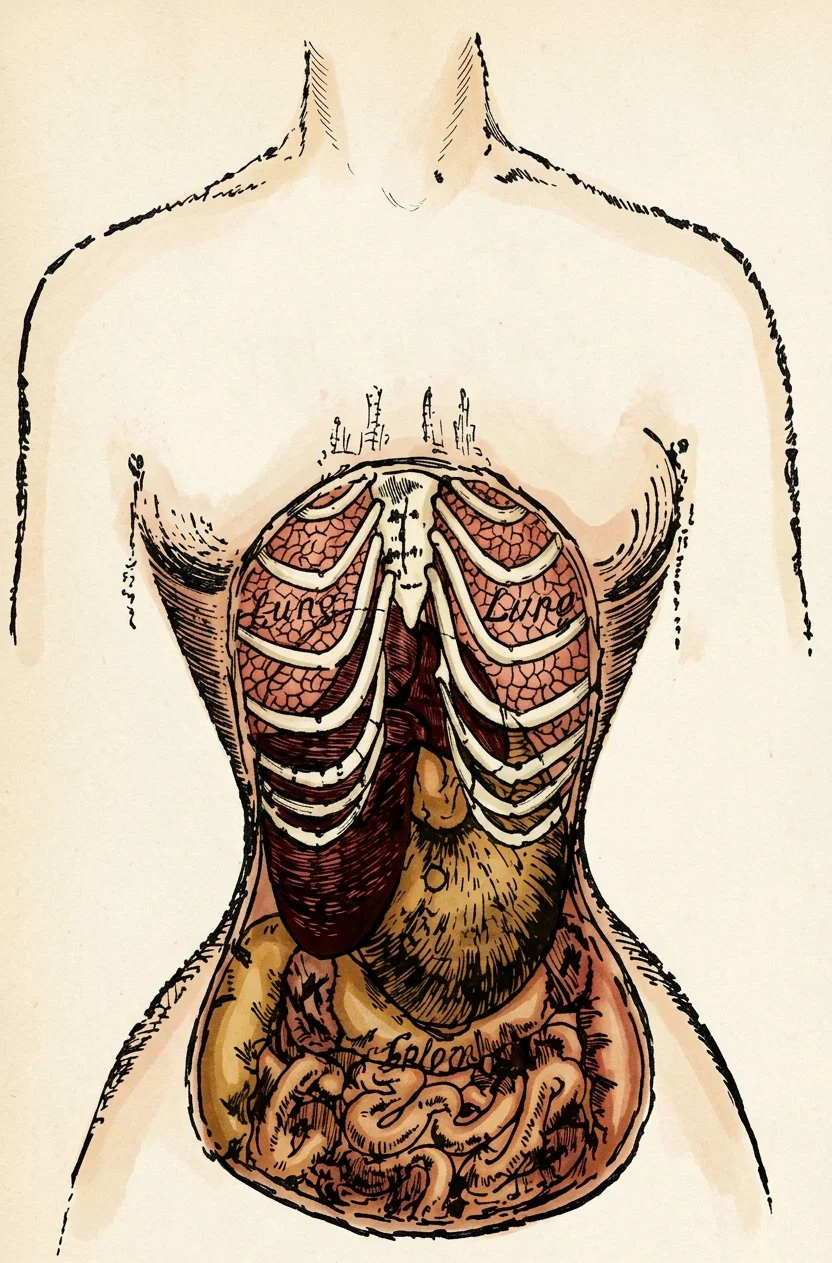
Let us clothe the described figure in conventional garb—corset, skirt-bands (unsupported), etc.—and what happens?—The front line of a corset or corset waist is concave, or, at best, straight, and when this is broughtinto contact with the yielding abdominal wall, the contour is changed, and the shape of the waist becomes round.
But this can not take place without disarranging God’s plan. The various organs must be pushed downward (they can not go up because of the resistance of the diaphragm and chest walls); the whole mechanism is thrown out of gear. It is under the painful necessity of readjusting itself as best it can. No wonder a strong protest is sent up in the shape of pain, or a nameless misery, which is worse.
But is the uncomfortable feeling all the harm done?—By no means. The laws of our being can not be disregarded without consequences, which, unfortunately, are handed down from generation to generation, perhaps not in any specific disease, only a continually decreasing vitality. Weakened powers of resistance, which are easily overcome by dread diseases, attest to the sure results of transgression. “The wages of sin is death.” What, to compress the waist a sin! Why not? Have you, my dear sister, any right to slowly, but none the less surely, shorten your days? or if not so, to cut off a portion of your usefulness, which, after all, is the true measure of life? In the light of eternity lives are not measured by days or years, but by deeds. If the thought of harm toward your brother constitutes a heinous crime, how shall we escape the conclusion that deliberately destroying the health, so that your own life, and perhaps other’s lives, are to any extent robbed of any usefulness or beauty, is a sin?
We are in the world for a purpose. We have a work to do for ourselves and for the world at large. Mothers, how often do you think miserable feelings have led you to neglect something for which your little ones have suffered? And, O, how often little bodies have smarted as the consequence of mother’s ill feelings! You know and God knows. To be sure, tight, uncomfortable clothing is not responsible for it all, but it adds its share, and would remove much of the irritability.
If we could realize the wondrousness of this form we bear, if we could appreciate the fineness of the workmanship, surely we would not abuse it as we do. We would honor it for itself. And if we realized that in this body dwells the life of God, that he desires his Holy Spirit to dwell there, that this body is its temple, we would not deface what God has been pleased to call his dwelling-place. When he beseeches us to yield our bodies to him a living sacrifice, it is that he may honor us with his presence, and it surely can not but displease him when, at the dictates of fashion, we remodel that which was made after his own likeness. When we consider from whence is this pattern, and who the workman, we do not wonder at Shakespeare’s words: “What a piece of work is man! How noble in reason! How infinite in faculties! In form and moving how express and admirable! In action how like an angel! In comprehension how like a god! The beauty of the world! The paragon of animals!” But these words can hardly apply to the misshapen, distorted, and sometimes almost pitifully grotesque, figures we meet in our daily walk.
IDA M. POCH.