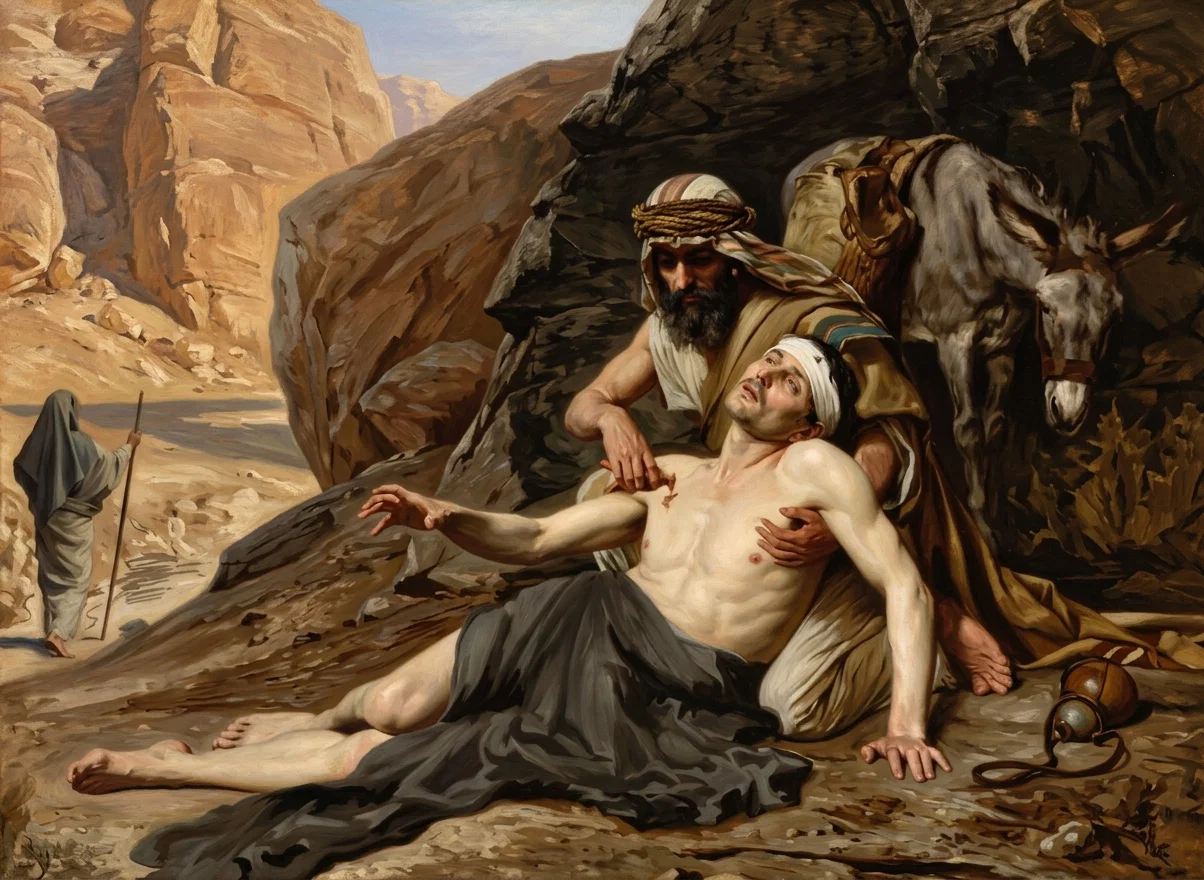
ABOUT twenty miles northeast from Jerusalem is the town of Jericho. Between Jericho and Jerusalem is a dense wilderness that has ever been the haunt of robbers.
IT was along the road in this robber-infested wilderness that the good Samaritan found the unfortunate Jew that had been robbed and supposedly killed. The story of it is in the next paragraph.
“But a certain Samaritan, as he journeyed, came where he was; and when he saw him, he had compassion on him.” Luke 10:33.
“A certain lawyer stood up and tempted Him, saying, Master, what shall I do to inherit eternal life? And He said unto him, What is written in the law? how readest thou? And he answering said, Thou shalt love the Lord thy God with all thy heart, and with all thy soul, and with all thy strength, and with all thy mind; and thy neighbor as thyself. And He said unto him, Thou hast answered right; this do, and thou shalt live. But he, desiring to justify himself, said unto Jesus, And who is my neighbor? Jesus made answer and said, A certain man was going down from Jerusalem to Jericho; and he fell among robbers, which both stripped him and beat him, and departed, leaving him half dead. And by chance a certain priest was going down that way; and when he saw him, he passed by on the other side. And in like manner a Levite also, when he came to the place, and saw him, passed by on the other side. But a certain Samaritan, as he journeyed, came where he was; and when he saw him, he was moved with compassion, and came to him, and bound up his wounds, pouring on them oil and wine; and he set him on his own beast, and brought him to an inn, and took care of him. And on the morrow he took out two pence, and gave them to the host, and said, Take care of him; and whatsoever thou spendest more, I, when I come back again, will repay thee. Which of these three, thinkest thou, proved neighbor unto him that fell among the robbers? And he said, He that showed mercy on him. And Jesus said unto him, Go, and do thou likewise.” Luke 10:25-37, R.V.
THIS poor man that had been robbed and left by the roadside for dead was in need of a real neighbor. He needed some one just then that would recognize in him a member of the human family in a distressing and perilous condition. He needed some one whose heart was overflowing with loving-kindness toward his fellow-men, regardless of race, or nationality, or family relationship. And just such help came to him in the person of the good Samaritan, else the unfortunate man would soon have perished.
THE priest who passed the man in this dying condition was the person who, of all others, should have had his life so bound up in love for humanity that he would have been able to think of nothing else but to help him. The Levites were specially appointed to do the service of God; then how could this son of Levi so disgrace his Master as to leave a sufferer without the needed help? It was left for the Samaritan to act the neighbor’s part.
THAT Samaritan was considered, by the priest and the Levite, as2an outcast. They considered themselves so much superior to him that they would have no dealings with him. But when the Saviour presents his real character, how superior does the neighborly Samaritan appear! How sharp is the contrast between an empty, soulless profession and the real life that is representing the law of God, and thus spreading blessings wherever it goes!
THIS parable of the good Samaritan shows that we should not be satisfied with a mere profession of godliness. The priest and the Levite made their profession so strong and so prominent as to be even obnoxious. But the Samaritan without making any particular demonstrations acted the part that every one will act who has the Christ-principle alive in the heart.
THE priest and Levite had all there was to an outward show of piety. They made an open spectacle of the wires and all of what they thought to be the paraphernalia of divine power; but those wires were not connected with the throne of God, and so the heavenly currents were wanting. These men were conspicuous because of their appearance of piety, and they were masters of all the fine-spun arguments that the scholasticism of that time had invented with which to befog and bewilder the minds of men. But their arguments could not convince and convict, and lead to the reforms that build a right character, for they lacked the power of real life.
WE may dispute much and imagine that we are doing valiant service for Christ; we may preach often, and write continuously, regaling ourselves with the thought that we are eloquent, or witty, or something of the kind, but no soul is converted. Our arguments are controverted by the infidel, and the crowds applaud him. But who ever saw or heard of any one that even cared to do aught else than to commend and admire the life that is represented by the Samaritan? All of which shows us that there must be the life of power and then every word will be with power.