BUT the day of the Lord will come as a thief in the night; in the which the heavens shall pass away with a great noise, and the elements shall melt with fervent heat, the earth also and the works that are therein shall be burned up." 2 Peter 3:10.
Is it possible for the above prophecy to be fulfilled? The unbeliever may reasonably ask. No one ever saw our world burned up; therefore we can not appeal to history; but to argue that it never has happened would not be a new argument, for in 2 Peter 3:4 we read that men will say, “Where is the promise of His coming? for since the fathers fell asleep, all things continue as they were from the beginning of the creation.” Men reasoned this way in the days of Noah, as tho because a certain event did not occur during a certain hour, minute, or second of time, it never did, would, or could happen, reminding one of the witty remark of a certain Frenchman, who, speaking of a shallow reasoner, said that “he thought and reasoned like a fish.”
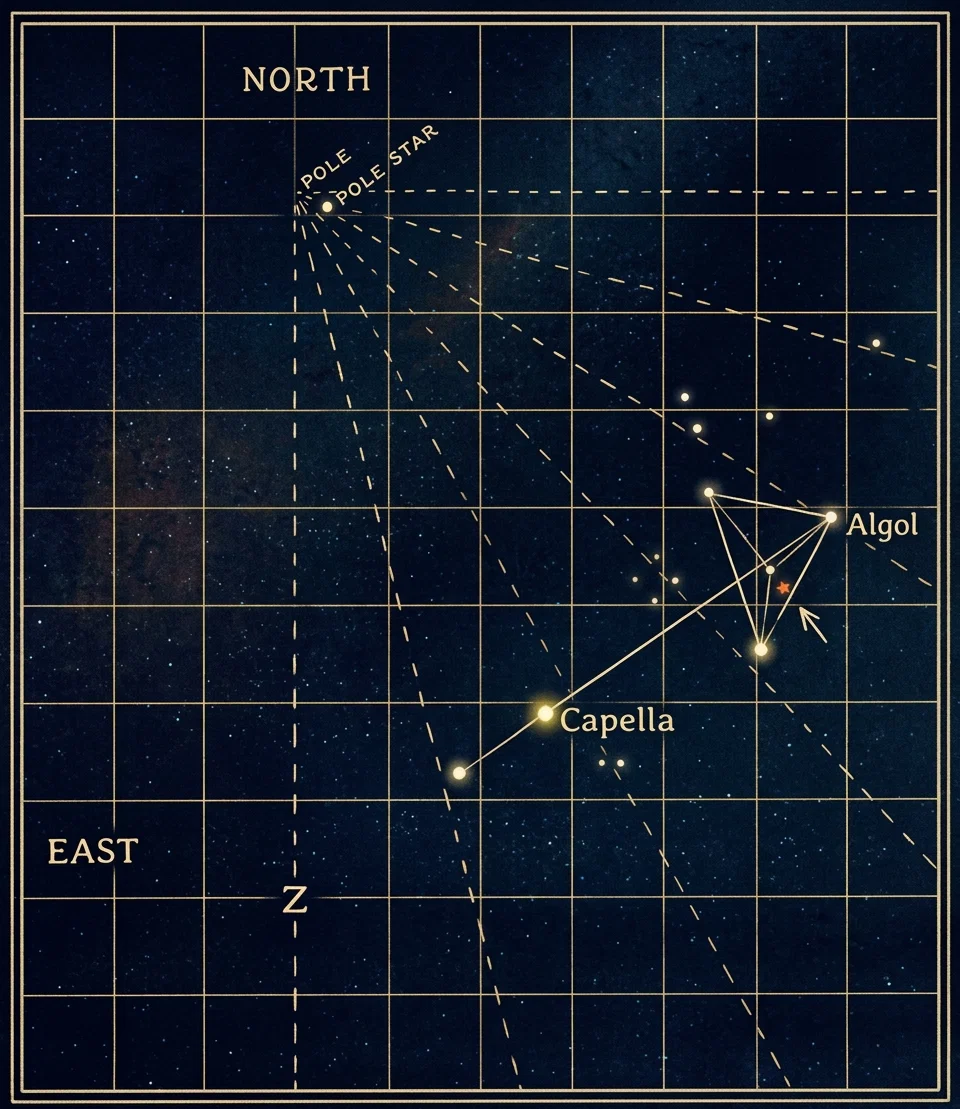
The occasion of this article is the sudden appearance of the new star, which is just now of such absorbing interest to astronomers, who are giving their united energies to make this shining example of a flaming world yield some of its mysterious secrets. Many of our great observatories are using all possible instruments and paraphernalia to pursue this latest phenomenon as long as it continues bright enough to give promise of results.
The new star will be known as Nova Persei, will be placed in the list of temporary stars, and will be numbered thirteen on the list of well-authenticated naked-eye cases; the first, “the star of Hipparchus,” 134 years B.C.; the last, Feb. 20, 1901.
Some of these have suddenly flamed up after having previously existed as small, insignificant stars, only to fade away again to about their former state, others have flashed into ephemeral glory only to dwindle down, down to utter extinction, so that they have passed beyond the ken of our mightiest telescopes; while some have appeared where no known star was ever known to be. Two, at least, have diminished in brightness, and have changed into small nebulae, that is, clouds of incandescent gas. The fate of the present star is, of course, unknown; it is not known at present (at least to the writer) whether or not it has ever had an existence on our best charts or negatives. It may have been one of the almost countless small stars known to astronomers, or it may prove to be entirely new. By new I mean only that it may have been unknown, and not that it was an entirely new creation.
At least seven of the well-known thirteen that have been discovered in the last 2,035 years, have appeared within the last century; but whether this is because they are more closely watched for, or are becoming more numerous, I do not pretend to say; only one of the seven mentioned was invisible to the naked eye at its brightest period, so the telescope had very little to do with the increasing number.
The present Nova will always rank very high on account of its great brilliancy; for, on the afternoon of February 24, or only four days after it had been photographed as a star of the tenth or eleventh magnitude, it was a half-magnitude brighter than Capella, according to the Lick Observatory astronomers. This marvelous increase of light will be better appreciated when I say that Capella has but two rivals in brightness in the entire northern hemisphere, while it requires a telescope of considerable power to even glimpse a tenth-magnitude star on a dark, clear night. It exceeded, for a few hours, all the stars in brightness except Sirius, the brightest star of all. Only one other of the thirteen ever attained the dignity of a first-magnitude star, that known as Tycho’s star, in Cassiopeia, in 1572, which became bright enough to be seen in full daylight, and has since often been called the “Star of Bethlehem.”
Naturally, we wish to know the reason of this marvelous increase of light. Several reasons have been offered to account for this sudden brightening of temporary stars; but I shall content myself by presenting two, which appear to me to be the best theories.
First, two suns or planets may have had a collision, dashing together with a high velocity. Should our earth, traveling, as it does, round the sun at a speed of eighteen miles a second—forty times faster than a cannon-ball—collide with another body of similar size and mass, there would be a mighty flash of light, while the heat developed would be great enough not merely to melt the two bodies, but they would be vaporized, and thereafter form a single mass of glowing vapor, the condition of thousands of heavenly bodies we see around us, and the astronomers on other worlds would suddenly have a new star in their skies; for our earth would be self-luminous.
If our own and another sun of the countless millions we see around us, should meet in a collision, they would meet the same fate but in a much greater degree, and because of their immensely greater mass would extend to and completely envelop their adjacent planets in a fiery mantle, that would in turn completely vaporize them, the whole becoming one mass, and merely adding one to the thousands and thousands of gaseous bodies that the astronomers call nebulae, and which may be found in every part of the sky.
The second theory is that two bodies may have approached each other so closely that the tidal effects produced by their mutual attraction5would easily account for all the phenomena observed in temporary stars. This is quite as simple as the first theory, but requires a more detailed explanation. It may be readily understood by an illustration taken from our daily experience of ocean tides. Just here I may remark that the theory of tides is to-day one of the most intricate problems confronting astronomers. I do not mean our insignificant ocean tides, altho the A, B, C of our ordinary tides is not thoroly understood; but I mean the far-reaching and stupendous tidal effects of double and multiple star-systems, and of star-systems in clusters, groups, and aggregations of which we know scarcely anything. Another La Place or Newton is needed to solve this grand problem. The tide-raising power, attraction, or pull of our moon upon a particle on the earth’s surface is such that a 4,000-ton weight at the surface, loses about one pound in weight when the moon is directly overhead. I here omit anything of the effect when the moon is underfoot.
Now the law governing the tidal wave, or effect produced between any two bodies, is this: “The tide-producing force of a heavenly body varies inversely as the cube of its distance and directly as the mass.” Taking, then, the moon and our earth, and the distance as 240,000 miles, the power of raising tides would be increased eight times each time the distance between the two bodies should be reduced to one-half. The tidal wave in mid-ocean is from two to three feet high; let us assume two feet; then if the moon and earth came within 120,000 miles of each other, or one-half of the present distance, the mid-ocean tide would be sixteen feet; if the distance is again reduced to 60,000 miles, the tidal wave would be 128 feet, and so on.
The specific gravity of the surface rocks of the earth is about three and one-half times that of water, but for the sake of simplicity we will assume four times; then if our earth was composed of melted rock, and the moon at 240,000 miles, the tides of melted rock would be one-fourth that of water, or six inches high; reducing the distance to 120,000 miles, they would be four feet high; at 60,000 miles, thirty-two feet; at 15,000, 2,048 feet; and at 5,000 miles the tide would be 55,296 feet high, a fiery wave of molten rock over ten miles high!
I have assumed here a molten earth. “Since the fathers fell asleep,” it has had an apparently stable crust. Only an earthquake now and then, or a volcano vomiting its red-hot grist of lava, has reminded us that we live upon a crust that is estimated by our most eminent thinkers and investigators to be only from 40 to 100 miles thick, which, if it should be subjected to a pull, or stress, or strain, such as the moon would give at the distance of 5,000 miles, or even more, would be elongated, and the earth would be pulled out of shape. Even if it were solid, which is almost unthinkable, it would be rent and crushed to powder, and the rocky crust upon which we live would not only be melted by the enormous heat produced by the friction of such an energy, but it would be vaporized. Both bodies would be merged in one, and form a fiery cloud of glowing gas, the very “elements” having been “melted,” yes, vaporized, by “fervent heat.” It seems to me that even Peter’s graphic prophecy hardly does justice to what would happen if ever our earth and moon should approach each other within a few thousand miles.
If two mighty globes like our sun should approach each other, the results would be the same, but in a proportionate degree; for “the tide-producing force of a heavenly body varies inversely as the cube of the distance, and directly as the mass.”
That some such catastrophe has overtaken our new star is at least possible. Passing, as it did, in about four days, from a tenth or eleventh magnitude, to brighter than the first-magnitude star, means an increase of light, and consequently heat, of not less than twenty thousand times.
One of the weakest points of these theories is that the temporary stars fade away so rapidly. Either theory will easily account for the increase; but the decrease seems unexplainable, unless we assume that the stars were converted into a nebula (as they were in two cases), and the nebula continued to expand until, by the very expansion, it would decrease in light, from the fact that the given amount of light would come from a larger area, and must consequently diminish in intensity, but not, perhaps, in amount.
Spectroscopic investigations have been undertaken at all our large observatories; but we must wait for weeks and probably months before they publish the results obtained by the giant instruments. The writer, with a star spectroscope of moderate power, has observed the star on several nights, and found the spectrum crossed by wonderfully bright hydrogen lines (the lines in all but a few stars are dark) greatly exceeding anything he had ever seen before, and indicating (indicating is too mild an expression; demonstrating would probably be nearer the truth) that the body was “wrapped in a mantle of incandescent hydrogen.” Should our sun meet with a similar experience to the new star, the heat, increased probably twenty thousand times, would vaporize this earth, if it did not altogether envelop it in the expanding gases, and thereby make it a part of the chaos of world-matter. Would the Creator permit this? Why not? Has He not said that “the elements shall melt with fervent heat, the earth also and the works that are therein shall be burned up”? Are our ways His ways?
The tendency of all hot bodies is to cool, eventually, and even our sun must cool in time. What is considered the best calculations give it something like five millions of years before it will become so cool that it will no longer shine. Then what? Five million years seems a long time to such an insect as man with his small power and great confidence in himself; but it is scarcely to be counted in eternity. Five million years will come as certainly as to-morrow morning. What would the solar system be without the light and heat of the sun? Life, as we know life, would be impossible; and science can see but one object in the system, and that is life, life as we know it.
There are millions of stars, and all the stars are suns; therefore there are millions of suns cooling—approaching the condition of things that means death to all life with which we are familiar. How many have already cooled? And of the millions of the hot ones, in past eternities, can it be otherwise than that there are millions of cold suns—suns that have reached old age, and expired, ceased from usefulness from mere lack of heat? What can dead suns and worlds do that is good from the standpoint of science or any other standpoint? What greater blessing than for two of these old, decrepit, worn-out suns or worlds, pursuing their cold, dark, trackless way in space, without the ability to give out the power of life—what better thing can happen than a sudden rushing together, and with this crash of worlds putting into each other the fire that makes life possible? Then new heavens and earths would result, and the worn-out matter would be as new and as pregnant with possibilities as it was “in the beginning.” “Behold,” Christ says thru John, “I make all things new.” Rev. 21:5. GAMMA BETA.