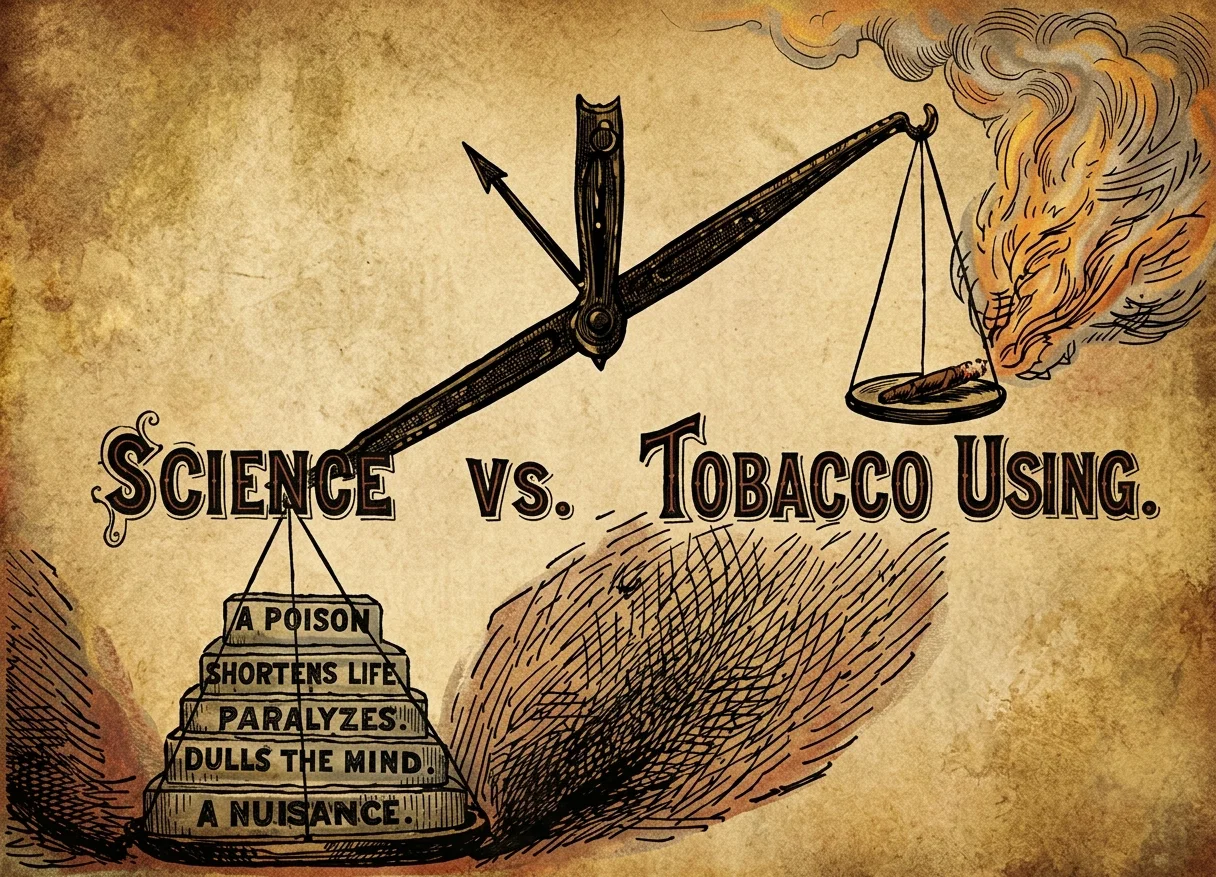
Our engraving shows tobacco placed in the scales of reason and weighed with science in the opposite scale. Our artist has pictured the scale-pan which carries the smoking cigar as rising high in the air, while the other scale-pan, weighted with the charges which science brings against the use of the weed, falls heavily down.
Respecting the use of tobacco, there is a difference of opinion, as there is upon every other question relating to human affairs, physical, moral, or political. Science is a great arbitrator, to whom all questions of this sort may be referred. Modern science has by its marvelous achievements won the respect of all civilized men, and established its authority upon a basis of unquestioned solidity.
The mathematician sits down at his desk, with certain unexplained facts before him, and after months of figuring announces to the world a new planet. The astronomers turn their powerful instruments toward a vacant spot in the heavens, and the new world shines out, for the first time beheld by the eyes of man. Science takes a handful of earth, throws it into a chemist’s crucible, and after weeks of patient toil, writes down upon a bit of paper all that that handful of earth contained. Science does not stop with this little earth, in her inquisitive researches. She turns a spectroscope at the sun, or at a distant nebula, and with equal certainty names its constituents.
This same marvelously exact science has investigated tobacco, and has disclosed certain things about this nauseous but strangely fascinating drug, which every user of the weed ought to know about. Here is what science says about tobacco and tobacco-using:—
1. Tobacco Is a Deadly Poison.—It contains a peculiar oil, found in no other plant that grows, which is almost as deadly in its effects as prussic acid. A drop or two will kill a cat in a few seconds, and five times that quantity is a deadly dose for a strong man.
2. Tobacco Intoxicates.—A man who uses tobacco is never really himself while he is under its influence. A hungry man takes an extra cigar or quid, and ceases to be hungry. A tired man indulges in an extra pipe, and no longer feels fatigue. All his senses are benumbed, and it is reasonable to suppose that the delicate moral sensibilities, like the more purely physical senses, succumb to this powerful narcotic. Benzoni, who traveled on this continent (America) more than three centuries ago, thus described the effects of tobacco upon the aboriginal smokers: “They lose their reason” and “fall down as if they were dead, and remain the greater part of the day or night stupefied.” Men who smoke much are really intoxicated all the time; and there is no doubt that the vice of smoking leads in a powerful manner to the vice of alcoholic intoxication.
3. Tobacco-Using Stunts the Growth.—When the use of tobacco is begun before the body is matured, its worst effects are seen. It effectually stunts the growth. The intellect is also blunted. This fact is now so well known that France, Switzerland, and several States in this country, have prohibited the sale of tobacco to boys under sixteen years of age, and have even made it a crime to give tobacco to boys. If tobacco is so bad for boys, is it not unwholesome for men?
4. Tobacco Is a Great Cause of Disease.—It would naturally be expected that a poison so powerful as tobacco would be a potent cause of disease, and the facts fully justify this conclusion. It is positively known that the use of tobacco, by lowering the vital tone, is a predisposing cause of many diseases, and it is equally well known that it is a positive cause of many maladies, among which are the following: (1) Nervousness is one of the characteristic results of the use of tobacco. Every narcotic has the effect to diminish the nerve tone, and it is only a question of time that the nerve tone will become exhausted, and then the individual will become a victim of that hydra-headed malady, neurasthenia, or nervous debility. (2) Dyspepsia. Some persons are induced to resort to the use of tobacco under the delusion that it is a panacea for dyspepsia. It will undoubtedly benumb the stomach, but it is an effectual cause of this protean malady rather than a cure for it. (3) Disease of the lungs. This is particularly true of smoking, which introduces into the lungs a considerable amount of soot, which is deposited in the lungs and may cause the development of tubercle. (4) Injury to the voice. This is particularly true of smoking. The hot, acrid vapors taken into the throat injure the delicate mucous membrane, and produce what is well known to physicians as “smoker’s sore throat.” (5) The tobacco heart. The rigid examination made of men seeking to enter the army has developed the fact that a very large proportion of old smokers are afflicted with what has been called “the tobacco heart.” The pulse is feeble and irregular, and indicates that the heart is in a condition of chronic poisoning. This condition is the precursor of more serious diseases of this important organ, which may result fatally. General paralysis, and especially that form known as creeping paralysis, is very frequently caused by the use of tobacco. Locomotor ataxia, a disease in which the patient reels like a drunken man when he walks, is also sometimes due to this cause. The use of tobacco in any form is now well known to be a potent cause of a peculiar form of blindness which comes on insidiously, and is called “tobacco amaurosis.” This disease is well known to oculists. (6) The sense of smell is soon lost by snuff-takers and cigarette smokers. The sense of taste, also, seldom survives the long use of either the quid or the pipe. Tobacco is a general paralyzer. (7) Smoker’s cancer. The death of General Grant and several other prominent public men within the last10few years from smoker’s cancer has fully informed the public of the fact that the filthy weed is capable of inducing this horrible and usually incurable malady. (8) Other bad diseases. The very worst and vilest of diseases are often communicated by means of cigars and pipes. Cigars are often infected by diseased workmen.
Science says most emphatically, tobacco is a vile and filthy weed, destructive of both mind and body. Reader, if you are addicted to its use, make haste to rid yourself of the baleful influence of this poisonous drug.