The Scriptures declare that God “hath made of one blood all nations of men for to dwell on all the face of the earth.” Whatever the color of the exterior man, the same life-giving blood courses through the veins of all men in all climes. Diversity of climate and circumstances has produced different conditions; but whatever these conditions, the souls of all mankind are of equal value; for they have been bought with the blood of Christ.
That the reader may better appreciate the influence of the Word of God upon these dark-skinned savages of the South Sea, this brief outline of their history as heathens and since is penned.
Among the little specks of land that dot the South Pacific Ocean, is the little kingdom of the Friendly Islands. It is composed of three smaller groups, called the Vavau, Haapai, and Tongan. The natives of these islands are of a dark skin, perhaps a little darker than the American Indian. Their features are of European caste, and their general manner of life somewhat similar to the natives of the other South Sea Islands.
There is, however, an interesting history connected with the early religious practices of these Friendly Island people, and general manner of life, that varies in some respects from the people of the surrounding groups. But very little is authentically known of the history of these natives previous to the beginning of the nineteenth century. A thrilling incident took place about that time, which has connected the inhabitants of the Friendly Islands with their fellow-men in other parts of the world. It is as follows:—
On the 12th of February, 1805, a vessel by the name of Port-au-Prince weighed anchor at Gravesend, England, and, after cruising several months among the islands of the Pacific Ocean, cast anchor for the last time on the 29th of November, 1806, off the northwest point of Lefuga, one of the Haapai group, which lies nearly north from Tongatabu. The ship carried several large cannons, some muskets, and a supply of ammunition. In several instances the ship had fired on the natives of several islands, foraged their fields for fresh supplies, and in some instances treated the inhabitants in a very unbecoming manner. In the evening of the day that she lay at anchor, a number of native chiefs came on board with a large dressed hog, and a quantity of ready dressed yams, as a present to the ship’s company. Among them was a native of another island, who could speak a little English, which he had learned on board an American vessel that had taken him from the Sandwich Islands to Manila, and had thence brought him to the Friendly Islands, where he had remained ever since. This man tried by all means in his power to convince the ship’s company that the natives were disposed towards them in the most friendly manner. Notwithstanding all of this, a number of the crew were suspicious of foul play, and mentioned their fears to the captain, but with no effect save to be rudely repulsed. He cursed his men and ordered them to continue their work. Eighteen of the men revolted and went on shore. During all this time the natives were busy concocting a scheme to slay the ship’s company and take possession of the vessel.
On December 1, 1806, about eight o’clock in the morning, the natives began to assemble on board, and soon increased to three hundred in different parts of the ship. The captain was invited by the man who had learned to talk English on board the American vessel, to go on shore and view the country. This he did unarmed. About half an hour after he left, Mr. Mariner (one of the ship’s company, and whose life was spared, as we shall see further on) was in the steerage. He was about to mend a pen, and went to the hatch for light. Looking up he saw a man standing on one of the guns, endeavoring by signs to prevent any more natives coming on board. He heard a loud shout from the natives, and saw one of them knock the man down with a club. Seeing now too clearly what was the matter, he turned about to run towards the gun-room, when a native caught hold of his hand; but luckily escaping from his grasp, he ran down the scuttle, and reached the gun-room, where he found one of the ship’s crew. Thinking the magazine the safest place, they ran there. After consulting what was best to be done, they decided to blow up the vessel, and perish with their enemies. Mr. Mariner accordingly went to the gun-room to procure flint and steel; but was not able to get at the muskets without making too much noise, and thus attracting the attention of the enemy. He returned to the gun-room, where he found his companion in great distress from the apprehension of his impending fate. Mr. Mariner next proposed to his companion that they go at once on deck, and be killed quickly, while their enemies were still hot with slaughter, rather than by greater delay subject themselves to the greater cruelties of cooler barbarity. His companion finally consented to follow, if Mr. Mariner would lead the way. This he did, and upon lifting the hatch, he saw two natives examining the sword of one of the officers, and other arms that were on his bed. Their backs being turned, he lifted off the hatch entirely, and jumped into the cabin. The natives turned around, whereupon Mr. Mariner threw up his hands to signify that he was unarmed and at their mercy. He then uttered the word “Aroghah,” which is a word of friendly salutation among the Sandwich islanders. He then asked them, partly in English and partly in his own language, if they meant to kill him, as he was quite ready to die. The native chief replied in broken English that he should not be hurt, as the chiefs were already in possession of the ship. He then asked him how many persons there were below, to which Mr. Mariner replied, “Only one.” He then called up his companion, and they were taken in the custody of a petty chief.
Mr. Mariner was taken on shore, and, after being stripped of his clothing, he was pointed to a mat in the corner of a native hut, where he was made to understand that he was to lie down. This he did, but had been there but a short time when a messenger from the king arrived, announcing that his majesty had sent for the prisoner. He was commanded to follow, and soon they were in the presence of the king. The king took a fancy to him at first sight, and he was treated very kindly from that time on. He put his nose to his forehead (a mark of affection) then ordered him to be washed and oiled with sandalwood oil. He was provided a mat to lie down upon, where, overcome with fatigue both of body and mind, he soon fell fast asleep. During the night he was awakened by a woman, who brought him some baked pork, and boiled yam. He did not taste the pork, for fear it was the baked flesh of his companions, but ate heartily of the yam. After appeasing his hunger he soon11dropped off to sleep again. Upon rising the next morning he was surprised to see every one with his head shaved. They were to bury a great chief that day, and it was their practice on such occasions to shave their heads.
Before they accepted the Christian religion, whenever they buried a chief of some note, they would surround his grave, and beat their bodies and faces with their fists. Sometimes they pierced their cheeks with arrows, letting them hang over their shoulders, while the blood ran down their faces and dropped upon the ground. This was highly expressive of their affection for the deceased. The one who beat himself the most violently, and tortured himself the most cruelly, was considered as having the most love for the dead. Such was the blind zeal of these poor natives before the rays of light from the cross shone athwart their benighted pathway.
Some days were spent by the natives in examining the Port-au-Prince and the things on board. After their curiosity was somewhat satisfied, they set fire to the ship, so as to more easily get at the ironwork. Previous to this, however, the guns and ammunition had been taken on shore, by the order of the king. There is one incident that took place prior to the burning of the vessel, which shows how little value these people in their heathen condition placed on human life.
The king, observing one of the natives busily engaged in cutting out the iron fid from the main top-gallant mast, and having a personal dislike for the man, resolved to put a stop to his work. A Sandwich islander was amusing himself on deck by firing off his musket. The king turned to him and told him to try to bring that man down from aloft. Without the least hesitation he leveled his piece, and shot him. He fell upon the deck, breaking both thighs, and fracturing his skull. The story of the cross has caused them to place a higher estimate upon human life, and it is doubtful if a native in the group would do such a deed now, even if ordered by a chief, unless his life was threatened.
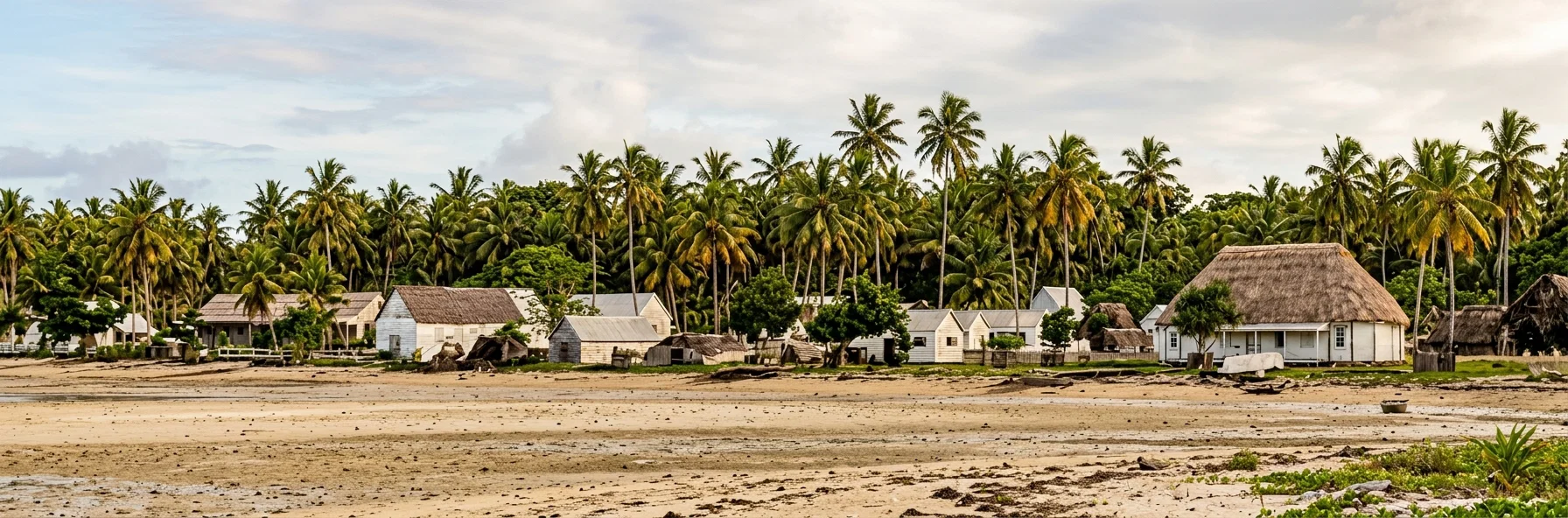
A VIEW OF NUKUALOFA, THE CAPITAL OF THE TONGAN ISLANDS.
(From a photograph kindly furnished by Brother E. C. Chapman.)
Early Influences.
This people would, doubtless, be in a far better spiritual condition had there been more unity among the early missionaries, and a better example set before them by the Europeans who first settled among them.
Just a little prior to the opening of the missionary work among them, a man from off a European vessel decided to make his home among the natives. For some time he lived on friendly terms with them, and was much respected by them. Some time after the ship Duff arrived and left some missionaries, and some white men who from choice decided to remain among them. They built a house, in which they shut themselves up to sing and perform ceremonies, as the Tongan king expressed it. Matters went on well for some time. At length a quarrel arose between these two European parties, at first about an iron pot which was borrowed, then about some pigs that one party accused the other of stealing. Each party went to the chiefs with their troubles. One party said to them that the other white men were under sentence of banishment for their crimes; that they had been brought to the Friendly Islands to remain during their natural lives, instead of being executed in their native land. The other party in turn reported concerning their enemies that they were men sent out by the king of England to bring a pestilence on the people of Tonga, and that they accordingly shut themselves up in the house they had built, to perform witchcraft, and make incantations, which was the cause of the pestilence then raging. A scourge was upon the people at that time and two or three chiefs died every day. The complaining party continued: “You see the effects of their incantations; several of you are dying every day; by and by you will all be cut off, and the king of England will take possession of your islands. You have the remedy in your power but will not use it.” The chiefs felt alarmed at this report, and rushed upon the white men and killed all but three, who were then under the protection of a great chief. Such was the fate of some of the early missionaries. It seems that it was all brought about through the influence of a spirit entirely foreign to a true ambassador of Christ.
Educated in Warfare.
The natives of the Friendly Islands, it is said, never were a bloodthirsty, warlike people. They lived in peace among themselves, and with the natives of other groups, until they visited the Fiji Islands. About the time that Captain Cook first visited these islands some of these natives were found assisting a party of the Fijians in one of their civil wars. They used to visit the Fiji Islands to procure sandalwood for making oil, and would sometimes assist one of the parties in their struggle against their enemy. In this way they soon learned the art of war, how to make stronger bows and arrows, and to more dextrously handle the spear, which encouraged them to fight among themselves. In addition to their acquired knowledge, which they had obtained in the islands of Fiji, in manufacturing implements of war, they were further encouraged by the capture of the muskets, cannons, and ammunition from the Port-au-Prince.
A great chief by the name of Finau (Fee-noo), ambitious to become king of the group, raised an army, and with his artillery from the captured vessel, was successful everywhere he went. His warriors were first marshaled at the Haapai Islands. After subduing some of the smaller islands, and thereby augmenting his army, he finally decided to attack Tongatabu Island, and accordingly sailed with his little fleet for that island. He landed at a little consecrated spot of land, containing a few acres, called Maofaga. In this place are the graves where the greatest chiefs, from time immemorial, have been buried, and for this reason the spot is considered sacred. If the most inveterate enemies chance to meet on this ground, they must look upon each other as friends. If they should not do so, they expect an untimely death or some great misfortune to overtake them. There are several of these consecrated spots on the different islands.
Human nature is the same the world over, whether found in the bosom of an ambitious savage chief or that of a general in a civilized nation. The general who leads his battalions on the field of battle tries to inspire them with a spirit of bravery; so likewise did this chief try to encourage his warriors. He had them painted and dressed in warlike costume, then paraded them up and down in lines before him, teaching them how to use their clubs, etc. Those warriors of some note would run up close to their chief, brandish their club, and exclaim, “Fear not, Finau; no sooner shall we reach the field of battle than here is a club with which I will kill any one who dares to fight against us.” Finau and his chiefs thanked them for their sentiments of love and loyalty, and then Finau addressed them in the following manner:—
“Be brave in battle; fear not death; it is far better to die in war than to live to be assassinated at home, or die of a lingering disease.”
Before they went forth to battle, they consulted the gods. This was done through the priests. The night before the consultation was held, the one who desired to know the mind of the gods, which was usually a distinguished chief or person, ordered his cook to kill and prepare a hog, a basket of yams, and two baskets of ripe plantains. The next morning these were taken to the priest who was to consult the oracle. At the appointed hour the people gathered before the priest, and sat down before him upon the ground. These heathen people believed that pride was displeasing to their deities, and the chiefs accordingly took their places promiscuously among the common people, which their position never allowed them to do on other occasions. The idea prevails, even in heathen nations, that the higher power, whatever they regard that power to be, abhors pride, but is well pleased with self-abnegation.
As soon as all were seated, the priest was considered inspired, the gods being supposed to exist within him from that moment. He sat some time in silence, with his hands clasped before him, and his eyes cast downwards, remaining perfectly still. While the food was being shared out and the kava drunk (the kava is a root, which is pulverized, soaked in water, and then drank as a beverage), he was often consulted; sometimes he answered, at other times not; in either case he remained with his eyes cast downward. When he began to speak, it was in a low tone, but his voice gradually arose to, or a little above, its natural tone. All that he said was supposed to be the declaration of the god, and he always spoke in the first person, as if he were the god. Sometimes his entire form became agitated, finally convulsed, and large drops of sweat stood upon his forehead. He shed tears profusely; his breast heaved with emotion; and his utterance was choked. These extraordinary impulses and convulsions were taken for the inspiration of the gods. Elated with the assurance of victory from their heathen deities, Finau and his warriors marched away to the field of battle. With12their heavy cannons and muskets, of course they were victorious over an enemy whose most effective weapons were small spears, bows, and war clubs. Tongatabu was subdued.
Base Treachery.
He then sailed his fleet to the island of Vavau, and attacked it.
After a long struggle, a council was held, and conditions of peace discussed. Finau’s conditions were that he was to be honored as king, and all hostilities were to cease. Some of the Vavau chiefs expressed a fear that if these terms were accepted, after Finau had full possession, he would avenge himself on them for fighting against him. He assured them in the most emphatic language that he forgave them all, and that he would never seek revenge in any way. Most of the chiefs seemed satisfied, and peace was declared. Some of them, however, who were better acquainted with the treacherous character of Finau, left the island and took up their abode in Fiji and other islands. Their apprehensions of his revengeful disposition were well founded. It was not long after this that Finau was presiding at a Kava party, when suddenly he gave orders to men, who had been previously appointed, to seize all of the chiefs who had been particularly active against him in the late war. His orders were immediately obeyed. Their hands were tied behind them, and they were taken down to the beach, where several were despatched with a club. The remainder were reserved for a more signal punishment. They were put into old leaky canoes, taken out several miles to sea, and left to sink.
It is impossible for the human mind to transcend its own attributes in its perceptions of a deity of its own creation. As these heathen people were sometimes sorely displeased, even angry, at their fellow-creatures who had ill treated them, and sought for revenge, so likewise they attributed the same disposition to their gods. Whenever they considered that their gods had been greatly offended, they did some very cruel things to appease their wrath. Sometimes they strangled an infant to pacify the anger of the gods or for the recovery of the sick. A mother whose infant had been strangled for the recovery of its sick father, through excessive grief for her child and the death of a near relative, became insane. One day she was down on the beach gathering up sea-shells, when Finau and Mr. Mariner chanced to pass that way. King Finau, who was tired of seeing her around in her condition, and was also desirous of seeing the execution of a musket ball, asked Mr. Mariner to shoot her. He replied that it was contrary to his religious training, and the laws of his native land, to kill an innocent fellow-creature in cold blood. His refusal was accepted by the king, and the poor woman escaped that time. In a few days, however, the king and Mr. Mariner were passing the same place, and again observing her wandering along the beach, he turned to a Sandwich islander who was at hand with his musket, and ordered him to shoot her. He raised his gun, took steady aim, and fired. She was in the act of picking up a shell when the shot struck her. She screamed, jumped into the air, and fell dead in the sea. It is said that most of the natives were glad that she was dead, as she used to disturb them when drinking kava, and at times would break in on them during their worship.
These people, who have been so treacherous in character and revengeful in their nature, have abandoned war, and exchanged their heathen ideas for the religion of the Bible. The story of creation, recorded by the pen of Moses, has produced belief in the existence of the true God, and the story of the crucified Saviour has touched a responsive chord in the heart, and their superstition has, to a great degree, yielded to gentleness and faith. E. HILLIARD.