SOUTHWESTERN ASIA

6%

Pacific Press Publishing Company · Oakland, California · Jul 22, 1897

FromSigns of the Times, Vol. 23, No. 28.

Read the full edition

SOUTHWESTERN ASIA.

Southwestern Asia includes Persia and Turkey. Persia has a population of 9,000,000. There are 9,000 Parsees, 20,000 Jews, 23,000 Nestorians, 43,000 Armenians, 800,000 Kurds, and the others are Mohammedans, chiefly of the Shiah faith.
The reigning ruler is Shah Muzafer ed-Din, who was born in 1853, and ascended the throne in 1896. He is the absolute ruler over, and master of, the lives and goods of all his subjects. The laws are based on the precepts of the Koran.
The Persians are a social and polite people. The women are kept in seclusion. They are nearly all Mohammedans.
The mullahs are the ministers of their religion. They are leaders in worship, interpreters of the sacred law and its traditions, and teachers of the schools.
The sayids are a semi-religious order, direct descendants of Mohammed. They are exempted from taxation, and are supported by the alms of the people.
The dervishes are religious mendicants. They stroll from place to place, telling stories and collecting money.
The religious rites of the Mohammedans are the repetition of their creed, prayer, giving alms, pilgrimages, and fasting. The creed is, “There is no God but God; Mohammed is the apostle of God; Ali is the vicegerent of God.” Prayer is appointed for five times a day. Friday is the Mohammedan sabbath. There is a widespread belief in signs, lucky and unlucky omens, etc.
The missionary, Henry Martyn, said of the Persians, “They are clever and intelligent, and more calculated to become great and powerful than any of the other nations of the east.” Rev. S. G. Wilson, for fifteen years a missionary in Persia, has lately written: “The Persians have alert, active minds. They are untrained and unscientific, but naturally intelligent, subtle in argument, sharp in business, skilful in imitation, artistic in execution, socially entertaining, fond of humor, delighting in poetry and music, and remarkably well informed for their limited opportunities. Persian art and civilization gave birth to Arab culture in Bagdad and Spain, with its philosophy, mathematics, and architecture. Persian poets have sung in immortal verse.”
Protestant missions are permitted among those who are not Mohammedans. There are about 3,000 Protestant converts, chiefly in the missions of the American Presbyterian Church. There are also missions of the Church of England and of the Lutherans.
In Turkey in Asia is embraced Asia Minor, Syria, Palestine, Arabia, Mesopotamia, Armenia, and Kurdistan. Asiatic Turkey has a population of 21,608,055. There are found in Asia Minor, 9,123,432; in Armenia and Kurdistan, 2,457,400; in Mesopotamia, 1,350,280; in Syria and Palestine, 2,676,943; in Arabia, 6,000,000.
The ruler is Sultan Abdul-Hamid II., born in 1842, and ascended the throne in 1876. The sultan is an absolute monarch, and reigns in accordance with the teachings of the Koran.
There are about 5,000,000 Arabs, of whom 2,000,000 are Bedouins, sheltered only in tents, dwelling chiefly in the desert, and moving from place to place with their camels, horses, and sheep. There are 1,000,000 Kurds, 3,000,000 Armenians, 100,000 Nestorians, 250,000 Maronites, 350,000 Roman Catholics, 100,000 Jews, and 75,000 Druses. The others are Turks. The Arabs, Turks, and Kurds are of the Mohammedan faith; the others claim to be Christians.
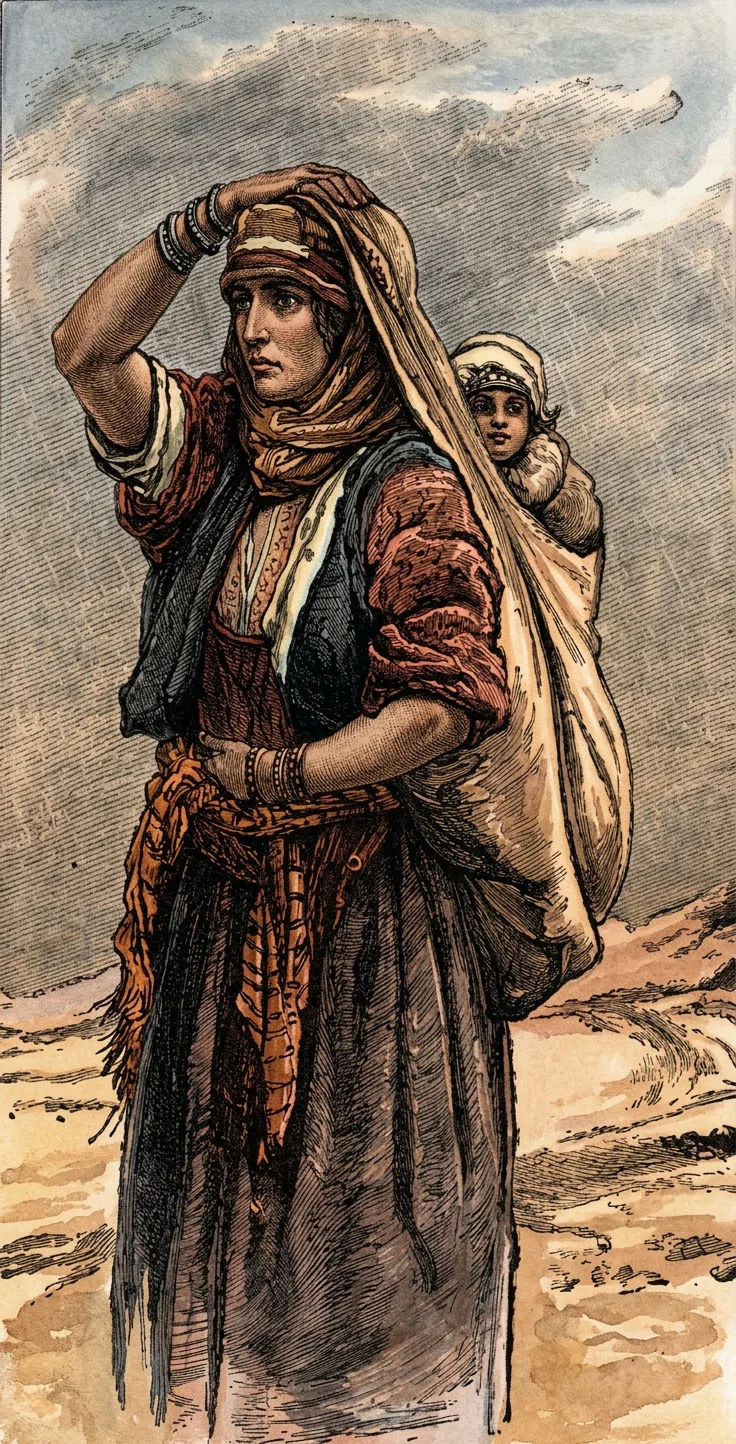
ARABIAN WOMAN AND CHILD.
Protestant missions are carried on in Asia Minor and Armenia chiefly among the Armenians by the American Board of Foreign Missions.
In Arabia are some small Protestant missions. At Aden is the mission of the Scotch Presbyterian Church; at Kerak and Muscat, the missions of the English Church Missionary Society; at Busrah, Bahrein, and Muscat, the missions of the American Dutch Reformed Church.
In Syria and Palestine are missions of the English Church Missionary Society, Free Church of Scotland, Friends, American Presbyterian Church, American Reformed Presbyterian Church.
A missionary in Arabia writes that in Arabia there are less difficulties in the way in reaching the Mohammedans than elsewhere. He also says: “Arabia is the home of the Mohammedan religion. While there are nearly 200,000,000 Mohammedans scattered over the world, they all turn their faces in prayer toward Mecca, and hope to make at least one pilgrimage thither. This shows what a strategic point Arabia is for missionary work. The fall of Mohammedanism in Arabia means the fall of Mohammedanism in the world. Once convert a Mohammedan, and he is likely to prove a good missionary of Christ, as he has been of Mohammed. He is naturally religious, naturally generous, and naturally a wanderer—three great missionary qualities.”—Gospel in All Lands.