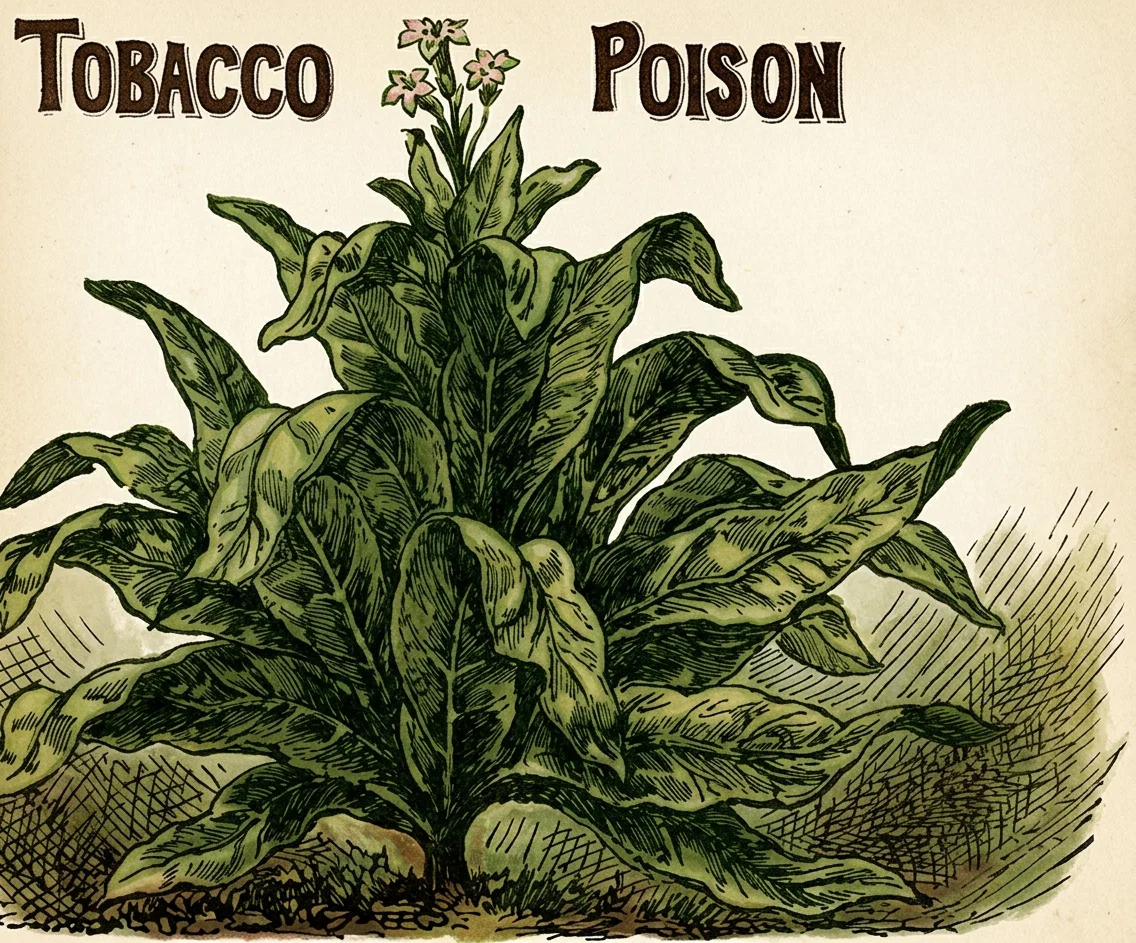
Chemists, botanists, and physicians unite in pronouncing tobacco one of the most deadly poisons known. No other poison, with the exception of prussic acid, will cause death so quickly, only three or four minutes being required for a fatal dose to produce its full effect. It is botanically known as nicotiana tabacum, and belongs to a class of plants known as the solanaceae, which includes the most poisonous of all species of plants, among which are henbane and belladonna. There are more than forty different varieties of the plant, all of which possess the same general properties, tho varying in the degree of poisonous character.
Nicotine.—The active principle of tobacco, that is, that to which its narcotic and poisonous properties are due, is nicotine, a heavy, oily substance, which may be separated from the dried leaf of the plant by distillation or infusion. The proportion of nicotine varies from two to eight per cent., Kentucky and Virginia tobacco usually containing six or seven per cent. A pound of tobacco contains, on an average, three hundred and eighty grains of this deadly poison, of which one-tenth of a grain will kill a dog in ten minutes. A case is on record in which a man was killed in thirty seconds by this poison.
A Pound of Tobacco Will Kill Three Hundred Men.—The poison contained in a single pound of tobacco is sufficient to kill three hundred men, if taken in such a way as to secure its full effect. A single cigar contains poison enough to extinguish two human lives, if taken at once.
Hottentots use the oil of tobacco to kill snakes, a single minute drop causing death as quickly as a lightning stroke. It is much used by gardeners and keepers of greenhouses to destroy grubs and noxious insects.
A number of instances are recorded in which death has been produced by applying a little of the oil from the stem or bowl of an old pipe, to a sore upon the head or face of a small child.
Poisoning through the Skin.—The poison of tobacco is so potent and violent in its action that even the external application of the moist leaves to the skin is sufficient to produce most serious symptoms. If a cigar be unrolled, and the leaves composing it be applied over the stomach, great nausea will be produced in a very short time. This method has been used to induce vomiting. Cowardly soldiers have been known to place tobacco leaves under their arms just before going to battle, for the purpose of producing sickness.
Some years ago a man was detected in an attempt to smuggle a quantity of tobacco by placing the leaves next to his skin. The nearly fatal symptoms which followed, led to the discovery of the smuggler.
Deadly Vapor.—If tobacco is poisonous when applied to the skin, it is doubly so when inhaled. The smoke of tobacco contains, in addition to nicotine, several other poisons, the chief of which are pyridine, picoline, sulphuretted hydrogen, carbon dioxide, carbonous oxide, and prussic acid, all of which are fatal poisons when received into the system in any other than the most minute quantities. Thus it is not to nicotine alone that the evil effects of smoking are due, but to all of these poisons combined.
Birds, frogs, and other small animals die when exposed to the fumes of tobacco in a confined space. Cheese-mites, bees, and other insects may be quickly killed by directing upon them a stream of tobacco smoke from an ordinary pipe.
Poisoning through the Lungs.—Inhalation is the most speedy way of getting any volatile poison into the system. The reason of this is obvious when the fact is made known that the lungs present a mucous surface fourteen hundred square feet in extent, every inch of which is in the highest degree capable of absorbing gaseous substances brought in contact with it. This membrane is of the most marvelously delicate character, being of such exceeding thinness that it forms scarcely any obstacle to the passage of gases which enter the lungs by respiration. Just underneath this delicate membrane passes all the blood in the body, or an amount equivalent to the whole quantity of the blood, once every three minutes. The vapory poison inhaled by the tobacco smoker is not simply taken into the mouth and then expelled, but it penetrates to the remotest air-cells, and spreads itself out over the whole of the immense extent of membrane stated. Thus it is plain that the blood of the smoker is literally bathed in the narcotic fumes drawn from his pipe or cigar.
So readily does the system receive the poison of tobacco in this way, that it has repeatedly been observed as a fact that persons who are engaged in the manufacture of cigars often suffer much from the characteristic effects of nicotine poisoning, even when not using the weed.
When tobacco is applied to the mucous membrane, as in chewing and snuff-taking, its poisonous elements are absorbed in essentially the same manner as when it is applied to the skin, but much more rapidly. In chewing, considerable quantities are also absorbed through the stomach, being swallowed with the saliva.
The giddiness, nausea, and deathly sickness which follow the first attempt to use the drug, are indubitable evidence of the poisonous character of tobacco, which evidence is confirmed by the difficulty, in many cases very great, experienced in becoming addicted to its use. In severe cases of poisoning, violent vomiting and purging, vertigo, deathly pallor, dilatation of the pupil, a staggering gait, disturbed action of the heart, interference with respiration, and, in extreme cases, insensibility and syncope, are commonly observed. Only a very small quantity is necessary to produce these symptoms in a person not accustomed to its use; but in persons who have habituated their systems to the poison, a much larger quantity is required.
Persons not accustomed to the use of tobacco often show symptoms of poisoning from taking a very small quantity of the drug, as by inhaling its fumes in a smoking-car or a barroom. Infants are often sickened by inhaling the air of a sitting-room which is poisoned by a smoking father.
The fact is established beyond the possibility of successful controversy, that tobacco is a poison, deadly in large doses, pernicious and harmful in all doses. It taints the breath, ruins the digestion, obliterates taste and smell, spoils the blood, oppresses the brain, depresses the heart, irritates the nerves, wastes the muscles, obstructs the liver, dims the vision, stains the skin, and deteriorates and contaminates every organ and tissue with which it comes in contact in the body. Its influence is to lessen vitality, to benumb the sensibilities, to shorten life, to kill.