Dr. O. G. Place and wife, who went last winter to India to engage in medical missionary work, passed through Italy on their journey. We give here a letter from Mrs. Place, published in the New York Indicator, which is both interesting and instructive:—
“Naples, Italy, Jan. 12, 1897.
“We arrived at Naples last evening, after a five hours’ run from Rome. Italy is not all sunshine. We have been waiting two days to visit Vesuvius, but thus far it has been too cloudy and rainy for us to start out. I am not very desirous of taking the trip to the top, but the doctor is quite anxious to go. I should about as soon view the scene from the distance, and watch the old crater smoke his pipe, as to climb up his cheek and peep into his mouth. It is one thing to read about volcanoes, but quite another to see their awful grandeur with our own eyes.
“Sunday we visited Pompeii. The reality here is also much grander than the pictures. We went first to the museum, where we saw petrified bodies of men and women, some of them almost perfect, who 1,800 years ago were buried here in the awful avalanche of burning lava from Vesuvius. The bodies are placed in glass cases on tables down the center of the room. Some of these bodies show the agony of fright, and are in heart-rending attitudes as they were when they were suffocated in their great houses. Several had evidently thrown themselves upon the floor, with the forehead resting on the back of the hand, to keep the sand and ashes out of their faces. Little did they know what an avalanche that was, or that eighteen centuries would pass, and then men and women would gaze upon their petrified forms.
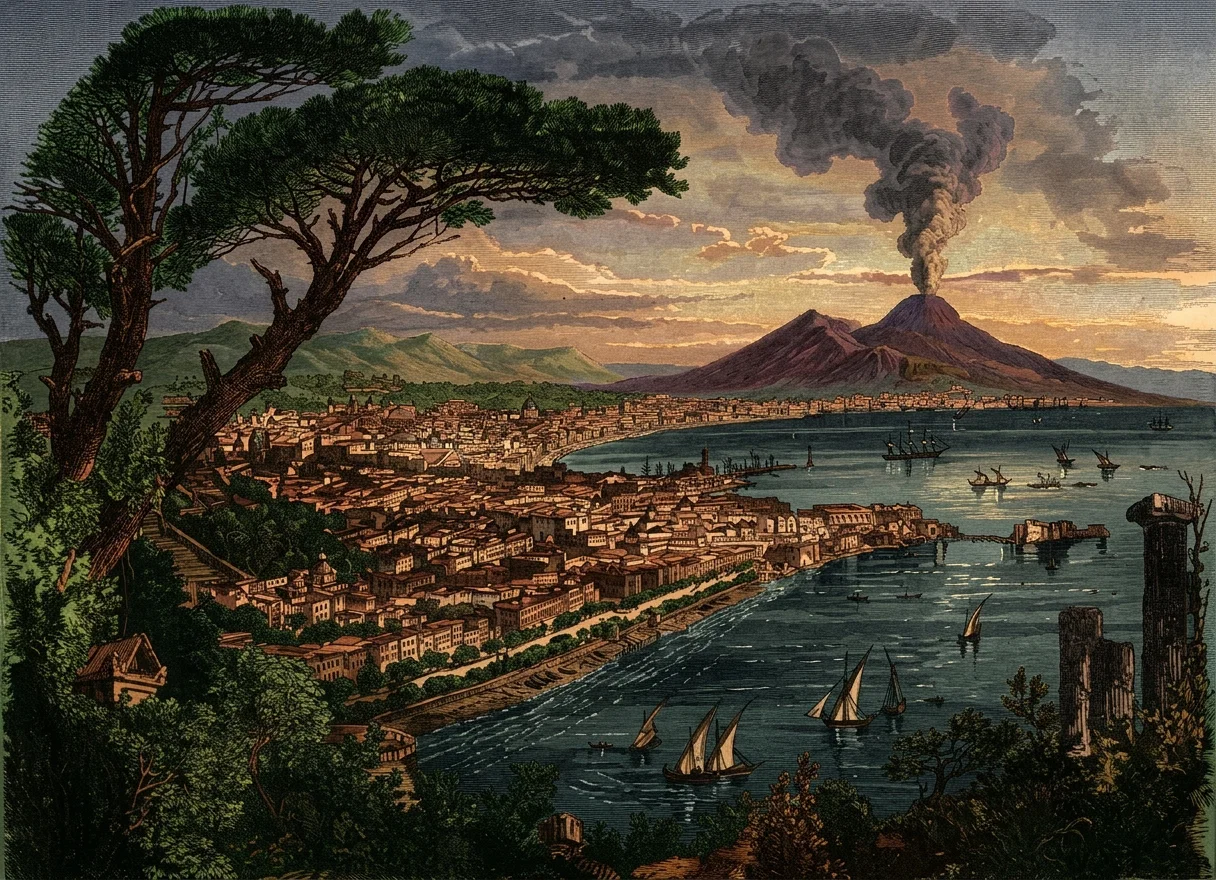
THE CITY AND BAY OF NAPLES; MOUNT VESUVIUS IN THE DISTANCE.
“It was fascinating to walk about the streets of this exhumed city, and turn aside into houses and rooms, the walls of which in many instances were as intact as 1,800 years ago. In some places these walls are only two or three feet high, and in other places they rise over one story high. The streets are very narrow and paved with lava. In some places we could see the ruts made evidently by the wheels. Along each side of the street is a single foot-path, elevated a foot or two above the level of the street, and two or three stepping-stones occasionally for crossings. The rooms of the houses are nearly all very small, but were evidently richly decorated with paintings. Nearly all the statuary and the finest paintings have been removed to the city museum; but one large house is left just as it was found, but covered with a roof and kept under lock and key, and supplied with gates in the doorways so none but officials can enter. But slight restoration has been made in this house. They have planted flowers and shrubbery in the garden, which is an enclosure in the middle of the house. A broken marble table has been pieced together, and other little touches of like nature here and there.
“Here in the ‘Women’s Department, is a petrified body, on an elevated bank of earth, where probably was a bed, and in another room several skeletons lie in the loose dirt. In the garden of this house are two fountains, and several pieces of statuary, and in the kitchen we saw the old brass and bronze utensils.
“We visited the old temples, Forum, and theaters, and they seem so real and wonderful. I would have gladly spent more time there.
“At 7:45, January 13, we left Naples by train for Brindisi [pronounced Brin’de-ze]. Coming out past old Pompeii, we had one more view of the grand old ruins, then on close by the base of Vesuvius, descending the range through miles of tunnels, whizzing out into the light for a little glimpse of beauty and again back into the darkness. Our trip to Brindisi was pleasant, where we arrived at 18:10 (or ten minutes past eighteen o’clock). This is the way the Italian guide-books reckon time, from midnight to midnight, instead of A. M. and P. M.; 18:10 therefore would be to us 6:10 P. M.
“Brindisi is a small place, and the principal business is at the docks; but we must wait here four days for our boat to take us to Port Said, Egypt.”
The doctor adds a note concerning the customs of the people of Naples and vicinity, as follows:—
“Speaking of the customs of the people, we will note that women work like men, and men about the same. Boys smoke, and girls knit and sell trinkets. In the lower town one can not imagine the awfulness of the filth. There is a perfect medley of poor donkeys, cripples, goats, fish, priests, more filth and creeping things, in the hair, on the body, and almost everywhere. Street scenes are common which would not be right to speak of before decent people. It is indeed a sad picture. I am not at all a believer in Darwinism; but if he had turned his argument the other way around, and endeavored to prove that men created in the image of God were degenerating themselves to the level or below, of the dog, ape, etc., he could have demonstrated his theory in even street scenes in some of these Italian cities, and I could have agreed with him. These scenes constitute a very black daub on the fancy pictures of the temporal millennium.
“Among the poorer classes the women and children mostly go barefooted. Some wear toe sandals, but no stockings. It is very important not to go to a baker or a meat shop, for it has a depressing effect upon the action of the salivary glands when one comes to eat. It is astonishing, this influence of mind over matter, and perhaps especially in this warm climate.
“The teams consist of anything that can draw. We have seen oxen, dogs, cows, donkeys, mules, men, women, and children acting the part of teams. The mules and donkeys, however, seem to predominate. Once in a while we saw a horse. These are all driven without any bits.
“I must tell you about the milkmen. In all southern Italy the cows are driven through the streets from house to house with their calves following, that the people can know by the age of the calf how long the cow has been milked. Any one who wants milk comes out with a goblet, cup, jar, or bottle, and the milkman milks the amount wanted, and then goes on to the next house. This same practice is followed with the goats, except the kids do not go with the goats through the streets.”