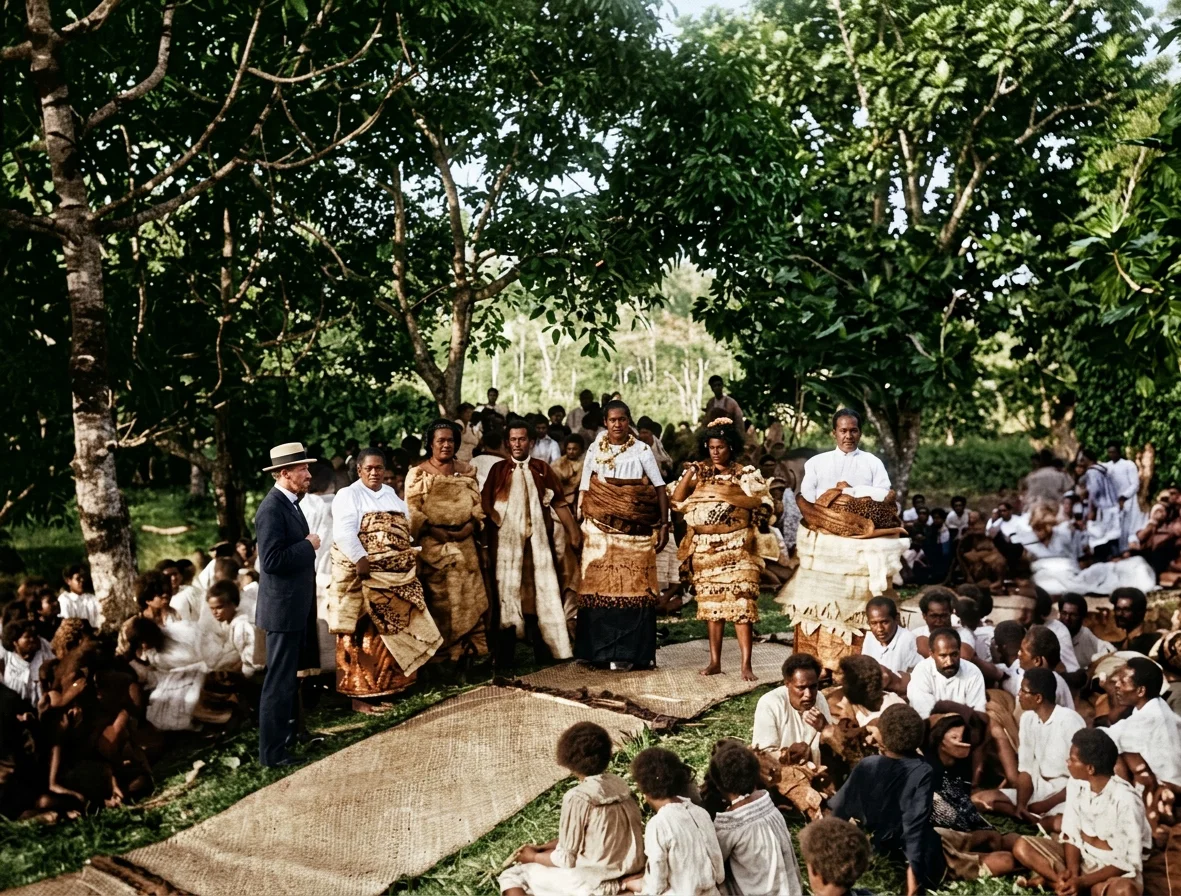
Among the many great royal weddings of modern times not the least by far, if not the most magnificent, was that of Princess Adi-vuikaba, the daughter of Ratu Timcoe, king of Fiji, and granddaughter of the once famous King Cakambou (pronounced Thakambough), who for many years was the great enemy of Christianity during the work of the early missionaries in Fiji.
The marriage took place at Rewa, the largest native town in the Fiji group, and about ten miles distant from Suva, the capital. The bridegroom is Tui Sawau, Roko Tui Rewa. Roko Tui is an official title meaning high sheriff, which is the position next to the king in authority. The actual power of a person possessing that title depends much upon his own ability. If he is a simpleton, all the disagreeable work will be given him to do, and but little of the honor and profits of his office. If he be active and prudent, his power and honor will be equal to the king himself. Tui Sawau was educated in Sydney, Australia, is a fluent speaker in English, and has great influence among his own people.
The bride has very little, if any, knowledge of English; but she is bright and amiable, and has an excellent voice for singing.
Since the beginning of this year the preparations for the wedding have been in progress. As the process for making native cloth is such a slow and tedious one, and such immense quantities were needed for the wedding, it was necessary that the preparations should be thus early begun.
The wedding was to be on Wednesday, July 29, and the invited guests began to arrive the week before, there being representatives present from nearly all parts of the group. The day previous to the wedding five thousand had arrived, which number increased to fully six thousand by the next day. More than fifty native yachts lay at anchor in the river Rewa, upon whose banks the town is built.
The people of Rewa were expected to make provision for the reception of visitors, and in order to do this they constructed a large native house about two hundred feet long, by thirty feet wide, without any partitions. Other smaller houses were used for the same purpose, and they too were filled to overflowing.
As would be supposed, the wants of such a vast multitude would require no small attention; accordingly a monster feast was prepared.10Among the flesh meats provided were some six hundred pigs and three hundred turtles. There were yams and taro innumerable, while all other Fijian delicacies were served in abundance. Yagona, a choice drink of the natives, was served ad lib. It is made from the root of the kava tree, and is prepared in the following manner:—
A group of native young men or young women sit on the ground in a circle, with a large wooden bowl in the center, and a plentiful supply of kava root at hand, which they each chew vigorously until it is reduced to a soft pulp, when they spit it into the bowl. When a sufficient quantity is chewed, they mix it thoroughly with water, and strain out the pulp by passing through it a sieve-like leaf. Some one of the chewers then fills a cup with the beverage and offers it to the visitors. If one does not take a drink, they feel highly insulted, after they have taken the pains to prepare it. The drinking of this yagona produces a peculiar effect upon a person. Unlike alcohol, it affects the legs instead of the head, rendering the limbs useless for a time.
The enormous quantity of food consumed at this feast can scarcely be estimated. To give a slight idea, it may be mentioned that for one evening meal a trench was dug 200 feet long, 2 feet wide and 4 feet deep, and this was filled to the brim with taro (a vegetable that resembles the potato), while along the top were laid, cross-wise, roasted pigs. Most of the people were present four or five days, and meals larger than this were served in the morning and at noon, so the amount of food consumed and wasted must have been immense.
The mekes, or native dances, commenced the day before the wedding. The parties from the various towns performed in turn on the rara, which is a large open space in the center of a native town. Some of the performances were considered very good. The dancing and feasting were continued until morning, when fresh relays arrived.
On the morning of the wedding day the presents began to pour in. There were native mats by the hundreds, and thousands of yards of tappa (a kind of cloth made by the natives from the bark of the malo tree, and painted in different designs with ink). The natives of Vatu Lele presented some 2,000 bunches of bananas, the bunches varying in weight from 20 to 40 pounds. To make their present as imposing as possible they raised a scaffold 60 feet high in the air, which they decorated with gay tappa streamers, and covered it with bananas, making a very pretty show.
During the day, the uncle of the bride, Ratu Epeli, the greatest living chieftain of the Fijians, held a grand reception, at which he presented each visitor with a fan.
As it was impossible for the marriage ceremony to be held in the church (Wesleyan), as so few would be able to witness it, a framework was quickly erected outside and covered over with mats, forming a very pretty edifice. Seats were provided for the European visitors, of whom there were a large number present, while six of them used cameras at pleasure. The rara was crowded by the different tribes, all sitting on the ground. The floor of the structure was covered with mats and some beautiful tappa, while mats were laid on the ground from it to the residences of the bride and bridegroom, respectively.
About 4:30 P.M. Ratu Epeli left his house, followed by the bride and bridegroom, who were accompanied by a retinue of attendants of both sexes, fanning them and making themselves otherwise useful. Ratu Epeli and the bridegroom wore immense sulas of tappa. (A sulu is the native dress, and extends from the waist to the knees.) The sulu of the bride was made of very beautiful mats, very finely woven, over which was worn a silk pinafore. Both parties seemed quite nervous, especially the bride.
The wedding ceremony was conducted by three Wesleyan clergymen, missionaries to Fiji. The students from the Wesleyan school were present, who rendered some excellent singing for the occasion. The ceremony being over, the newly-married couple proceeded to the house of Ratu Epeli. They then returned to the scene of the marriage, and from there they left for their future residence at the other end of the village.
The dancing was then resumed, and continued without abatement until the evening of the next day, when the guests began to take their departure.
The white people were highly pleased to have the privilege of being present on such an important occasion, as it may be years before another wedding of such magnitude occurs.