Reader, does it ever occur to you that the tender beefsteak or juicy mutton-chop which you so much relish for breakfast may be less wholesome and nourishing than you have supposed it to be? In Bible times, and indeed among most nations at the present day, bread was the staff of life; but the average American evidently believes that beef or flesh food of some kind is the chief means by which strength is to be replenished. The error of this opinion is shown by the fact that millions of human beings are practically vegetarians, and yet enjoy most excellent health; and the additional fact that the strongest and the longest-lived of all members of the animal kingdom are not flesh eaters. The object of this article is not, however, to argue the question whether the use of flesh food is harmful or unnecessary, but to call attention to the fact that much of the flesh food consumed is either in a diseased state or liable to be diseased.
All of the domestic animals which are used as food are liable to diseases, many of which are similar to those from which human beings suffer. Consumption, or tuberculosis, scrofula, rheumatism, typhoid and malarial fevers, smallpox, scarlet fever, pleuro-pneumonia, influenza, carbuncle and jaundice, are a few of the diseases to which food-animals are liable, to say nothing of such functional disorders as torpid livers, dyspepsia, and deficient or disturbed secretions. Besides these diseases, there are those terrible maladies, tapeworm and trichinosis, which are known to arise from the use of diseased flesh, and from this cause only. These disorders are known to be exceedingly prevalent among cattle and hogs, and increasingly so.
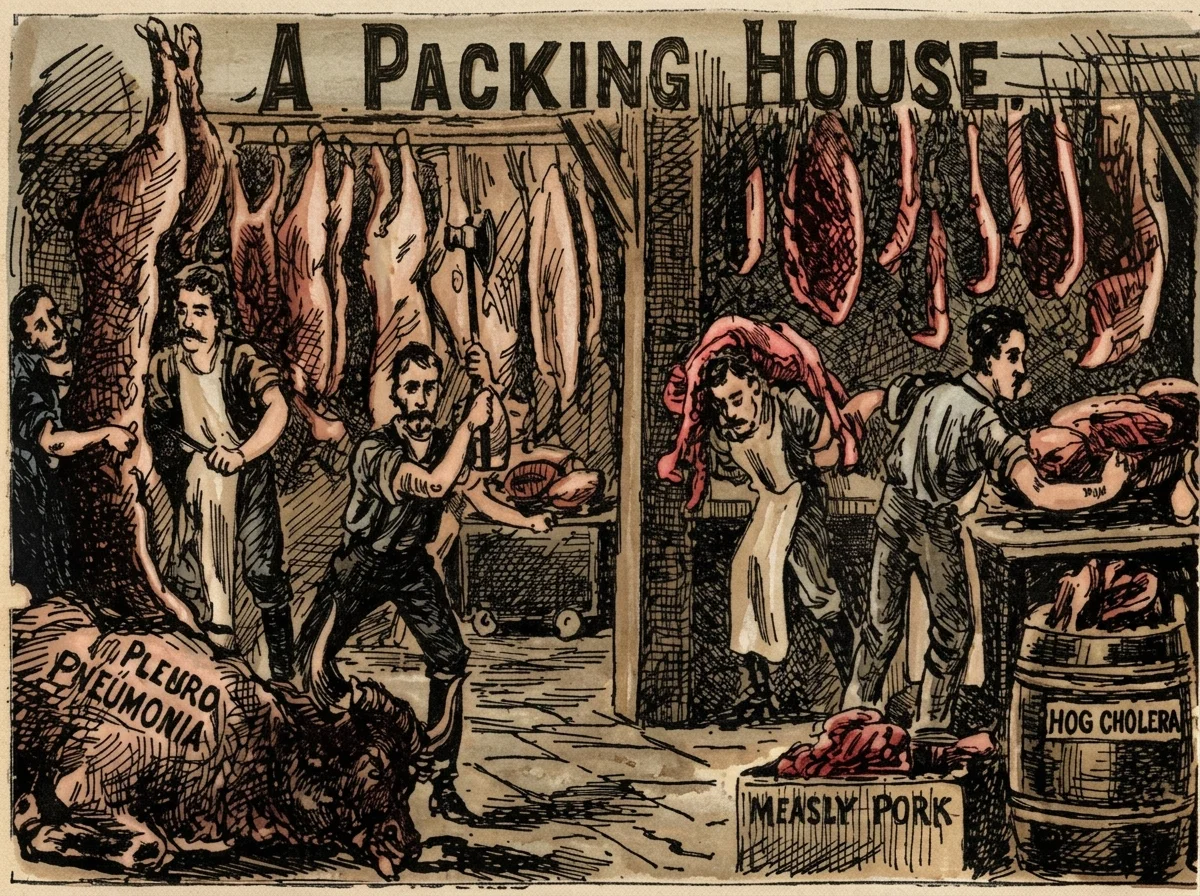
Reader, do you feel no uneasiness on this subject? Then come with us for a visit to a packing-house in some large western city, where thousands of animals—cattle, sheep and hogs—are daily slaughtered and prepared for market. We will not undertake to study the whole immense business in all its details, but will just glance about here and there and note what we may see that has a bearing on the question which we are considering. Perhaps the first thing we note is a long inclined plane up which is being driven in single file, a long line of hogs, fat, unwieldy and blear-eyed. Most of them look as tho they were not enjoying the best of health, and a few appear to be positively sick. There is one that is evidently scarcely able to walk. He totters slowly along, and at last falls in the middle of the procession. If he had held out to the other end, he would have been seized by the legs, swung up, his throat cut, and in a twinkling he would have been in the course of preparation for the pork barrel. Now he is doomed to go to the rendering establishment, where he will be thrown into a great cauldron, and stewed up with a lot of other sick hogs, for a few hours, after which a great part of him will appear in the shape of first-class steam-refined lard.
There is no question that vast numbers of hogs sick with hog cholera, and other diseases to which the animal is subject, find their way in one form or another into the stomachs of the people. If the sick porker had been able to reach the top of the inclined plane, he would have been eaten without so much circumlocution; and if his consumer had died of some mysterious disease, it would probably have been charged to Providence or the weather instead of the pig or the packer. Unquestionably, thousands of deaths of this sort do occur every year, the real cause of which is seldom suspected. A few years ago a family in Michigan was made sick by the use of steam-refined lard. A portion of the lard was sent to an eminent microscopist, who reported that he found in the lard the germs of hog cholera, which certainly was sufficient explanation of the sickness.
Let us take a look at the dressed carcasses which are lying about in scores. Here is one, the flesh of which is of a dark purple color. The color signifies that the animal was suffering with an acute fever when it was killed. Will this flesh be likely to make pure blood and healthy tissues?
Here is another which has a pale pink color. What does this signify?—Simply that the butcher got the start by a month or two of a consumption, which was preying upon the animal’s vitality. If we had seen its lungs, we should have found them studded with tubercles. It is more than likely that those who eat the flesh of this animal will consume some millions of tubercles in so doing; and it is possible that some of them who happen to take their steaks a little rare10will contract the disease. It is very probable that this is one of the most common sources of the rapid increase in prevalence of this greatest of all the scourges of civilization. According to the most reliable statistics, it appears that about one-fifth of all who die fall victims to this most incurable of maladies. Here is one source of infection with the disease which it would be wise to avoid.
That carcass over there which has a golden yellow cast was from an animal which had jaundice. The flesh is stained with bile; and yet some one will eat it with no thought of the horrible grossness which he is consuming.
Suppose we take a closer view of some of the fine rounds and roasts which are going to be served up on somebody’s table before a week has passed. Here is a piece of splendid-looking meat, which would be quite likely to make a carnivorous man’s mouth water for a liberal slice of it. Let us cut off a bit and put it under a pocket microscope which we happen to have with us. You notice some little white specks scattered here and there. Do you ask what they are?—These are small cysts. In each one of them is curled up a little tapeworm. When the flesh is eaten, the sac will be dissolved by the gastric juice, and the little worm will be liberated. It will soon fasten itself by a pair of minute booklets to the side of the intestine, and will begin to grow, feeding upon the digested food which ought to nourish the host who furnishes him a lodging. Our worm may go on growing until it reaches a length of fifty or a hundred feet, or even more. The careful study of tapeworms which has been made within the past few years has developed the fact that in nearly all cases in which persons become infected by these loathsome parasites they have been obtained from beef or veal.
According to the report of an expert who investigated the matter in the state of Indiana, about one in ten of all hogs are infested with trichinae. When this infected pork is eaten, as most of it undoubtedly is, it is likely to give rise to a disease known as trichinosis, one-half the cases of which prove fatal.
It has been ascertained in England that the use of the flesh of animals which have died of pleuro-pneumonia is a cause of a malignant and very deadly form of disease known as malignant carbuncle. Dr. Livingstone observed the same thing in South Africa.
It has been asserted by a most eminent authority on this subject, Professor Gamgee, that one-fifth of all the meat sold in the markets is from diseased animals.