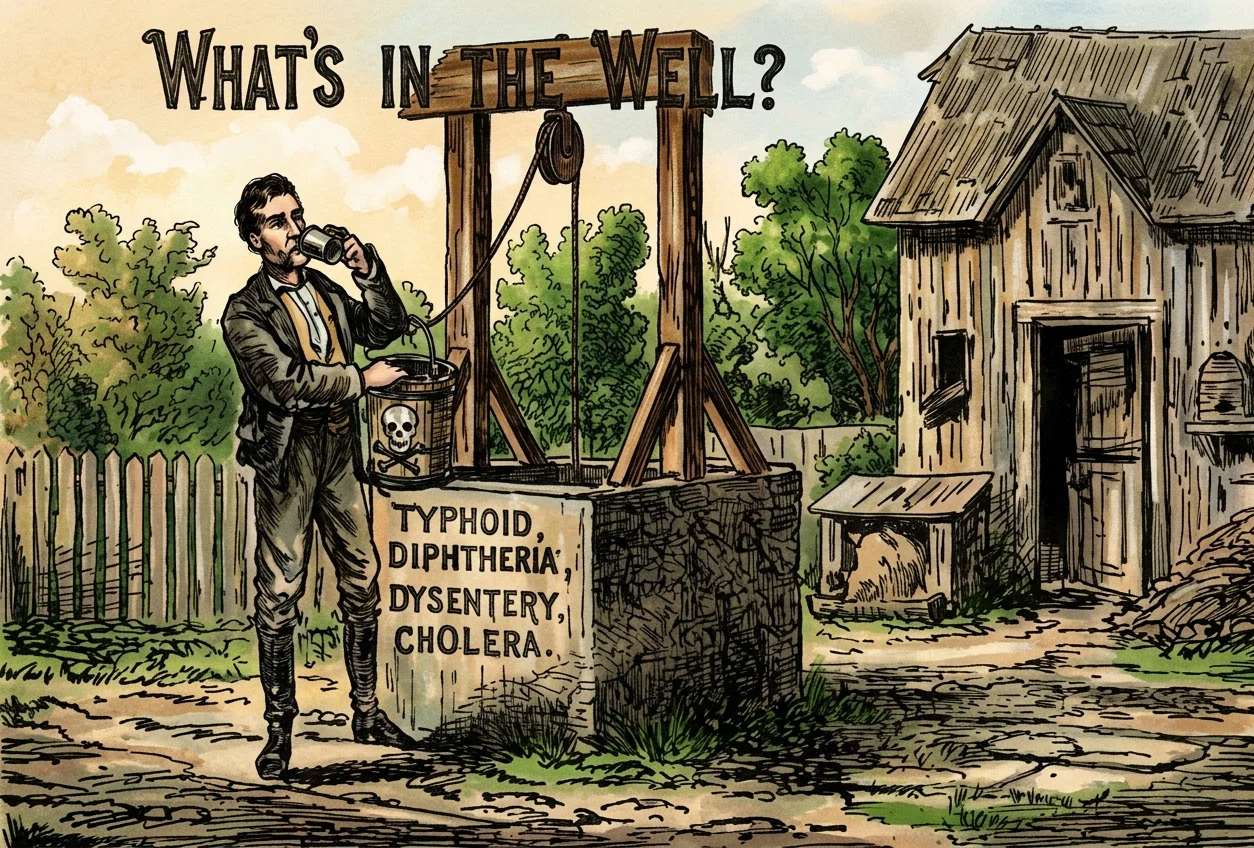
What's in the Well?

6%

Pacific Press Publishing Company · Oakland, California · Jul 16, 1896

FromSigns of the Times, Vol. 22, No. 28.

Read the full edition

What's in the Well?

WHAT'S IN THE WELL?
WHAT'S IN THE WELL?
BY J. H. KELLOGG, M.D.
Water, to be sure, but there may be something more. Perhaps, like a silver mine in Nevada, it has “millions in it”—millions of filth, of germs, of suffering, and possibly death. It will be well worth while to look into the well and see what there is in it that should not be there.
Every one ought to know that the “old oaken bucket,” or the most improved modern means of hoisting water, may bring from the cool depths of the well the invisible but deadly causes of fatal illness; and that the same draught which brings refreshment to the thirsty laborer and cools his parched tongue, may introduce into his system seeds of disease and death. But how do these dangerous things get into the well? Let us see.
The well, for convenience, is located in the back yard, perhaps a rod away from the house, or it may be even nearer by. There are some other things beside the well which for convenience are grouped close about the back door. Here is a cesspool at a little distance, perhaps only a few feet from the well; and there is a vault, a filthy institution which is an open disgrace to civilization. A little farther away is the garbage heap. In other locations are the chicken coop, the pig-pen, and stable, with their accumulations of decomposing filth. It may be that in a remote corner a dead animal has been buried to save the trouble of conveying it to a distance. A damp and reeking spot near the back door marks the place where the house slops have been deposited since the drain to the cesspool became stopped up with the accumulated filth of a half dozen years.
Each one of the sources of filth mentioned, is a contributor to the well. What becomes of the slops which are deposited upon the ground?—A portion evaporates, but the greater part soaks into the ground. Many persons imagine that what goes into the ground is destroyed. Certainly this is a mistake. The filth which has disappeared from the surface is out of sight, but not out of existence. It is present in the soil, and even more active for evil than if it were still upon the surface. The water which we derive from our wells comes from the soil. If the soil is filled with filth, the water will necessarily be contaminated. Whatever filth is deposited upon the surface in the vicinity of a well, may sooner or later find its way into the well. Every rain washes it a little deeper down, until it reaches the well itself or the underground veins of water by which it is fed.
Scientific investigations have shown that typhoid fever, cholera, diphtheria, and possibly malaria and a number of other diseases, may make their entrance into the system in this way. Indeed, as regards the two first-named maladies, it is known that drinking water is almost the sole means of communication. So it is perfectly safe to say that if one will take care to see that his drinking water is always pure, he will escape death from either typhoid fever or cholera. And it is also evident that if one suffers from either of the diseases named, it is because he or some other person has been guilty of neglecting to protect his drinking water from contamination. The late Dr. Parkes, of England, once remarked, “When a man dies of typhoid fever, some one ought to be hanged.” Certainly some one ought to be educated, and to do this is the object of this tract.
Cesspools, vaults, and other sources of filth, have no business within many rods of a well; but the probability of something of this sort being placed near to any well is so strong that it is much the safer way to make the well in such a manner that it will be practically safe from contamination from sources of this kind under any circumstances. This may be accomplished by making what is commonly termed a bored or driven well. An iron pipe is driven into the ground until water is reached. This will prevent the surface water from getting into the well, and if the pipe is carried down until the “second water” is reached, so that it penetrates some distance of dense rock or clay, the protection may be considered as practically perfect.
Every housekeeper should know how to tell bad water from good, which is not always very easy to do, at least not unless one has some instructions in methods. The following rules for the examination of water are so simple that they may be followed by any person of intelligence, and they will be found to be sufficiently reliable to answer a very useful purpose:—
How to Examine Water.—Only a skilful chemist can make a perfectly accurate and reliable examination of water; but the following suggestions will enable any intelligent person to make such an examination of drinking water as will greatly diminish the chances of injury from this potent source of disease:—
1. Notice the color of the water. Pure water has no color, is free from sediment, and does not contain suspended or floating specks or particles.
2. Observe the odor. Pure water is absolutely free from odor. Water which has a distinct odor is to be suspected.
3. Notice also the taste. Pure water is free from flavor.
Remember good water is colorless, odorless, tasteless.
If you wish to test the water further—and it is necessary to do so to be even reasonably sure that it is pure, as some waters which are free from color, taste, or odor, are still very impure—take a few ounces of the water, place it in a clean bottle, add a small lump of white sugar, and put it in a warm place for a few days. If the slightest turbidity appears within a week or two, the water is unsafe to use.
Here is another test: Get at a drug store a solution consisting of three grains of permanganate of potash, twelve grains of caustic potash, and an ounce of distilled water. This is a test solution by means of which organic impurities may be detected. Put some of the water to be tested in a clean glass. Add a drop of the purple test solution to the glassful of water. It will produce a faint pinkish tinge. If the water is pure, the pink color will remain; if the water is impure, the color will disappear. If the color disappears within half an hour, the water is unfit to drink. The more impure the water is, the sooner the color will disappear.
The danger of using water which is suspected of being impure, is greatly lessened by boiling. Filters may be relied upon for removing suspended particles and for removing the unpleasant flavor of rain waters; but a really dangerous water is not rendered safe by filtering in the ordinary manner.