THE BIBLE IN JAPAN

4%

Pacific Press Publishing Company · Oakland, California · Jul 9, 1896

FromSigns of the Times, Vol. 22, No. 27.

Read the full edition

THE BIBLE IN JAPAN.

BY REV. H. LOOMIS.
ONE of the encouraging and suggestive things at the present time is the possession of the Bible on the part of so many of the Japanese in high places, and with many of them it has evidently been a treasured book.
When on my way to Korea last fall, I was on the same steamer that carried the Japanese consul to Chemulpo. He had spent several years in the United States, and spoke English very fluently.
I asked him about Christianity, and he told me that he had never made a profession of religion, but he used to attend church in New York, and he had a prayer-book that he read every day and enjoyed very much. He accepted with evident pleasure a copy of the New Testament, and asked for another copy for one of his servants.
When I called upon the chief of police in Yokohama, he told me that he had a Bible that he had studied secretly. He said that its teachings were good, and if they were followed it would lessen his work very much.
The governor of Yokohama told me that he had a Bible, and spoke in favorable terms of our work. Count Inouye also said to me a few days ago that he had both an English and a Japanese copy.
Having found the authorities in Tokyo favorable to the distribution of Scriptures among the policemen, I ventured to call upon the head of the police department in Yokohama in order to ascertain if the same opportunity would be given here. He listened to my request with evident satisfaction, and said that he would not only grant the privilege, but fully approved of the project.
Then he added that the prostitutes of this city and the region round about were under his supervision, and he would have distributed among them any copies of the Scriptures or other religious books that I might be able to supply. He said that such reading matter would be especially useful to those who were in the hospital that were devoted especially to that class. He reported that in Yokohama there were upward of two thousand prostitutes, and the average number in the hospital was about one hundred and thirty.
When asked if Christian workers would be allowed to visit the hospitals, he replied that as the diseases were considered contagious no one except the physicians and attendants was permitted to go among them. This, he said, was the standing regulation, but he was evidently dissatisfied that such was the case.
When I called to deliver the books, he said, with evident pleasure and satisfaction, that he had consulted with the governor in regard to the matter, and that the governor had given his cordial approval.
The question was then asked if the regulation regarding the visitation of the hospital by Christian workers could not be changed. He replied that a new building was now in process of erection, and in it would be a special apartment where the patients could be gathered for religious instruction.
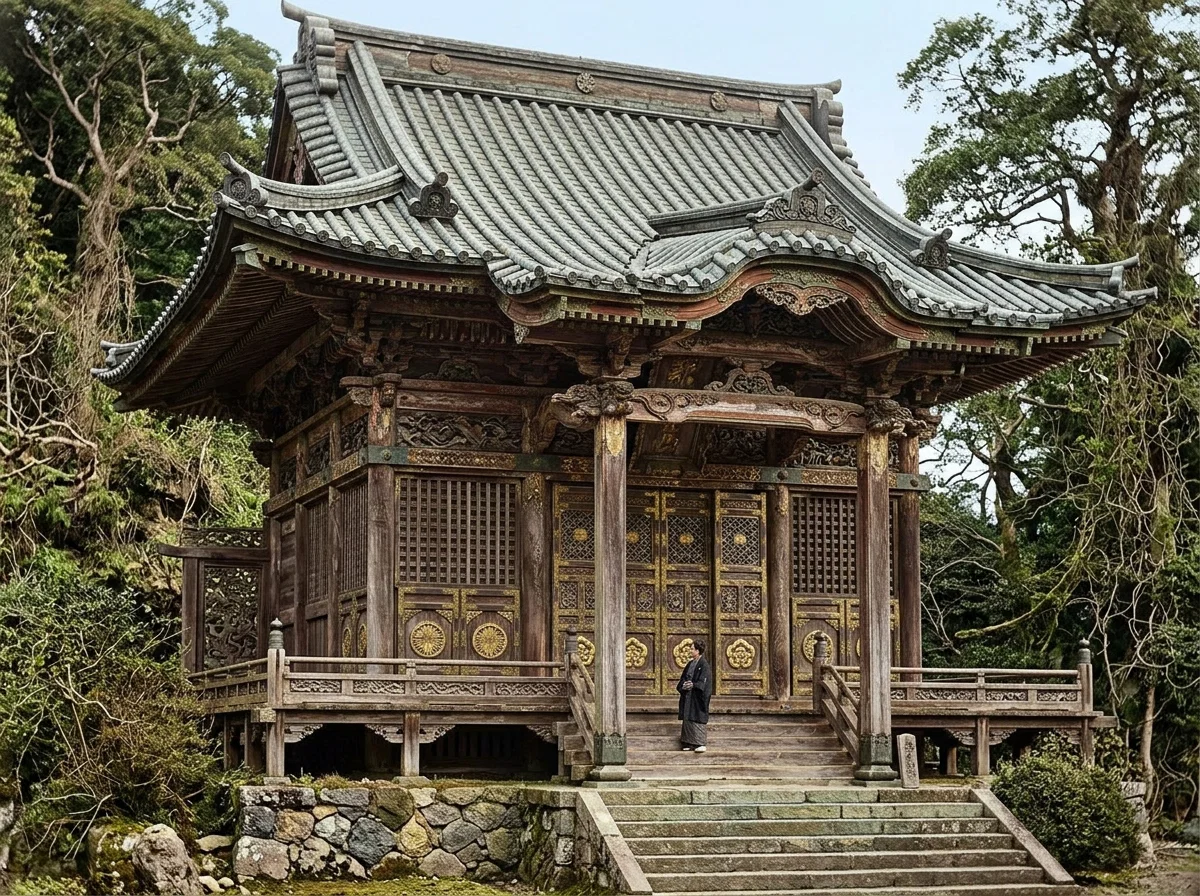
BUDDHIST TEMPLE.
BUDDHIST TEMPLE.
After this experience in Yokohama, it seemed advisable to try what could be done among the fallen class in Tokyo.
The chief of police there was equally ready to grant my request, and instructed one of the subordinates to make out a letter to each one of the local heads of the police, giving instructions that freedom to distribute the Scriptures and other books was to be given, as well as the privilege of visiting the hospitals for the purpose of Christian teaching.
Two sections of the city have been visited, and the authorities have shown entire willingness to give all liberty that is desired. The only lack now is the number of persons who are qualified to undertake such a work, and who have the time to devote to it. It is thus far only an experiment, and in this connection it is an important fact that the fallen women in Japan are never found to occupy so low a position as in other and Christian countries. This class of people “are not despised but pitied by the better classes of society, and indeed it is known that they are pursuing their degraded avocation from no fault of their own, but at the will of their parents or nearest relatives, who have for the most part sold them in early years to the proprietors of houses of public resort” (Dr. Rein), where they are trained up for this purpose.
What may come of this effort we can not tell, but as the Lord has apparently opened this door, it seems an indication that here is a new and needy field, where the Gospel should be proclaimed, and if no souls are saved, the responsibility will not rest upon those who make the effort.
When we remember that it was one of the same class who washed our Saviour’s feet, and wiped them with the hair of her head; and to one brought before him, that he might add to her grief and shame, he said, more in pity than in condemnation, “Go, and sin no more;” and that harlots are the class who shall go into heaven before the self-righteous, we have abundant examples to show that we are to regard no class as too depraved and hopeless for the power of Christ to save.
Some of the officers of the police department in Yokohama have begun the study of the Bible, and there is a regular class which meets every evening for the purpose of learning English and Bible study.
On visiting the cavalry barracks in Tokyo it was found that there was a change in the officer in command since I had been there before. The colonel now in charge had been in China and there made the acquaintance of one of the chaplains, and he spoke in high praise of the sermons which he had heard. He received the Scriptures very willingly to distribute among the men, and said that they were at liberty to attend services on the Sabbath if they so desired.
A lieutenant of this command had been wounded while in China, and was sent to the hospital at Hiroshima. While there he received a copy of one of the Gospels, and also saw and heard Miss Talcott. He spoke in high praise of her work, and asked for a complete New Testament, that he might learn more of the teachings of Christ.
Permission has been granted to visit the Red Cross and other hospitals in Tokyo regularly, and to distribute Gospels and other books as may be desired. And there is also full liberty to speak to the patients about Christ.
For several months past some of the Christians in Sendai have been trying to get permission to give Scriptures and other Christian books to the soldiers in the military hospital at that place. But while the officials would allow visitation, everything of a Christian character was strictly forbidden.
As the surgeon general had been so friendly to the work in Hiroshima, he was asked if the restrictions in Sendai could not be removed. He replied that he would send a letter to that effect. The result has been that perfect freedom has been given to distribute books and teach the men to any extent.
So here and there doors are opening wider and wider to the spread of the Gospel. It is our duty to enter and give to the perishing multitude the word of life.
Gospel in All Lands.