The 2,300 Days

4%

Pacific Press Publishing Company · Oakland, California · Jun 18, 1896

FromSigns of the Times, Vol. 22, No. 24.

Read the full edition

The 2,300 Days

PROPHECY OF DANIEL 8. NO. 2.

BY W. L. ILES.
“Now that being broken, whereas four stood up for it, four kingdoms shall stand up out of the nation, but not in his [Alexander’s] power.” Verse 22.
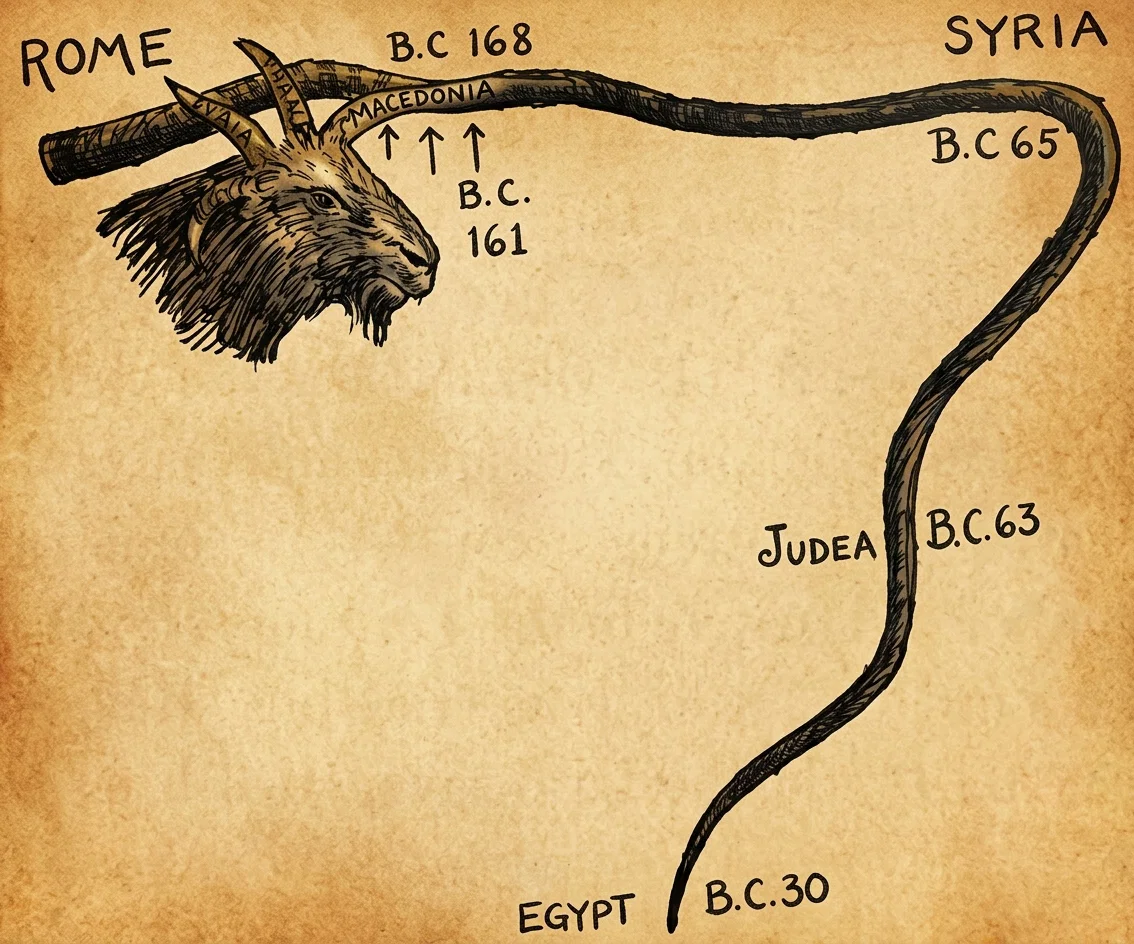
After the death of Alexander, his four leading generals, Cassander, Lysimachus, Seleucus, and Ptolemy, divided the Grecian Empire between themselves. These divisions were known as Macedonia, Thrace, Syria, and Egypt.
The vision of Daniel continues: “And out of one of them [the horns, or kingdoms into which Grecia was divided] came forth a little horn, which waxed exceeding great, toward the south [Egypt], and toward the east [Syria], and toward the pleasant land [Palestine].” Verse 9.
Of the power represented by this symbol the angel says: “And in the latter time of their kingdom [the four divisions of Grecia], when the transgressors are come to the full, a king of fierce countenance [the little horn] and understanding dark sentences, shall stand up. And his power shall be mighty; . . . and he shall destroy the mighty and the holy people. . . . He shall also stand up against the Prince of princes [Christ].” Verse 23.
What power was it that conquered Egypt, Syria, and Palestine, and also stood up against Christ and destroyed his people? Rome alone will answer to the specifications. Rome has two aspects, and they are expressed in history as Pagan Rome and Papal Rome. Under the pagan rule, and previous to A.D. 538, the ecclesiastical power was under the domination of the civil power. After A.D. 538 under papal rule, the church dominated the civil power. These two phases of the Roman power are referred to in Dan. 8:13, 14.

The 2,300 Days.

“Then I heard one saint speaking, and another saint said unto that certain saint which spake, How long shall be the vision concerning the daily [‘desolation,’ understood, Pagan Rome; the supplied word ‘sacrifice’ is incorrectly used], and the transgression of desolation [Papal Rome], to give both the sanctuary and the host to be trodden underfoot? And he [the saint] said unto me [Daniel], Unto two thousand and three hundred days; then shall the sanctuary be cleansed.”
When Daniel heard the angel tell how this king of fierce countenance would stand up against the Prince of princes (Christ), and destroy his people, he fainted. In verse 27 Daniel says, “And I Daniel fainted, and was sick certain days; afterward I rose up, and did the king’s business; and I was astonished at the vision, but none understood it.” Gabrielhad been commanded to make Daniel understand the vision, but Daniel fainted, and became sick, so the explanation had to be postponed till he had recovered. The account of the angel’s return to complete the explanation of the vision, is resumed in chapter 9:21. Daniel says: “Yea, while I was speaking in prayer, even the man Gabriel, whom I had seen in the vision at the beginning, being caused to fly swiftly, touched me about the time of the evening oblation. . . . I am now come forth to give thee skill and understanding. . . . Therefore understand the matter, and consider the vision.”
The vision, so far as it related to the ram, goat, notable horn, the four horns which came up when it was broken, and the little horn, which destroyed the saints and stood up against the Prince of princes, had already been explained, so Gabriel resumes his explanation at that part of the vision left unexplained, that which related to time, or the 2,300 days mentioned. Thus he explains: “Seventy weeks are determined [cut off, or marked off] upon thy people and upon thy holy city, to finish the transgression [fill up the cup of their iniquity], and to make an end of sins [Christ makes the last offering for sins], and to make reconciliation for iniquity [we are reconciled to God by the death of Christ, Rom. 5:10], and to bring in everlasting righteousness [the life of Christ upon earth is everlasting righteousness; the everlasting law is exemplified in and through him], and to seal up [make sure] the vision and prophecy, and to anoint the most holy [the heavenly sanctuary].”
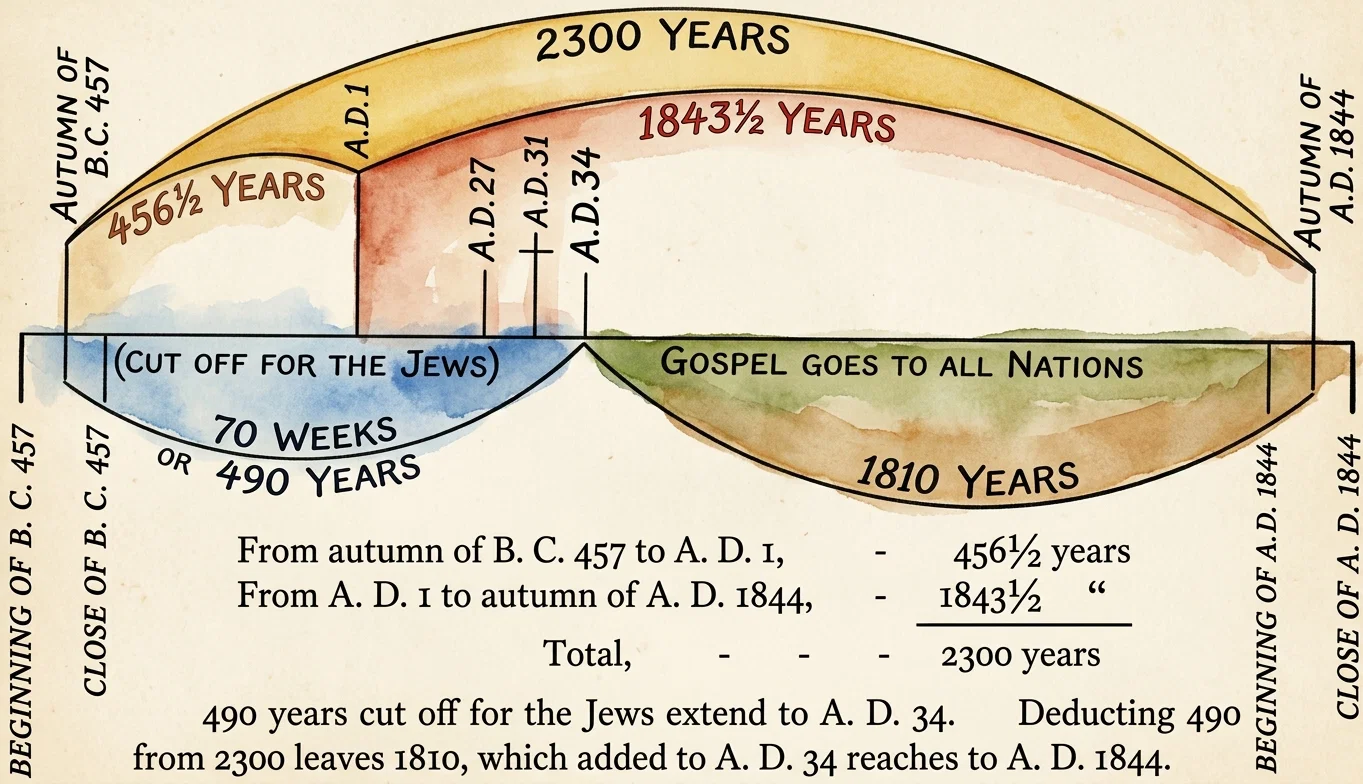
DIAGRAM OF THE 2300 DAYS. (Symbolic Time.)
All these events must take place during the first 70 weeks, or 490 days, of the 2,300 days. This was the time marked off upon the Jewish people.
The work of Christ is woven into this time vision, to seal it, or make it sure. We can plainly see that if the first 70 weeks, or 490 days, of the 2,300, reach down this side of Christ’s life and crucifixion, the greater portion of that long period is in the new dispensation. A day in symbolical prophecy always represents a year (Eze. 4: 6), and as the ram, the goat, and all the horns, are symbols, so the days are symbols, representing years, and the 2,300 days, instead of being literal days,—a little over six years,—represent 2,300 years.
The 70 weeks (the first 490 years of the 2,300 years) were to reach beyond the life and crucifixion of Christ, and the remaining 1,810 years extend on down into the new dispensation. Let Gabriel give us the starting point (verse 25):—
“Know therefore and understand, that from the going forth of the commandment to restore and to build Jerusalem, unto the Messiah the Prince, shall be seven weeks [49 years], and threescore and two weeks [434 years].” From the commandment to build Jerusalem until the Messiah must be 49 years plus 434 years, which equals 483 years. In the seventh chapter of Ezra we find the commandment or decree to restore and build Jerusalem, and the date given in the margin is B.C. 457. Coming down the stream of time 483 years from B.C. 457 brings us to A.D. 27. In A.D. 27 Christ was anointed with the Holy Spirit after his baptism, and became the Messiah, or Anointed. Seven weeks plus 62 weeks equal 69 weeks, which ended in A.D. 27. One week (7 years) more completed the 70 weeks allotted to the Jews, and brings us to A.D. 34, when they ceased to be God’s chosen people, and the Gospel went to the gentiles. In A.D. 34, the end of the 70 weeks (490 years), Jerusalem is doomed to destruction. The Jews have filled up the “cup of their iniquity,” the sin-offering is made, and everlasting righteousness has been brought in, in harmony with the declaration of the angel.
Seven weeks and threescore and two weeks, or 69 weeks, ended in A.D. 27, when Christ became the Messiah. Seventy weeks ended in A.D. 34. The angel still continues to explain what shall take place between the end of the sixty-ninth week (A.D. 27) and the end of the seventieth week (A.D. 34). “And he [Christ], shall confirm the covenant [new covenant] with many [of the Jews] for one week; and in the midst of the week [seven years] he shall cause the sacrifice and the oblation to cease.” Verse 27.
The week above referred to is between A.D. 27 and A.D. 34. The middle of this week would be A.D. 31, and then the sacrifice and oblation were to cease. In A.D. 31 Christ offered himself as a sacrifice, and when he died upon the cross, the veil of the temple was rent in twain, showing that the work in the Jewish temple had been completed, and that no more sacrifices were to be offered there.
If 70 weeks, or 490 years, of the 2,300 years reach to A.D. 34, the remainder of the 2,300 years—1,810 years—brings us to A.D. 1844. If we remove this date one year, it throws all the other dates connected with Christ out of their place, and thus destroys the strongest evidence of his Messiahship.
This prophecy is the foundation of the work of William Miller. Between the years 1837 and 1844 William Miller and his associates preached that Christ’s second advent would take place about 1844. They believed that “this earth was the sanctuary to be cleansed, and that its cleansing would be accomplished by fire at the second advent of Christ.” Miller’s mistake was in the event to transpire at the end of the 2,300 days, but not in the time when it ended.

What Is the Sanctuary?

We are not left in darkness and doubt about what the sanctuary is; for the Bible gives us clear and definite statements concerning this question. The subject of the sanctuary will be considered in the next article.