THE BACK YARD EXAMINED

9%

Pacific Press Publishing Company · Oakland, California · Jun 11, 1896

FromSigns of the Times, Vol. 22, No. 23.

Read the full edition

THE BACK YARD EXAMINED

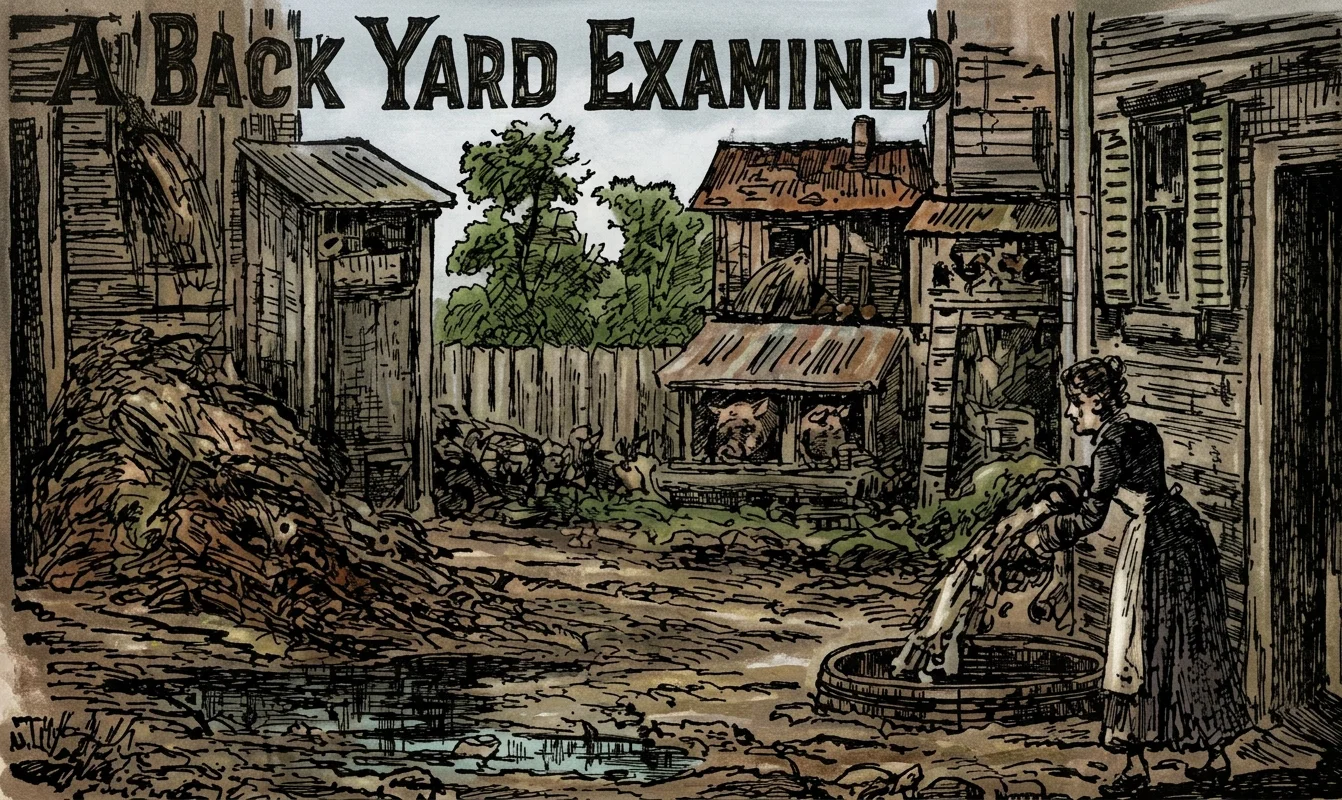
A BACK YARD EXAMINED
BY J. H. KELLOGG, M.D.
The front yard of the average house is likely to be orderly, cleanly, and not obnoxious to either good taste or good sanitation. Graveled walks, a smoothly cut lawn, a few elegant shrubs and evergreens, all suggest the highest degree of neatness and good taste. Let us step around to the back yard. What a contrast! Close by the door stands a garbage barrel, which testifies to at least two of the senses that its history goes far back into the dim past. Once a week the milkman comes with a cart, and empties the unsavory receptacle, stirring to the bottom its reeking contents. (Let me whisper in parenthesis that some of the same comes back in tin cans and earthen jars. Swill milk is not an unknown article, even in rural districts, where hay and grain bring a good price.) At all hours of the day and night this half-rotten receptacle of decomposing organic matter sends out upon the air its filthy emanations.
Near by is a brown-looking spot of earth, over which are eagerly crawling myriads of the first insects of the season, and from which ascends a noxious vapor, visible in the cool morning air, but not difficult to discover if not visible by its pungent, nauseating odor. This, the gardener explains, is the dumping place for the dish-pan and the wash-tub since the drain-pipe became clogged, a few months ago. Frozen up during the winter, it was annoying only by its unsightly appearance, but now that the vernal sun has come, the accumulation of months sends forth a constant stream of noisome smells, which are too often experienced to need further description.
A rod or two from the house we notice a little depression in the ground. This, we learn, is the location of the cesspool. The boards which once formed its roof have rotted away and allowed the overlying earth to drop into the receptacle beneath, which originally consisted of a bottomless box or barrel, half filled with stones, and connected with the kitchen sink by means of a long wooden box. The wood has now nearly disappeared, a few rotten fragments only remaining. Out of this putrescent hole rises a stench which finds no counterpart elsewhere than in a similar contrivance for domestic poisoning.
A few feet distant is an edifice which we are at a loss to know how to describe. A correspondent was in the same predicament when he sent us a clipping for publication which he said was “rescued from the place consigned to infamy.” The edifice referred to probably ought to have been consigned to infamy, if it had not been, and the same should be said of most others of the same class. Though carefully guarded from observation by a close lattice, covered by clambering vines, its presence is easily detected, and that without close proximity. How often, as we walk along the streets at night, does the air, which heaven sends us pure, sweet, and potent with life-giving energies, come laden with poisonous exhalations from dozens of such sources, and freighted with the agencies of death! The vault of an out-house often becomes a much more dangerous enemy to human life than a powder magazine or a nitro-glycerine factory; yet the latter are by law required to be located far apart from human habitations, while the former is tolerated in the closest proximity to human dwellings, often even under the same roof with human beings.
Death in the Well.—In the midst of all these sources of the most dangerous filth is located the well, from which is to be daily drawn one of the most essential of the necessaries of life. Is it any wonder that the cup of life is often transformed into the cup of death? Only think of the conditions of a family with death enthroned in the well, and daily dealing out his poisonous draughts to its members! The mysterious Providence which deprives a family of its loved ones through the agency of typhoid fever, may, in the majority of instances, be proved to be a mysterious connection between the well and a privy vault or cesspool.
A settler in a new country generally digs two holes in the ground after erecting his humble cottage. Into one goes all the filth, offal, and slops; out of the other comes all the water for family use. These holes are usually so near together that the contents mingle, so that what goes into one comes out of the other. In an old settled country, a man in making a home digs two or three holes for filth and one for water, so that the latter is often surrounded by the former. As most of the water from the wells is returned to the holes for the reception of filth, a very large share of it may find its way back to its original source.
At no great distance we may find a stable, with its filthy accumulations, which are drenched at every rain, and contaminate the soil for many feet around, and to an unknown depth. Here is another probable contributor to the water supply. We have seen scores of wells located in the barn-yard, so as to be convenient for watering the stock, but used for culinary purposes as well, if not in any other way, in the form of milk, beef, pork, or mutton.
Some one may imagine that this picture is highly colored; but the experienced sanitarian will certainly say we have not told half the truth.