GOD'S LAW

4%

Pacific Press Publishing Company · Oakland, California · May 21, 1896

FromSigns of the Times, Vol. 22, No. 21.

Read the full edition

GOD'S LAW.

The following is worthy of careful reading in these days, when God's law is despised not only by worldlings, but by professed Christian ministers and teachers. It is from a sermon by Rev. John Knox Wright, B.D. (Presbyterian), of Spallumcheen, B.C., printed in the current number of the Homiletic Review:—

The Law Came Straight from God to Man.

Man was not left to discover or reason it out for himself. The law is not a constitution agreed upon among men for self-government. It came direct from the Moral Governor of the universe, in such form and by such means that it is impossible either to mistake its meaning or to question its authority. God wrought it into man's very being at the creation. The breath breathed into man's nostrils, by which he was made a living soul, was the breath of moral purity and beauty, and it gave a moral nature and a sense of moral obligation. Man always bears the mark and echoes the voice of his Creator. Indeed, so essential and indestructible an element of man's make-up was the moral law that, notwithstanding the ruin and corruption and degradation of sin, it is true of man everywhere and always that he has the law written in his heart, and that his conscience bears witness, his thoughts the meanwhile accusing or else excusing one another.
This same law was given of God to Moses in Horeb. The Lord, manifesting his presence upon the mount in thick darkness, lightnings, clouds, and fire, first uttered the Ten Commandments with an audible voice unto all the people of Israel; and then, having written them with his own finger upon two slabs of stone, delivered them in this form to his servant. Moses did not compose this law, he did not even write it at the dictation of God. God himself spoke it and wrote it, and gave it to Moses in a complete, durable form. It was no new law, but the original law of creation and conscience. In its promulgation at Horeb the divine law was set upon the candlestick of human language, that it might give light to all dwelling upon the earth.
Throughout all the Scriptures it is declared that God was the Author of the moral law, and that he has the right to demand and the power to enforce obedience.

The Law Is Enforced by the Most Powerful Sanctions.
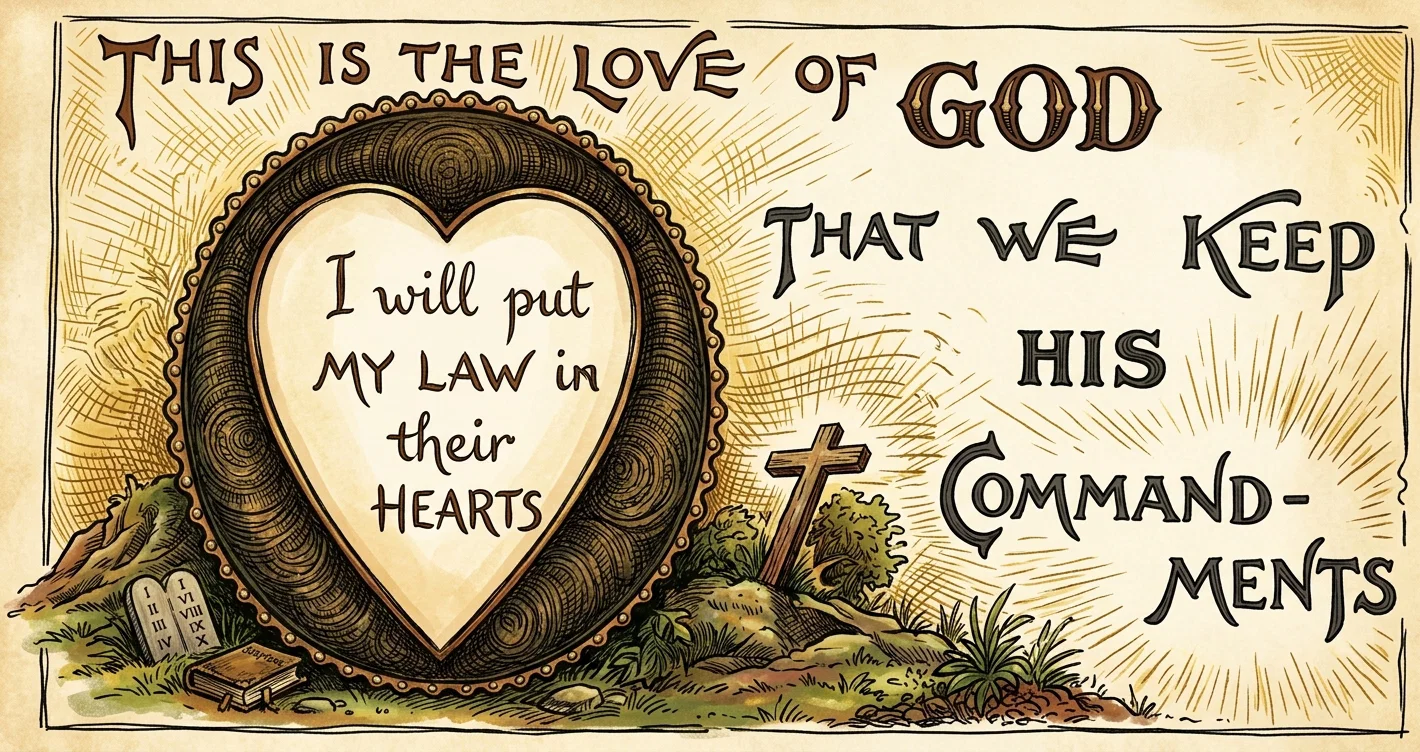
To it are attached promises of blessing and reward, and threatenings of curse and punishment. In the very terms of the law itself we find a muttering of wrath against disobedience, which sinks into a sweet whisper of mercy and favor toward those who love and fear the Lord.—“I the Lord thy God am a jealous God, visiting the iniquity of the fathers upon the children unto the third and fourth generation of them that hate me; and showing mercy unto thousands of them that love me, and keep my commandments.”
The rewards of obedience are great, precious, and sure. The punishments of transgression are severe, terrible, and certain. These rewards and punishments are both temporal and eternal. Both have had their testimony all along the past history of the world. Nations and men have prospered and flourished, or have met with suffering, disaster, and ruin, according to their estimate and treatment of the moral law. The sanctions of the law are powerful because they come from the hand of Him who is omniscient in wisdom, righteous in judgment, and omnipotent in might. O, doubt it not, my brother, God is exceeding jealous for the honor of his law!
The Law Has Necessary, Universal, and Perpetual Authority.
1. Necessary. Man's obligation to keep the law does not depend upon his own profession or resolution. Some people excuse themselves in reference to a certain looseness of conduct by saying that they make no profession of religion, or that they have very liberal views. They say that it is quite proper and necessary that professing Christians should recognize the authority of the law, but they contend that every man has the right to judge for himself. Brethren, this is all wrong; no man has the right to set his judgment, or opinion, or prejudice, or wilfulness, against the plain, positive precepts of the divine law. The authority of the law is due to its divine authorship. Obligation to it depends upon the moral nature of man, and upon his necessary relations to God. Between God, the Moral Governor, and man—an intelligent, responsible, moral creature—there is necessarily the moral law. It must be so; it is so.
2. Thus it must be evident that obligation to the moral law is universal. Wherever you find the moral faculty, the moral law has authority; there is no man without the moral faculty, therefore all men are under obligation to the law.
3. Thus also the authority of the law is perpetual. God can not change. His government over all rational, responsible creatures must always be moral government. The law is a perfect, absolute, unalterable standard for all men in all ages. It is the pure, changeless word of God, which liveth and abideth forever.

The Law Is the Basis and Shall Be the Crown and Glory of the Gospel.

Brethren, this may seem a strange statement, but I hope to make it clear to you, and to convince you of its truthfulness. The Gospel did not destroy the law. It did not lower its standards. It was not intended as an apology for its severity. The Gospel honors and magnifies the law, declaring that it is holy, just, and good. Owing to the corruption and weakness of man, the law had been broken and dishonored, so that that which was ordained unto life, became a minister of death, a revealer of guilt, a witness of condemnation. There were some things which the law could not do—not because of any weakness or imperfection in itself, but because of the fallen, corrupt condition of human nature. The law could not pardon a transgression, therefore it could not give life and salvation to guilty sinners.
It gave the knowledge of sin, measured the extent of man's weakness and the depth of his fall—thus it prepared for the exhibition of pardoning mercy and saving grace by showing the necessity for it.
Then again the law determined the plan of salvation and the provisions necessary, so that in the exercise of mercy the divine righteousness might be preserved and declared, so that God might be just in justifying every one that believeth. The law must be magnified and satisfied, man's guilt must be taken away, and his debt paid; so it was necessary that the Lawgiver himself should come, and in the nature of man, as his surety and ransom, fulfil all righteousness and put away sin by the sacrifice of himself. The absolute immutable perfection of the law rendered Calvary necessary in the scheme of human redemption. It is here that mercy and truth meet together, that righteousness and peace kiss each other.
Still further, the condition of pardon and salvation under the Gospel—which is faith—is determined by the law. What is faith but the recognition and acceptance of the truth that Christ in our behalf made a full satisfaction to the law, and took away our guilt, and canceled the sentence of condemnation by the sacrifice of himself. Our faith must look up through Christ to the holiness and justice of God, of which the law was the expression, for justification and peace. This is what Paul means when he says: “Do we then make void the law through faith? God forbid; yea, we establish the law.” Thus we must see that the law is the basis of the Gospel—determining its plan, and provisions, and conditions of salvation.
But there is more to be told. Through Christ Jesus comes the renewal of man's nature and the gift of life and power, so that men who were dead in trespasses and sins, and under the carnal mind, and led captive by the devil at his will, are caused to love and delight in, and are enabled to obey, the law. Thus we read: “What the law could not do, in that it was weak through the flesh, God sending his own Son in the likeness of sinful flesh, and for sin, condemned sin in the flesh; that the righteousness of the law might be fulfilled in us, who walk not after the flesh, but after the Spirit.” The weakness and imperfection were not in the law itself—but altogether in man. In saving man from guilt and penalty and restoring him to righteousness and favor, God stamps again his own image upon his creature, and gives a new communication of his own nature, and a fresh infusion of his Spirit—so that man may go forward again in the original line of development, and rise to honor, reward, and happiness by obedience and service according to the high, pure standard of the moral law.
The law is always the same. The motives to obedience are higher and the power stronger because of full satisfaction andreconciliation, and the free gift of life and salvation through the redemption of Christ. Through love and gratitude we obey and serve and follow, and seek to prove what is the good and acceptable and perfect will of God our Father.
Delighting in the free divine mercy which pitied us in our low and lost condition, which took us from the horrible pit and miry clay, which called us from darkness to light, from banishment to favor and fellowship, from guilt to pardon, from penalty to reward and blessing, we become followers of God as dear children, and put on the new man, which after God is renewed day by day in knowledge, righteousness, and true holiness.
The crown and glory of the Gospel come to each man when the law of God is enthroned in his heart and manifested in his life and conduct.
It is said that in ancient times some laws were put into verse so that the people might learn to sing them. Brethren, through the grace and Spirit of Christ, God's law becomes poetry to us and his statutes a song. The law and the Gospel shall rejoice and reign together when the sons of God, forever victorious over weakness and sin, shall sing the song of Moses and the Lamb in the heavenly mansions of their Father.
O, surely, brethren, we can not give too earnest heed to these words of the prophet, “Remember ye the law”!