WONDERFUL FAITH

9%

Pacific Press Publishing Company · Oakland, California · Apr 16, 1896

FromSigns of the Times, Vol. 22, No. 16.

Read the full edition

WONDERFUL FAITH.

The Thief on the Cross.
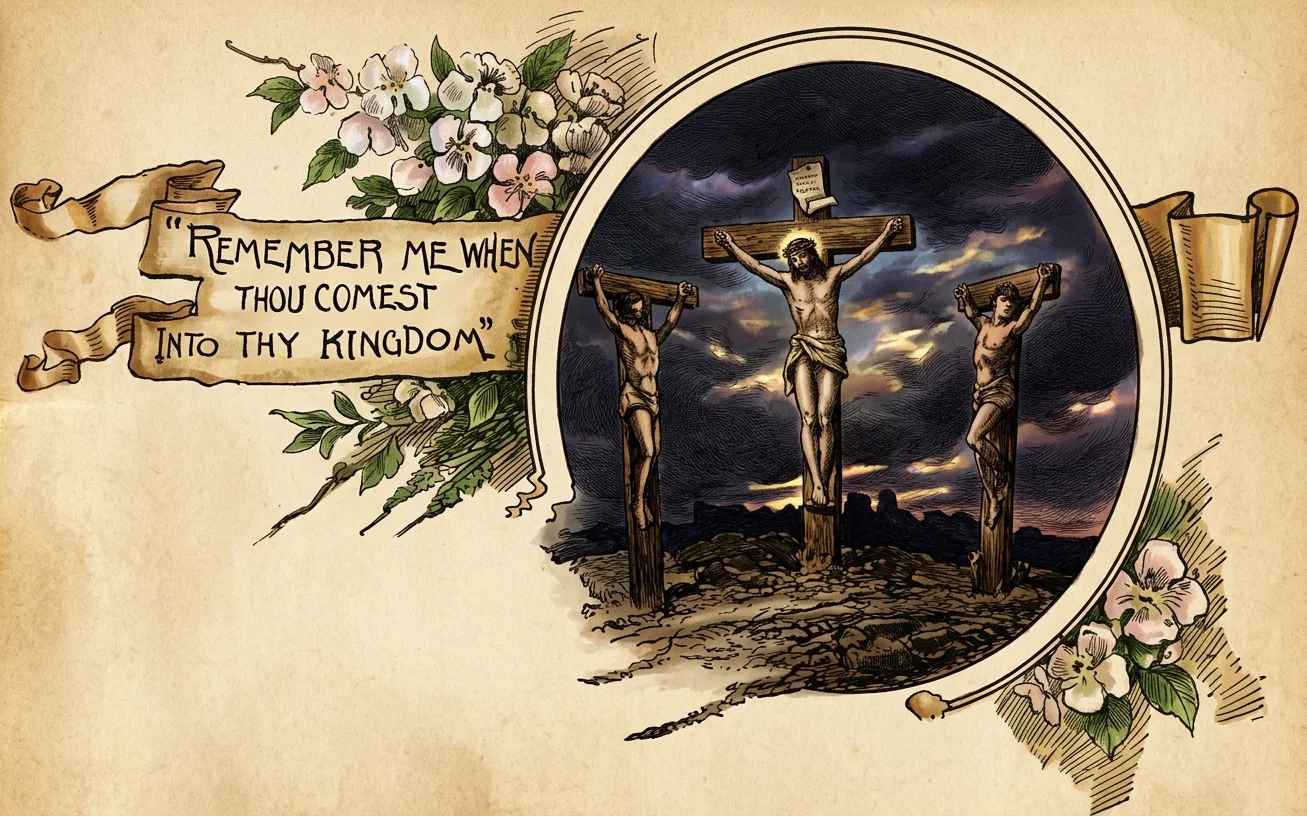
THERE is, perhaps, no example of more wonderful faith, taking into consideration the surroundings, than that of one of the malefactors who was crucified by the side of Jesus Christ. Beside him was a Man, remarkable then only in his sweet dignity, his patience, his unruffled temper, his unselfishness. He sought no self-justification; he committed his case to God.
And yet his disciples had forsaken him. Many who had shouted his praise were now anathematizing him. His own nation, especially the highest and most noted religious teachers among them, had condemned him to die. Even God seemed to forsake him, and the heavens overhead gathered blackness.
Yet, amid all this, while Jew and gentile cursed and reviled the Man of Calvary, the heart of the dying criminal was strangely stirred. He was probably a Jew. He may have heard Christ preach in some of the great outdoor assemblies. He certainly had ideas in the right direction concerning the kingdom of the Messiah. Jesus had taught that his kingdom was not near, that it was like “a certain nobleman [who] went into a far country to receive for himself a kingdom, and to return.” See Luke 19:11–13. Daniel had taught that that kingdom was to be given in the end of the ages of the probationary period, in close connection with the judgment. See Dan. 7:13, 14, 26, 27. Messiah was to go away for awhile to the Father, and to come again into his kingdom, and why might not this Jesus be the Messiah of Daniel(chapter 9), the Suffering One of Isaiah (chapter 53)? And as the Spirit of God brought home the great, glad truth to his heart, he saw in the dying One the world's Redeemer, the Prince of Life; and, while he gave mild rebuke to his copartner in crime, from heart and lips there rose the simple, earnest prayer of faith to the Sufferer beside him: “Lord, remember me when thou comest into thy kingdom.” Luke 23:42. When thou shalt come again to raise the dead (1 Thess. 4:16, 17), to reward thine own (Matt. 16:27), to take thy throne (Matt. 25:31), in the earth made new (Revelation 21, 22), in the Paradise of God, then, “Lord, remember me.” All this is implied in the thief’s request. Wonderful faith in that hour of darkness! Sweet words to the ear of the Redeemer! And wonderful was our Lord’s reply. Leave the common punctuation of the text, and read Christ’s answer according to facts of context and other scriptures: “Verily I say unto thee this day, Shalt thou be with me in Paradise,” or, as it might as truly be rendered, “Thou shalt be with me in Paradise.” So reads the Emphatic Diaglott. The interlinear literal rendering of the Greek reads, leaving out punctuation, of which the original Scriptures knew nothing, “Indeed I say to thee to-day with me shalt thou be in the Paradise.”
Notice the force of the expression, “I say unto thee to-day;” “I say . . . to-day,” yes, to-day, when my own nation have rejected me and condemned me; to-day, when one of my own disciples has betrayed me, and another has denied me, and others have forsaken me; to-day, when even heaven seems leagued with earth against me; to-day, when seemingly I have no power to help a single soul in any way—even to-day, as you have faith to ask, so I have grace to promise, as I will have power to fulfill, “Thou shalt be with me in Paradise” when I come into my kingdom. The Lord’s answer was in harmony with the thief’s request.
But Paradise is where God dwells, where his throne is, as we learn by a comparison of Rev. 2:7 and 22:1, 2. That glorious city, and garden of delights, and throne will form a part of Christ’s kingdom in the earth made new, as we may learn from chapter 21. But they are now in heaven, in the presence of God.
“But did not Christ mean that he and the thief would be in Paradise on that day that he spoke the words?” asks one. No, he could not have meant this, for Paradise is where God dwells, and three days after this Christ declares that “I am not yet ascended to my Father.” John 20:17. He, therefore, did not mean that the thief would be with him in Paradise that day; for Jesus did not go then; nor did the thief probably die, as by the method of crucifixion the victim often lived several days, and near the close of the day, when the thieves were taken from the cross, their legs were broken, to prevent escape and hasten death. The promise of Christ, therefore, pertained to that day; its fulfillment, to the time when he came into his kingdom.
Wonderful faith! Wonderful answer at a wonderful time! But the same Saviour lives to-day, and, tho to grief-blinded, despair-darkened eyes he may seem to be dying, he lives in all the fullness of God, and will hear every prayer of faith. We may pray the same prayer, with the same assurance.
“When Thou comest in Thy kingdom, Sinful tho my heart may be, Like the penitent thief, I pray Thee, Jesus, Lord, remember me.”