And he spake this parable unto certain which trusted in themselves that they were righteous, and despised others;
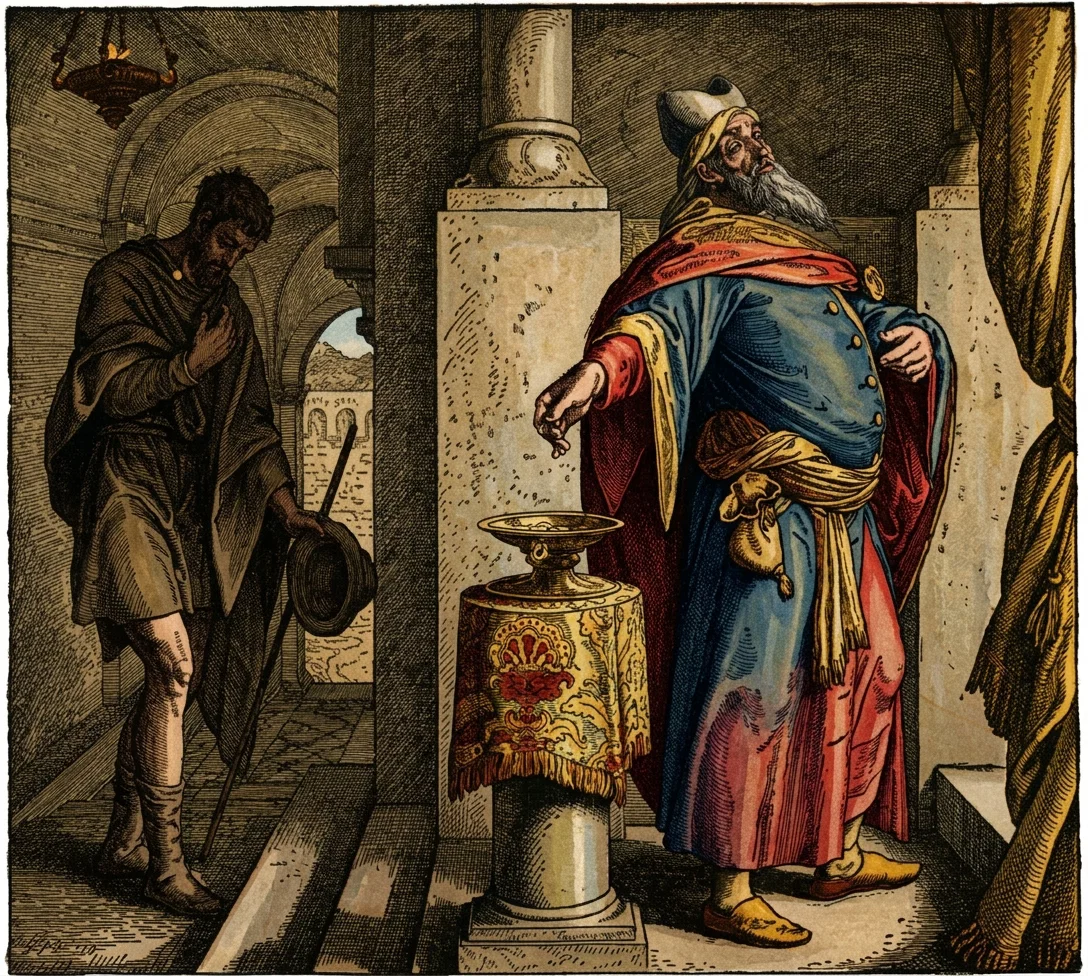
Two men went up into the temple to pray; the one a Pharisee, and the other a publican.
The Pharisee stood and prayed thus with himself, God, I thank thee, that I am not as other men are, extortioners, unjust, adulterers, or even as this publican.
I fast twice in the week, I give tithes of all that I possess.
And the publican, standing afar off, would not lift up so much as his eyes unto heaven, but smote upon his breast, saying, God be merciful to me a sinner.
I tell you, this man went down to his house justified rather than the other; for every one that exalteth himself shall be abased; and he that humbleth himself shall be exalted.
And they brought unto him also infants, that he would touch them; but when his disciples saw it, they rebuked them.
But Jesus called them unto him, and said, Suffer little children to come unto me, and forbid them not: for of such is the kingdom of God.
Verily I say unto you, Whosoever shall not receive the kingdom of God as a little child shall in no wise enter therein.
(Memorize verses 15-17.)
Golden Text: “The publican, standing afar off, would not lift up so much as his eyes unto heaven, but smote upon his breast, saying, God be merciful to me a sinner.” Luke 18:13.
NOTE.—In the first part of Luke 18 is given an example of persevering prayer, in the case of the widow and unjust judge. The purpose of the illustration is not to compare the Lord and the judge, but to contrast the motives of the two. The judge granted the request out of purely selfish motives,—he did not wish to be continually disturbed. Now if a request to an earthly judge be granted, no matter how ungraciously, how much more—infinitely more—will our requests and prayers be heard and granted when addressed to God, who delights in mercy and in giving good gifts to his children! Read in connection with this chapter, Matt. 19:13-20; Mark 10:13-31. Jesus is now on his way to Jerusalem for the last time. Further in the chapter he outlines the future to his disciples, who fail to grasp the meaning of his words.
Suggestive Questions.
(1) To whom did Jesus speak a certain parable? Verse 9. (2) What classes are brought to view? Verse 10. (3) How did the Pharisee begin his prayer? Verse 11. Note 1. (4) What good points did he mention? Verse 12. Note 2. (5) What is said of the publican? Verse 13. Note 3. (6) Which one did the Lord say was justified, or forgiven? Verse 14. (7) What general principle was thus exemplified? Same verse, and verse 9. Note 4. (8) Who were brought to Jesus as he taught? Verse 15. (9) How did the disciples regard this? Same verse. (10) What did Jesus say concerning the children? Verse 16. Note 5. (11) How may a man enter the kingdom of God? Verse 17, and note 5.
Notes.
1. The Pharisee stood.—Not merely that he assumed the usual attitude in prayer, but he placed himself, as the original indicates, ostentatiously. He “struck an attitude” purposely to be noticed by others in his vicinity. His rank would allow of much show in dress, and “he would have on his blue-fringed talith, and his phylacteries, conspicuous on his brow and his arm.” Prayed thus with himself.—This is precisely what he did. He did not pray to God, but his prayer was a sort of self-congratulatory effort, quite probably loud enough to be overheard. But the only difference between him and “other men,” to whom he referred, was that they were openly known to be such characters as he portrayed, while he, an outward observer of all points of the law, was inwardly as great a sinner as they were, in the sight of God perhaps greater, because of his profession and opportunities. His was a first-class example of self-righteousness.
2. I fast twice in the week.—The law appointed only one fast day in the year, but the rabbis by their interpretations made a burden of what was ordained by the Lord for a good purpose. They multiplied the law, rather than magnified it.
3. The publican.—It is also stated that the publican stood, but the word used shows that the attitude was nothing out of the ordinary. In fact, the sense of his sins so pressed upon him that he “would not lift up so much as his eyes unto heaven.” He did not try to hide the fact that he was a sinner, but smote his hands upon his breast in token of his sorrow. He was truly penitent, altho probably guilty of the sins enumerated by the Pharisee; for his public office as customs and tax gatherer afforded him opportunity to do those things. Of self-righteousness he had none, and so will it be with every one who finds the Lord and his forgiveness.
“One nearer to the altar trod,
The other to the altar’s God.”
4. Shall be exalted.—Abasement often comes to the haughty in the sight of their fellow-men. “Pride goeth before a fall” is a proverb frequently fulfilled in worldly matters. Also, the opposite is often true in matters of this life. The honest and truthful individual, who reveals his character by his unostentatious bearing, is given responsibilities and worthy positions. But preeminently is the principle true in spiritual things. Shame and destruction await the proud in heart, while the Lord himself will raise the humble to the honors of heaven. “The meek shall inherit the earth.” Ps. 37:11. With him also of a humble spirit dwells the high and lofty One, whose name is Holy. Isa. 57:15.
5. Of such is the kingdom of God.—In the midst of his teaching, infants and little children were brought to Jesus that he might touch them. The disciples, deeply interested in his discourse, regarded this as an inopportune interruption. But the Lord did not regard it so, and immediately drew from the incident an important lesson. Here were innocent, teachable, obedient hearts. Here was no taint of suspicion or doubt or unbelief; perfect confidence and faith were manifested. Such must be the attitude of him who would receive the kingdom of God, that is, accept the testimony concerning that kingdom, and live the life of a Christian. Of such, in the hearts of such, is the kingdom of God now, and of such characters will the earthly kingdom restored consist. This to the world seems foolishness, but it is the profound simplicity and wisdom of God. The reasonableness of it appears when we consider that the worldly-wise man is wise in his own conceit,—some of his ways are very good, better than the Lord’s perhaps, he thinks,—but the child of God relies completely on his Father’s advice and guidance. There is perfect harmony in the kingdom of God.