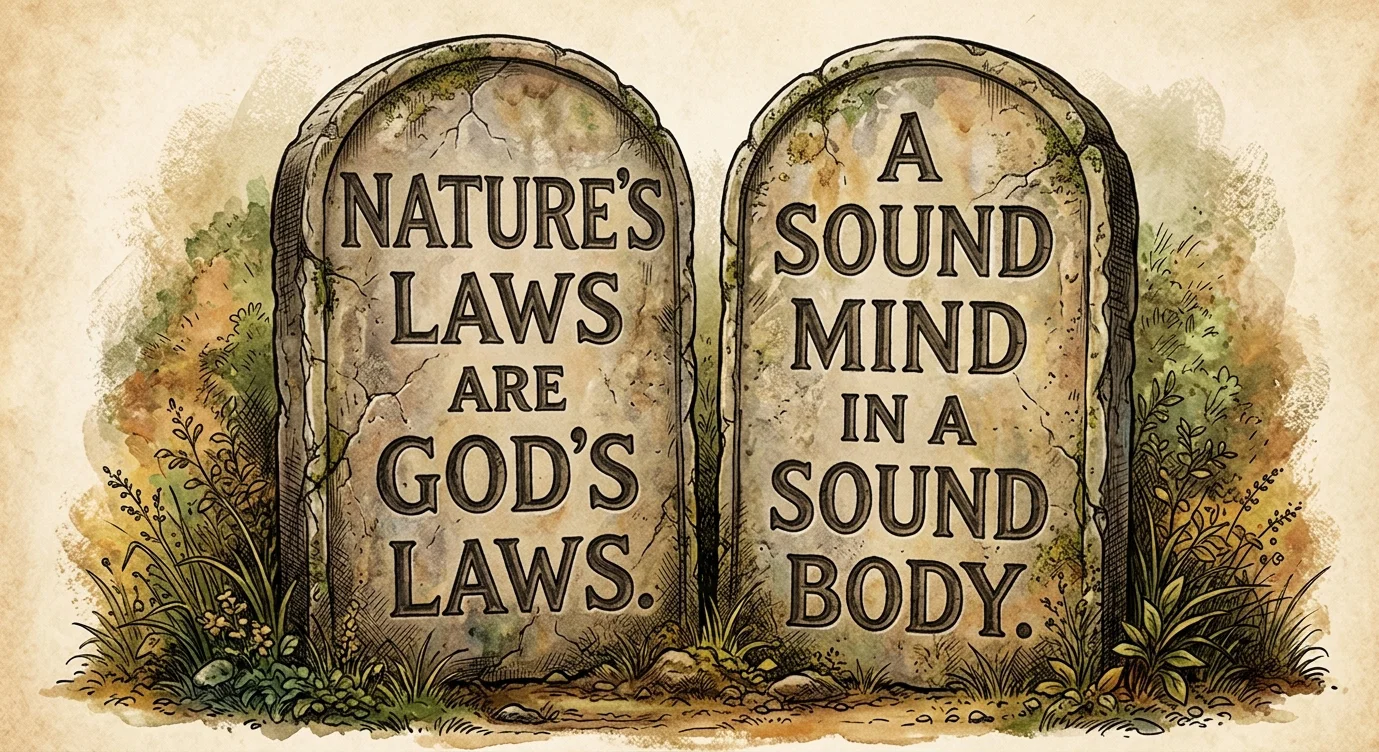
THE CODE OF HEALTH

7%

Pacific Press Publishing Company · Oakland, California · Apr 30, 1896

FromSigns of the Times, Vol. 22, No. 18.

Read the full edition

THE CODE OF HEALTH.

BY J. H. KELLOGG, M.D.
The essence of morality is right-doing, or the practical recognition of the obligation to law. Man is a part of the great universe, and is as much under the domain of law as the planets, rocks, trees, and other natural objects, or as the pebble, which, when thrown in the air, falls to the ground in obedience to the law of gravitation. In addition to the general laws which relate to all natural objects, and to which man is subject in common with all other objects, man is governed by various special laws which relate to his physical, mental, and moral welfare. Morality is generally looked upon as relating solely to those relations which are directly embraced in the injunctions of the Ten Commandments; but the view which regards man as a natural object, governed only by natural laws, and which defines right-doing as being simply obedience to law, gives to the term “morality” an immensely broader scope, and makes it include all those laws and principles by which his entire being is governed.
This notion of morality is confessedly a modern one, or rather a revival of a primitive idea which was hidden so deep in the mental and moral darkness of the middle ages that it has only in modern times begun to reach the light. “But,” says a young man who recognizes the importance of holding fast to the principles of morality, as related to other matters, “is it anybody’s business what I eat or drink or wear, or how I use my body? Do not I belong to myself? and haven’t I a right to do as I please with myself?” Let us see how much truth there is in the claim that individual rights include the right to treat the body in a manner not consistent with its interests,—to abuse the stomach for the purpose of affording the palate a questionable gratification; to whip and goad the brain and nerves by stimulants to do more work than is possible for them to do without injury; to recklessly violate any or all of the laws of health.
Here is a man who has vast possessions,—houses, barns, well-filled granaries, collections of rare and curious natural objects, galleries filled with beautiful works of art, safes filled with paying stocks and government securities,—all sorts of wealth. Suppose this man takes it into his head to destroy his wealth. Hold on there, says the Law, and its strong hand is laid upon him as soon as his purpose is discovered. A man who recklessly destroys his property is regarded as either a criminal or a lunatic, and, in either case, unfit to be at large. The state recognizes the fact that the man’s property is not wholly his own, or at least that others have interests in it. What he does not require for his own use, belongs to his children or other surviving relatives, or, in case he dies without a will and without heirs, to the state.
The state recognizes the right of a child to inherit from his father his due share of the property which the latter may have acquired. Ought not intelligent men and women to recognize the fact that the child has an even greater right to inherit from its parents a constitution unimpaired by vicious or injurious habits, or neglect of the requirements of physical law?
That quaint philosopher, Dr. Oliver Wendell Holmes, remarks that each one of us is an omnibus, in which ride all our ancestors. What right has any man by reckless habits of life to compel each of his children to carry about in his “omnibus” the results of the selfish gratification of depraved tastes and morbid appetites?
Another consideration, which certainly is worthy of thought, is the fact that the brain which does our thinking is a part of the body; and whatever seriously affects the physical health, whatever lowers nerve or vital tone, directly affects, in a harmful way, the mind. The man whose vital tone is lowered by sedentary occupation, by dissipation, by any means which overtaxes or exhausts the nervous system, is in a condition of lowered nerve tone, which means lowered brain tone, lowered mental tone, and lowered moral tone.
Thus it appears that health has a very important relation to morality, using the word in its common and narrow sense, and that no man who desires to live a pure and upright life can afford to run the risk of lessening his moral tone and his power of resistance to evil by impairment of his physical and mental vigor.

THE CODE OF HEALTH.

The laws which relate to individual health may be concisely summed up as follows:—
  1. Breathe only pure air.
  2. Drink only pure water.
  3. Eat only pure food.
  4. Take sufficient muscular exercise.
  5. Preserve proper attitudes.
  6. Discipline the mind by proper mental exercise.
  7. Take proper rest and recreation and sufficient sleep.
  8. Restrain the passions and govern the emotions.
  9. Give attention to personal cleanliness.
  10. Be temperate in all things.
To the man who will carefully and conscientiously observe all of those laws which relateto his physical health, nature vouchsafes, barring accidents, a long, comfortable life, free from a great share of the ills which come upon a large portion of mankind. A great share of the sicknesses, and even a large proportion of deaths, are unquestionably due to the violation of some of the plainest principles of health morality, and are wholly preventable. An eminent English sanitarian once remarked, “When a man dies of typhoid fever, somebody ought to be hanged.” Somebody is clearly responsible for the annual slaughter, for not less than one-third of all the sickness, and pretty nearly as large a proportion of the deaths. Let us each, with soberness and consideration, ask the reaching question, “Is it I?”