What is the Church? Who is its Head? Who are its members? What is the test? These are important questions, questions which are agitating the minds of many in the world to-day. Let us look for the answers in that Book of all books, the word of God, from the authority of which all Christian churches, in claim at least, derive their existence.
What Is the Church?
The word rendered church in the New Testament comes from the Greek word ekklesia, from the verb ekkaleō, defined by Liddell and Scott's Standard Greek Lexicon, “to call out or forth, to summon forth.” Ekklesia is defined to mean, “an assembly of the citizens regularly summoned, the legislative assembly,” opposed to a syllogos, a mere crowd or concourse, which might be “legal or riotous.” The word ekklesia is used in the Scriptures to describe the congregation of Israel in the wilderness (Acts 7:38), the “assembly” at Ephesus (Acts 19:32, 39, 41), and the various congregations of Christians associating together, as well as the general body of Christians. In fact, the word “church” in both singular and plural where it is used in the New Testament Scriptures, comes, with one exception, from the Greek word ekklesia, meaning “called out,” “an assembly of citizens regularly summoned.” The exception is Acts 19:37, rendered in the Revised Version “temples,” its proper meaning. The church of God or of Christ, is, therefore, composed of those whom God has called out, citizens of his kingdom, “regularly summoned.”
“Called Out.”
Who are called out? Called out by whom? Called out of what? Called out by what? Called out to what? These are all important questions, but all are specifically answered in the word of God. Who are called out? and by whom? We answer them both together. “The Lord hath called every one” (1 Cor. 7:17); says Jesus, “I came not to call the righteous, but sinners” (Mark 2:17). These expressions are not contradictory; for “all have sinned” (Rom. 3:23), hence it follows that all are called. “Even us, whom he hath called, not of the Jews only, but also of the gentiles.” (Rom. 9:24.) The caller is “the God of all grace” (1 Peter 5:10), through Jesus Christ, who thus speaks to all: “Come unto me.” “The Spirit and the bride say, Come.” All heaven is interested in the work of calling. God calls through every agency in harmony with his will, by his word and by his works, and even through the woe and misery caused by sin we may hear the voices from the throne of God calling to every soul on earth, “Come.” God calls all the children of men.
Called Out of What?
Out of the world, out of sin and darkness and woe and misery and death. “Who hath called you out of darkness” (1 Peter 2:9); “I have chosen you out of the world” (John 15:19); “Wherefore come out from among them [the unbelieving, the unrighteous, the children of darkness, the idolators], and be ye separate, saith the Lord, and I will receive you” (2 Cor. 6:17). This does not mean that the called of God shall not mingle with the unbelieving, with the idolator, with the worldling; it is his work, his duty, his privilege to remain in this world for a season, among the people of the world; but he is to be actuated by a different spirit, different aims, objects, purposes. This is shown by the means which God uses to call him out of the world, and the work and station to which he calls him.
Called Out by What?
The question has been answered in what has gone before. It is the voice of God that calls, speaking in many different ways, but preëminently through his word, the test of all other voices professing to be his. This voice which calls, this message which invites, is the Gospel of God; for says the apostle to the church, “He called you by one Gospel” (2 Thess. 2:14); and “called me by his grace” (Gal. 1:15), “the Gospel of the grace of God” (Acts 20:24). Blessed Gospel, in God's wondrous goodness sent down to the children of men!
Called Out to What?
That Gospel does not call us to take a certain definite name, to call ourselves the elect, and all others the reprobate. It does not call us to an old and superstitious creed, a prescribed ritual and service, a certain mountain or temple, a certain line of priests or succession of priests according to the flesh. It calls us—all—to better things. It calls us out of sin “to be saints” (Rom. 1:7); called out of the fellowship of the world, “unto the fellowship of his Son, Jesus Christ our Lord” (1 Cor. 1:9); “God hath called us to peace” (1 Cor. 7:15), from the strife and unrest of sin; from bondage he has “called unto liberty” (Gal. 5:13); “not called us unto uncleanness, but unto holiness” (1 Thess. 4:7); “called us with an holy calling” (2 Tim. 1:9); “called you out of darkness into his marvelous light” (1 Peter 2:9); called from the infamy of sin “unto his eternal glory” (chap. 5:10), “called you unto his kingdom and glory” (1 Thess. 2:12); and thus being separated from sin, and by his grace translating us “into the kingdom of his dear Son” (Col. 1:13), he calls us “sons and daughters” (2 Cor. 6:18), “sons of God” (12John 3:2); “and if children, then heirs; heirs of God, and joint-heirs with Christ” (Rom. 8:17); “fellow citizens with the saints, and of the household of God” (Eph. 2:19); whose “citizenship is in heaven, from whence also we wait for a Saviour, the Lord Jesus Christ, who shall fashion anew the body of our humiliation, that it may be conformed to the body of his glory, according to the working whereby he is able even to subdue all things unto himself” (Phil. 3:20, 21, R. V.). This is the church of God, the called-out ones by his Gospel unto himself, separate from the world, separate unto himself; separate from sin, separate unto holiness.
What Must Follow.
Now it must logically and inevitably follow that he who will not submit to God's call, who will not be effectually called, who will not make that “calling sure” by submitting to do and letting God do all that God requires, can not be a citizen of God's kingdom. He is not one of the called-out of God; he is not a member of the church of God. The church to which he belongs may be called by man, “The Church of God,” or “The Church of Christ,” or “The Church of the Apostles,” or “The Christian Church,” or “The Holy Catholic Church,” or the Methodist or Baptist or Adventist Church; the name or the church will not make him a citizen of God or a called-out one from the world; for a man may nominally belong to any ecclesiastical body, and yet be as much of the world as one who believes in no church whatever. It must inevitably follow that he who once yielded to God's call, but who turned from the path of right and in time of trial preferred and walked in his own way and the way of the world instead of that of God, would by thus doing take himself out from among the called-out ones, the church, and become one of the world, wherever his name might be enrolled. And this is as true of a church or body of such persons as it is of the individual. “Many are called, but few are chosen,” because the many will not submit to God's call.
The Head of the Church.
The truth of the last paragraph will more plainly appear as we contemplate the Head of the church and the relation of each member to the Head. As to who or what the Head of the church is we need not pause long. “Christ is the Head of the church; and he is the Saviour of the body” (Eph. 5:23), and his church is the body, and the individuals who compose it are members in particular (see Eph. 1:22, 23; 1 Cor. 12:12, 13, 27). The relation of the individual members to the Head is just as vital to the member as the relation of the body to the Head; for not only is “Christ the Head of the church,” but “the Head of every man is Christ.” Christ is the life, the power, the knowledge, the all in all, of every soul saved; and the relation of each soul to Christ is as purely personal as tho he were the only called-out one. Christ tasted death for every man, he lives for every one, he calls every one, and he personally saves every one who yields to the best call of the Gospel. If one cut himself off by unbelief, he dies as surely as does the branch cut off from the living vine. If he hopes for life in a church that has cut loose from God by unbelief, and accepted tradition and error in the place of truth, he will just as surely die. There is life only by personal abiding faith in Jesus Christ. A round of forms, elaborate ritual, and splendid ornate ceremonies, great names and sounding titles, wealth, magnificence, numbers, a succession of priests from Christ to the present, not one or all of these can save. Lucifer came pure from the hand of the Almighty Creator, and could certainly claim unbroken succession even in his own person, but he ministers death rather than life. Israel of old were the chosen people of God, to whom pertained “the adoption, and the glory, and the covenants, and the giving of the law, and the service of God, and the promises, whose are the fathers, and of whom as concerning the flesh Christ came.” Truly this was a sufficient guarantee of divine credentials! It showed that Israel was the congregation of God! In fact, they were called out of Egypt that they might “serve” God. All these wonderful blessings of God were most precious. But unless these blessings were held in the heart, and God's truth in the life, curses followed instead of blessing. Succession of priesthood through Levi was not sufficient; tracing the genealogy back to Abraham did not alone prove them to be the people of God; the temple, the ritual, the ark, were not of themselves credentials. Holding all these, yet Israel of old crucified the Lord of glory.
The Test of the Church.
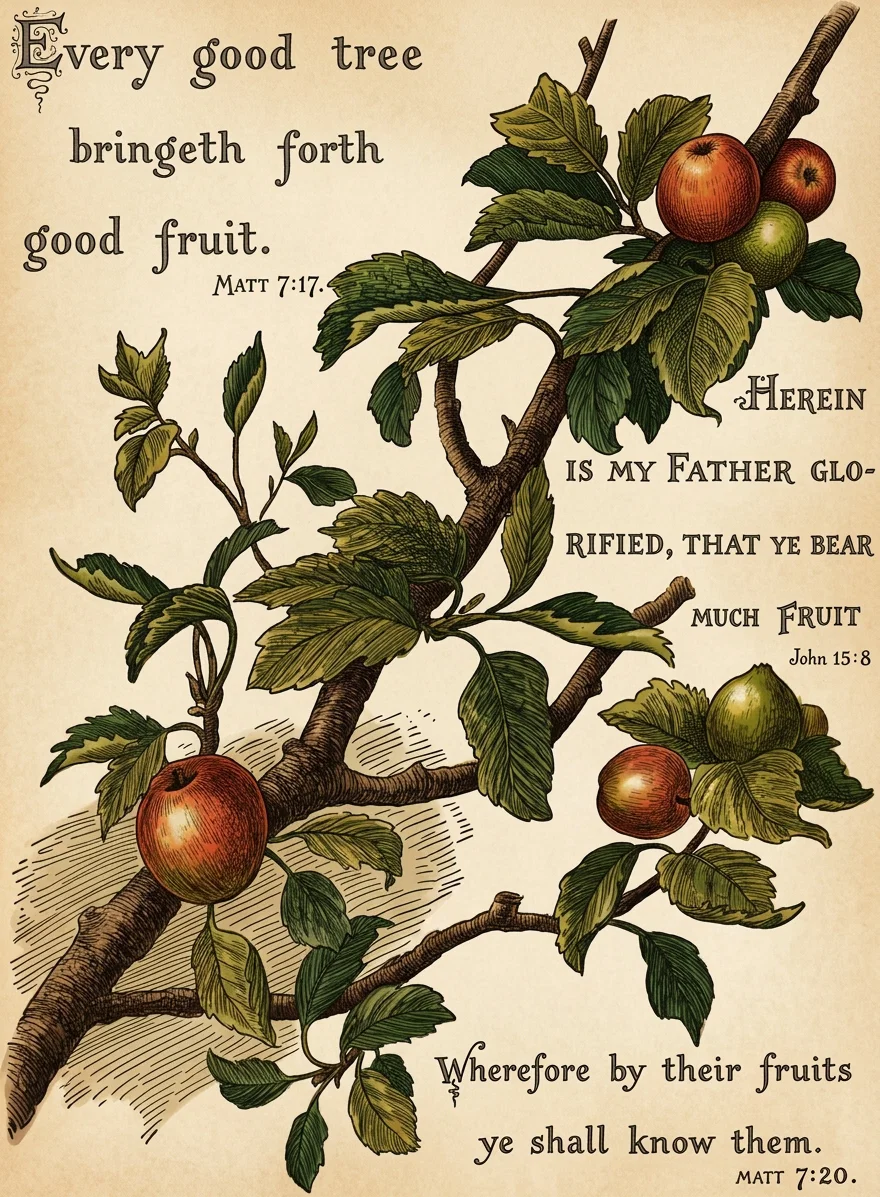
Our Lord gives us the test, a most effectual one for all peoples, ages, conditions and times. That test is—“Ye shall know them by their fruits.” (Matt. 7:16.) When the Jews boasted that they were free (John 8:33), because they were Abraham's seed, Jesus replied: “If ye were Abraham's children, ye would do the works of Abraham. . . . Ye are of your father the devil, and the lusts of your father ye will do.” (Verses 39–44). Said John the Baptist to the same class: “O generation of vipers, who hath warned you to flee from the wrath to come? Bring forth therefore fruits meet for repentance [“answerable to amendment of life,” margin]; and think not to say within yourselves, We have Abraham to our father; for I say unto you, that God is able of these stones to raise up children unto Abraham.” (Matt. 3:7–9). Man must be “born from above” before he becomes a child of God, before he is a member of Christ's body, or church, before he is a branch of the True Vine, before he bears fruit to God's glory. If this be not the case as respects the individual, he is not a member of the church of God. If this be not the case as respects a church, it is not the church of God. Lineage, priesthood, ritual, form, ceremonies, are all nothing apart from God. The indwelling word, Christ dwelling within the individual soul by faith, the fruits of righteousness manifest in the life, obedience to all God's commandments as given in God's word,—these are God's indications of the true church, the body of Christ. And, praise God, this blessed relation is open to every one. Reader, are you a member of the church of the living God? Are you his child? If not, why not?
One Mediator.
“There is one God and one Mediator between God and man, the man Christ Jesus.” Thus the apostle Paul writes to Timothy. God is one. He declares: “I am the Lord, and there is none else; there is no God beside me.” “There is no God else beside me; a just God and a Saviour; there is none beside me.” Isa. 45:5, 21. As there is but one God, so also there is but the one Mediator. A mediator is one who mediates, who goes between parties who are at variance, a peacemaker, an intercessor. God is governor of the universe. Man is a rebel against God's government. God wants to save man, and has made such provision that all may be saved who will accept the terms. As sinful man can not approach into the burning glory of God's presence, “God gave his only-begotten Son” to save man. That Son “gave himself,” stepped down from his position as Creator, veiled his glory in human flesh, and came down to the very lowest plane of human woe and misery in order to lift man up to God. He is “the fulness of the Godhead;” he is man with men. He is the ladder which reaches from sinful earth to the throne of God. He is the personal Saviour of every believing soul, the friend of every lost sinner. We need no Virgin, blessed tho she was, no saint how holy soever he may be, in order to get to Christ. All such go-betweens but hide the presence of our Lord. Like the unbelieving and uninstructed disciples of old, they would form a cordon, a holy guard, which would keep from the Fountain of Life, the thirsty, from the peace and rest of God the weary, from the Healer the soul-sick and body-sick. O reader, come to Jesus just as you are! All the excellencies, the tenderness, the condescension, the helpfulness which are found in any or all others are found more abundantly in him. None is so willing, none so able to help you; leave all others and go to him. He says, “Come unto me.”