Miracle and Lesson

6%

Pacific Press Publishing Company · Oakland, California · Mar 5, 1896

FromSigns of the Times, Vol. 22, No. 10.

Read the full edition

Miracle and Lesson

In John 6:15–21 is a short story of an event of wonderful interest in the earth-life of the Son of God. It reads as follows:—
“IT IS I; BE NOT AFRAID.”
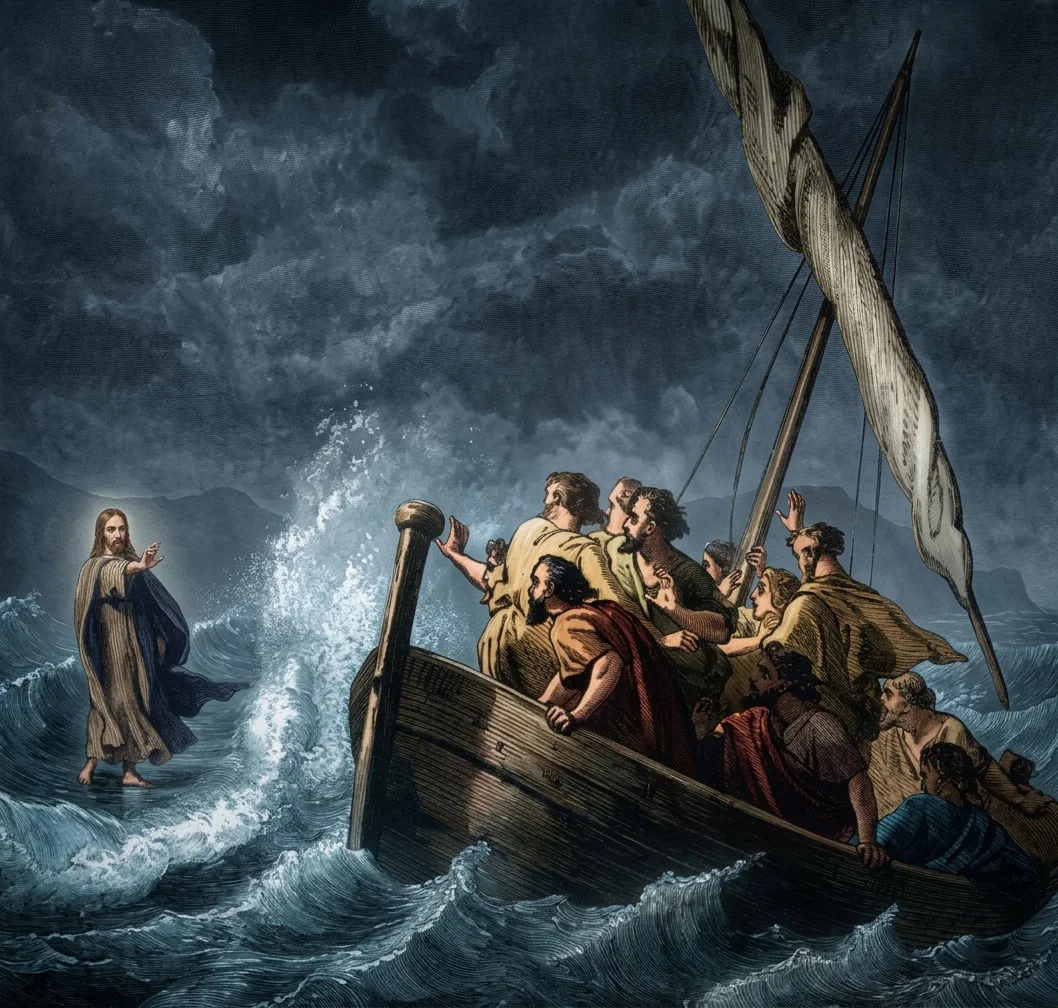
“When Jesus therefore perceived that they would come [“were about to come,” R. V.] and take him by force, to make him a king, he departed again into a mountain himself alone. And when even was now come, his disciples went down unto the sea, and entered into a ship, and went over the sea toward Capernaum. And it was now dark, and Jesus was not come to them. And the sea arose by reason of a great wind that blew. So when they had rowed about five and twenty or thirty furlongs, they see Jesus walking on the sea, and drawing nigh unto the ship; and they were afraid. But he saith unto them, It is I; be not afraid. Then they willingly received him into the ship; and immediately the ship was at the land whither they went.”

A Temporal Kingdom

Jesus had just fed the five thousand with five loaves and two fishes. This, with his wonderful teachings, impressed the people that the promised King had come. And such a King! he could supply all their needs in the desert, furnish all that was necessary to make them the first kingdom in the world, freed forever from the yoke of intolerance and oppression. As he offered not to become king, they would force the kingdom upon him, proclaim him king, rouse the Jews, and under such a mighty Leader throw off the Roman yoke. No doubt, whatever the selfish or patriotic motives of the people might be, Satan shaped the movement. It was the temptation in another form to avoid Gethsemane and Calvary.

“Not of This World.”

But Jesus knew the people, knew that it was the loaves and fishes rather than the reign of righteousness which they desired. He must reach the goal through self-denial, and so must all who come after him. Matt. 16:24. His “kingdom is not of this world.” John 18:36. It is not set up or to be set up by man. He receives it from the Father when his work is finished, as we are told in the Scriptures. (See Luke 19:12; Dan. 7:13, 14.) It will not be possessed till his second coming (Matt. 25:31; 2 Tim. 4:1), and then it will not be by the suffrages of the people that it is established, but “the zeal of the Lord of hosts will perform this” (Isa. 9:7). Jesus therefore left them alone, and sent even the disciples away. So also will he depart from those who in these days seek him or his cause for the loaves and fishes, for emoluments and honors, to make him a temporal king through the gateway of politics. How Christ will regard it now may be known by how he regarded it then. He will send them away, and he himself will depart.

A Night of Prayer

Jesus departed to pray. He must plead for the poor, blinded, selfish, deluded people, who could not understand his mission, or the nature of his kingdom, because they had not his Spirit. He knew before of their ignorance and hardness of heart. Even his chosen disciples were blinded. But on this day, when the bread furnished for the body should have led them to seek for the Bread of Life, he had come in contact with their selfish, erroneous ideas concerning his reign. He saw not only that multitude before him, but all succeeding generations. He saw his elect church yielding to the desires of the world. He saw the same principle work out the blackness and persecution of the Dark Ages. He saw in these days how his professed followers would nominally and outwardly make him king through selfish and political means. He saw it all, and how when he came to the same people in his truth, they would reject him, and crucify him again and again. Therefore he prayed alone. His disciples knew not the burden, because they did not know him or the people or themselves. He prayed for strength for the entire trial, prayed for that people and the people of all ages, prayed for his own.

The Disciples

Other evangelists tell us that he sent them away. Discouraged, doubtless, and dissatisfied at Christ’s refusal to be made king, they set out for the other shore, disconsolately propelling their boat. A storm arises, one of the wild, fierce, impetuous electric storms, perhaps, which sweep the Sea of Galilee, and threatens to engulf their frail craft. Discouragingly, yet with despairing energy, they labor on. It is not a long voyage, yet the night is nearly over, and they are still in the midst of the sea, the storm unabated. Their discouraged condition makes them superstitious and despairing. They fear they are doomed. The flashes of lightning but fill them with dread. Doubtless when all human hope was gone, they prayed. Even skeptics will do this. We are sure thedisciples of Jesus did. But what is that? A flash of lightning from the electric cloud reveals a figure walking on the water as upon the solid earth. Is it an answer to prayer? Their doubting, discouraged hearts hardly hope for this. It must be a phantom such as they had heard about in the superstitious law of the common people, even as we hear of them to-day. It was an ill-omened specter, presaging their destruction. The strong hands relax their grasp on the oars, and, trembling with terror, “they cried out for fear.”

“It Is I.”

But their prayer had been heard. Their Master had not forgotten them. He who had sent them on a mission would insure its success, despite “the prince of the power of the air.” He who created the world could control its storms. He who made the sea could walk upon its foam-crested billows as upon solid rock. His words of assurance reached the disciples, “It is I.” The Master had come; it was no ill-omened wraith, presaging certain doom. They knew the voice.

“Be Not Afraid.”

It would scarcely seem necessary that Christ should speak that word, after revealing to them who he was. But it is like God to make assurance doubly sure. He confirmed his promise to Abraham by an oath, so that the patriarch and his seed might have abundant evidence and strong consolation. He comforts the despairing and fearful disciples by his presence and assurance, “It is I, be not afraid.” What a change takes place in the little boat! Joy and hope take the place of fear and despair. The Deliverer has come, anticipating the dawning of the morning. He goes up into the ship; they willingly, O, how willingly, receive him! The storm instantly ceases, and straightway they are at the place to which they set out to go. Bowing before their Deliverer, they confess with humble gratitude, “Of a truth thou art the Son of God.” Matt. 14:33.

“That Ye Might Believe.”

The miracle and deliverance were wrought for the disciples’ sakes, but the story is written for our sakes, that we might also believe. Nay, more, these things “are written, that ye might believe that Jesus is the Christ, the Son of God; and that believing ye might have life through his name.” John 20:31. Jesus, the Son of God, is the same yesterday, to-day, and all days to come. We may have a part in his kingdom only in his way. We can not compel him to reign in our way. Reproofs are as necessary to men now as then, and if we insist on having our way, Jesus will depart from us. If in trouble, he sympathizes with us. If we call upon him, he will deliver us. If our hearts desire his help, if our life chords are all attuned to his voice, if our spiritual ears are attent to hear him speak, if our spiritual vision is longing to behold him, we shall hear his voice in the raging storm say, “It is I;” we shall hail with joy the blest assurance, “Be not afraid;” we shall behold him walking the storm-tossed billows with the tread of a conqueror coming to our rescue. How often he comes thus, perhaps in healing reproof, in what seems the sorest trouble, in unpopular truth! But in our blindness and perversity of humanity, we see only the ill-omened phantom. Happy indeed shall we be if we recognize and acknowledge him in all our ways. Do not fear the storms of life. Christ says, “Be not afraid.”