“Tempted Like As We Are.”— Says the Spirit of God in speaking of Jesus Christ:
“For we have not an high priest which can not be touched with the feeling of our infirmities; but was in all points tempted like as we are, yet without sin. Let us therefore come boldly unto the throne of grace, that we may obtain mercy, and find grace to help in time of need.” Heb. 4:15, 16.
Why Man Needs a Helper.—
When man yielded to the tempter in Eden, he sold himself a slave to sin. Rom. 6:16; 7:14. As the dominion of earth and all in it were given to him (Gen. 1:28), when he yielded himself to Satan, the earth and all within it passed from his control to that of the usurper (2 Cor. 4:4; Luke 4:6), and all creatures were made subject to vanity—death—by reason of man's subjection to Satan (Rom. 8:20). Man's flesh became sinful flesh, subject to the devil, its laws were perverted, and the holy emotions of purity became the unholy passions of selfish lust and sensuous indulgence.
The “Enmity.”— Man in yielding himself yielded all. But God's mercy did not leave him. “I will put enmity between thee and the woman, and between thy seed and her seed” (Gen. 3:15), are the words of the Lord to the triumphant deceiver. Therefore God implanted within the heart of man a longing for good, a hatred of evil, a conscience of sin. This may be blunted, stupefied, hardened by sin, but it is there, nevertheless, lightening every man that cometh into the world, and making it possible through the power of choice and exercise of faith to refuse the evil and choose the good. But this enmity to evil is subject to the carnal nature. In man is no power to extricate man. As one has said, “When I would do good, evil is present with me.” Rom. 7:21. While seeing beauty in God's law and delighting therein, it is still bound by the perverted law, the law of sin in the flesh. Verses 22, 23. It is the spirit dominated by the flesh, as the enslaved wife who longs to be free is bound by a tyrannical husband.
Christ the Deliverer.— But the same one found freedom in Christ Jesus. “For the law of the Spirit of life in Christ Jesus hath made me free from the law of sin and death. For what the law could not do, in that it was weak through the flesh, God [did by] sending his own Son in the likeness of sinful flesh, and for sin, condemned sin in the flesh; that the righteousness of the law might be fulfilled in us, who walk not after the flesh, but after the Spirit.” Rom. 8:2-4.
“Made Like unto His Brethren.”— In all things Jesus was made like men, save in yielding to sin. Yet he knew its power, for he had the same flesh. He was “made of a woman, made under the law” (Gal. 4:4), “made of the seed of David according to the flesh” (Rom. 1:3), and, in fact, was in the fullest sense the Son of man, clothed in all the weakness of humanity. As other men had sinful flesh, weakened by following perverted law through successive generations, responsive to the temptations of the threefold enemy, the world, the flesh, and the devil, so Jesus of Nazareth took the same flesh, that he might know man's temptations, that he might bear man's sins, and that the spirit born of God by faith might triumph over sin in the flesh.
A Triad of Trials.— The temptations of man sum up under three chief heads,—the inward cravings of the animal nature, the sin of presumption, or self-confidence, and the lust for the riches, fame, and power of the world. After the baptism of Jesus it is said that he “was led up of the Spirit into the wilderness to be tempted of the devil.” Matt. 4:1. He was there “forty days tempted of the devil.” Luke 4:2. The struggles of that forty days in the desolate wilderness we can never know. The doubts suggested as to whether he was the Son of God or not, as to whether his mission was to save men, as to whether he could conquer where Adam fell. In the sight of the visible glory of God, in less than forty days all Israel turned to a calf of gold. But Jesus proved faithful alone, surrounded with wild beasts, the chill air by night, the heat by day, the drear, desolate wilderness. Yet his faith pierced all the desolate atmosphere which enshrouded him and took hold upon God.
The Power of Appetite.— At the end of the2 (114)forty days' fast, Satan came as an angel of light, with the words, “If thou be the Son of God, command that these stones be made bread.” That he came as an angel of light we know, because he is the great deceiver; he does not reveal his true character till the last resort. See 2 Cor. 11:1. His first temptation was upon the point of appetite. Here our first parents fell. Satan would show to the Divine Father that all this hunger was not necessary for the Son of God. He also conveyed in his temptation a doubt of Christ's divinity. You need not suffer hunger, you should not, if you are the Son of God; and if you are, you will change these stones to bread. Jesus did not yield. The lost and fallen race had counted daily food, the indulgence of the flesh, more than the bread of eternal life, the word of God, through which all life, all food, all supply comes. Christ saw the failures of four millenniums, the excesses of the antediluvians, the degeneration of the cities of the plain, the fall of luxuriant Babylon, the deplorable end of men who could conquer the world, but not self, even the drunkenness of God's professed priests—all to a greater or less extent the deplorable results of appetite. He knew this weakness of men, and he was fighting the battles for them, overcoming in his own flesh, that he might overcome in the flesh of the weakest and vilest. He answered the tempter just as every tempted soul must answer, by the word of God: “It is written, Man shall not live by bread alone, but by every word that proceedeth out of the mouth of God.”
“The Sword of the Spirit.”— Jesus met the attacks of Satan by the only weapon which God has ever furnished to his followers, namely, “the sword of the Spirit, which is the word of God.” Eph. 6:17. But that weapon when rightly used by living faith, is always effectual. In it is all the power of God to do what is commanded or promised. It brought into existence the world, covered it with a flood, gathered into the seas its superabundant waters, made a path through the Red Sea, gave bread in the wilderness and waters in the desert; it has abounded to every good work. It “is living and powerful, . . . piercing even to the dividing asunder of soul and spirit, and of the joints and marrow, and is a discerner of the thoughts and intents of the heart.” Heb. 4:12. It strengthened the soul of Christ, and defeated the enemy. The weakest physically, clothed with God's armor, wielding by faith the sword of the Spirit, is more than a match for the strongest foe.
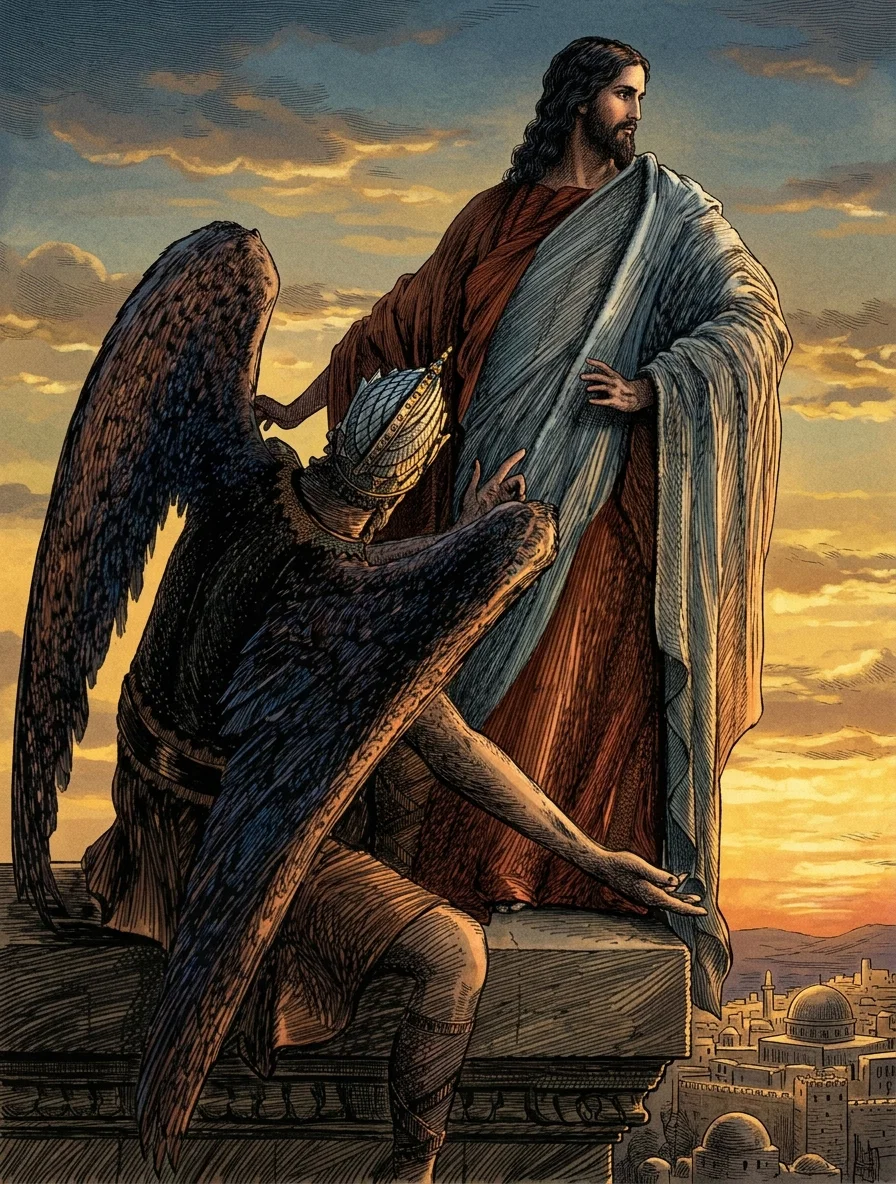
Presumption.— Sometimes our greatest danger comes just after some great victory. We feel that we are strong, and we are inclined to lay aside anxiety and trust to our own resources. So Israel thought after the walls of Jericho fell, surely little Ai would fall; but it meant loss and humiliation to overconfident Israel. It was upon the sin of presumption that Christ's next temptation came. Satan came with scripture in his mouth. “Then the devil taketh him up into the holy city, and setteth him on a pinnacle of the temple, and saith unto him, If thou be the Son of God, cast thyself down; for it is written, He shall give his angels charge concerning thee; and in their hands they shall bear thee up, lest at any time thou dash thy foot against a stone.” Satan quoted from Ps. 91:11, 12. And is not the scripture true and the promise sure?—Yes, indeed, but not for self-salvation or honor. Not once may God's power or protection be asked to minister to selfish lust or fame. See James 4:3. It would not be to God's glory to yield to the tempter. It would simply call attention to Jesus, not to the Father who sent him. The meaning of this scripture was demonstrated to Satan on another occasion when his servants tried to destroy Christ. See Luke 4:28-30. Jesus met the tempter with the word, “It is written again, Thou shalt not tempt the Lord thy God.” The first scripture quoted by Satan must not conflict with the one our Lord quoted. When some passage is dark, when Satan suggests a meaning which will minister to self, it is well to remember, “It is written again.” And again by the word Jesus conquered.
“The Lust of the Eyes, and the Pride of Life.”— It was the world and all its glory next. Satan does not come this time with an “if,” a doubt as to Christ's divinity. He throws off disguise, takes Christ to a high mountain, shows him in panoramic view all the kingdoms of earth, with all their glory, contrasts it with Christ's appearance, surroundings, and future sufferings, and then declares: “All this power will I give thee, and the glory of them; for that is delivered unto me; and to whomsoever I will, I give it. If thou therefore wilt worship me, all shall be thine.” Heretofore Satan came as a solicitous friend, a candid doubter, with Scripture on his tongue. Patiently, altho he doubtless knew him, Jesus answered him instructively. But when at last Satan reveals his true character, putting himself in the place of God, Jesus answers, “Get thee hence, Satan; for it is written, Thou shalt worship the Lord thy God, and him only shalt thou serve.” The great temptation was ended; Jesus was victor.
Lessons and Comfort.— We learn by this great temptation Christ's regard for Scripture; and it is a remarkable fact that he quoted from the writings of Moses, which the “Higher Critics” have treated so irreverently and contemptuously. See Deut. 8:3; 6:16; 10:20. To use the word one must have the word. “By the word of thy lips,” says David, “I have kept me from the paths of the destroyer.” Ps. 17:4. “Thy word have I hid in mine heart, that I might not sin against thee.” Ps. 119:11. It is only by the truth of the word, by the love of the truth, that we can escape the devices of the enemy. 2 Thess. 2:10-12; Ps. 91:4.
While the world was delivered unto Satan by Adam, he has no right to its dominion. Adam was given dominion that he might rule to God's glory. Satan is a usurper. The earth and all in it is doubly Christ's—by creation and redemption. We are bought with a price; let us yield ourselves to God.
We truly worship him whom we truly serve. “Why call ye me, Lord, Lord, and do not the things which I say?” says Jesus. Vain is the worship of men when they follow their own ways in preference to his. They are yielding to him who exalts himself to the place of God.
Christ won the victory in every point over the prince of all evil. He met temptations so great, with himself so weak, that these temptations can never be surpassed. Christ conquered for us, for you, sinner, whoever you may be. He holds that victory for you now if you will take it. He lived his life in sinful flesh, that he might live it again in you. He was tempted in all things, even as we; he is therefore able in all things to succor the tempted. In his humanity every fiber has been tried. The life of God has overcome the sin. And that life, given freely through Christ to every heart of longing faith, throbs responsive to every pain, every trial, every temptation which comes to his children. O sinner, accept him! He is a complete, a perfect Saviour. He will live his life in you if you will let him, and make true your wish to be a true man, a loyal citizen of heaven, and heir of God.
Christ Jesus Our Example.— Where self is given, there is nothing reserved. In this sense God the Father gave himself; for “God is love,” and Love gave the dearest thing in all the universe. When Christ gave himself in that far-back beginning, he held nothing in reserve. When the time came for him to act as the Captain of the Lord's host of angelic messengers to this sinful earth, he who was in the image of God did not affect to reign on the throne of the universe, but took upon him the form of the servant. He served with the other heavenly messengers as Michael—the one like God. He came with messages of mercy to Abraham, Jacob, Moses, Joshua, Isaiah, Daniel, and others. When the time came to be manifest in the flesh, there was nothing to hold him back; he had already yielded. When the temptation in the wilderness came, he followed the leading of the Spirit, submitted to the long fast, the fierce hunger, and the fearful test. And so with all the other temptations,—the garden, the denial, the persecution, the ignominious death,—he submitted to all, for he had already submitted to all when he gave himself.
In all this Christ is our example. He says, “If any man will come after me, let him deny himself, and take up his cross daily, and follow me.” Luke 9:23. The only cross which avails is the cross of Christ. See Gal. 6:14. All the sins of the world were borne there by Christ Jesus. If we believe him, if we accept him as our Saviour, we count his sacrifice ours by living faith. We reckon our sins as being there. We reckon his death for our sins as our death, and to him we give all the sins. And as the root or basis of sins is selfishness, we give up, if we truly believe Christ, all of self. We are to do as Christ did, empty ourselves. He “emptied himself” of himself, and God filled him with all his fullness. Thus it was that God gave himself through Christ for the world. We are to empty ourselves of self, and Christ will fill us.