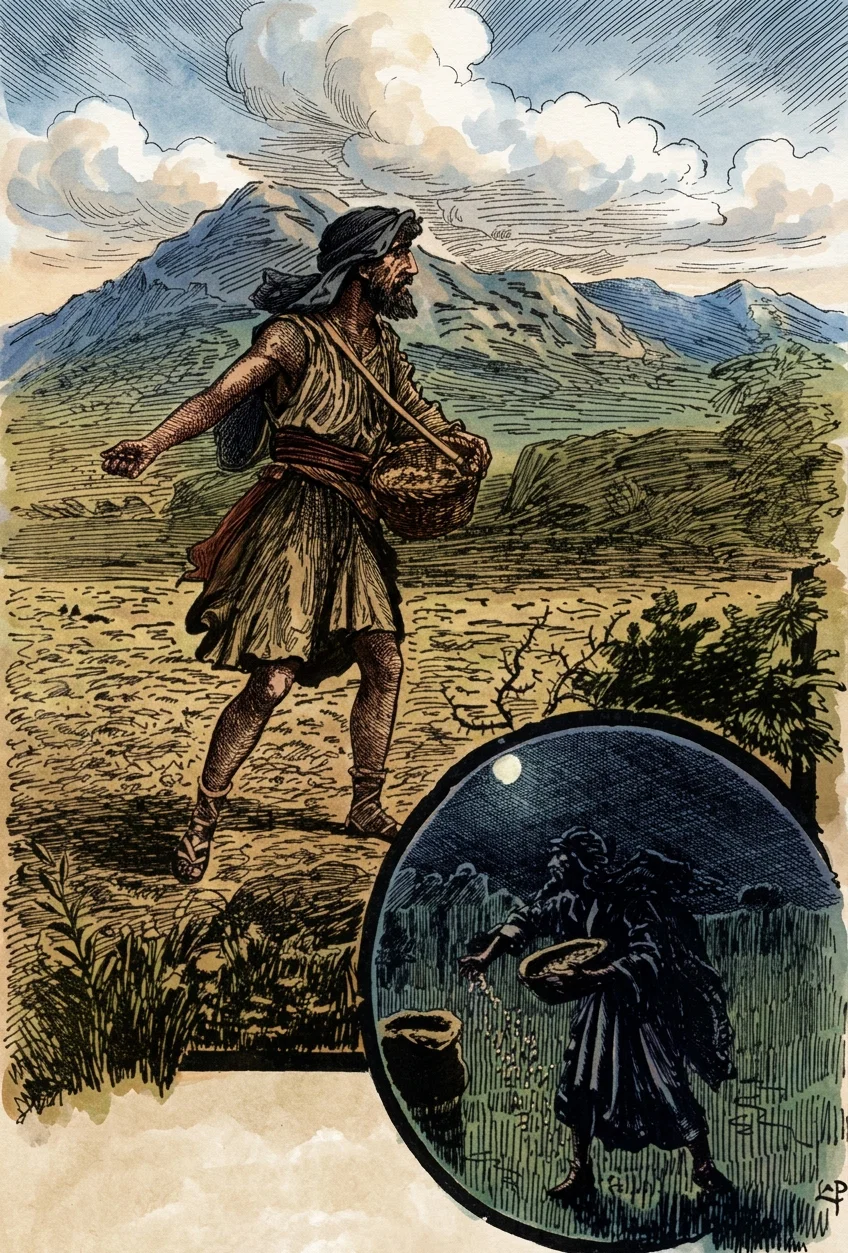
The Sowers.—One of the comprehensive parables of our Lord is that commonly called the “Parable of the Wheat and Tares,” or the “Parable of the Tares.” It is recorded only by Matthew, and reads as follows:—
“The kingdom of heaven is likened unto a man which sowed good seed in his field; but while men slept, his enemy came and sowed tares among the wheat, and went his way. But when the blade was sprung up, and brought forth fruit, then appeared the tares also. So the servants of the householder came and said unto him, Sir, didst not thou sow good seed in thy field? from whence then hath it tares? He said unto them, An enemy hath done this. The servants said unto him, Wilt thou then that we go and gather them up? But he said, Nay; lest while ye gather up the tares, ye root up also the wheat with them. Let both grow together until the harvest; and in the time of harvest I will say to the reapers, Gather ye together first the tares, and bind them in bundles to burn them; but gather the wheat into my barn.”
Light to the Upright.—There has been much speculation and many interpretations of this parable among expositors and teachers. It has been wrested and warped in every conceivable way to fit this doctrine or that, or to escape the conclusions of the parable itself. All this has been done in the face of the fact that our Lord himself has given us the interpretation of the parable. And yet those who thus construe the teachings of our Lord fulfill the very words of Jesus, spoken on the occasion when this parable was given. There is light in the parables of Christ in all his teachings if men will seek it aright, if they truly desire to walk in the light. “To the upright in heart there ariseth light in the darkness.” “Light is sown for the righteous.”
The precious jewels of truth are not given to be trodden underfoot of swine. They are living food to the hungry soul. “Blessed are they that hunger and thirst after righteousness; for they shall be filled.” The parables of Christ were given to illustrate the very truths which were already in the possession of the Jews, but they could not see them, because they did not know in their own lives the power of the truth. Wherefore, our Lord said:—
“For this people’s heart is waxed gross, and their ears are dull of hearing, and their eyes they have closed; lest at any time they should see with their eyes, and hear with their ears, and should understand with their heart, and should be converted, and I should heal them.”
The More Hopeless.—None are so blind as those who will not see; none so hard of hearing aright as those who stop their ears against instruction; none so hard-hearted, vile criminal though he may be, as those who determinedly resist the truth. The scoffing Pharisee at the foot of the cross who prided himself on his righteous life, was harder of heart than the penitent thief who was suffering justly for his crimes. Let the heart and life be opened toward God, and his truth will ever be light and beauty.
The Interpretation.—After Jesus had spoken the parable, his disciples came unto him and asked its meaning. He replied as follows:—
“He that soweth the good seed is the Son of man; the field is the world; the good seed are the children of the kingdom; but the tares are the children of the wicked one; the enemy that sowed them is the devil; the harvest is the end of the world; and the reapers are the angels.
“As therefore the tares are gathered and burned in the fire; so shall it be in the end of the world. The Son of man shall send forth his angels, and they shall gather out of his kingdom all things that offend, and them which do iniquity; and shall cast them into a furnace of fire; there shall be wailing and gnashing of teeth. Then shall the righteous shine forth as the sun in the kingdom of their Father. Who hath ears to hear, let him hear.” Matt. 13:37–43.
Christ the Sower.—Nothing can be plainer than the meaning here given. We may enlarge upon the meaning; but the words may not be perverted. Christ is the sower, not alone personally, but through his representatives. The good seed are the children of the kingdom, Christ’s kingdom of righteousness. They are made what they are by receiving the incorruptible seed of life, the word of God. See 1 Peter 1:23; Luke 8:11. The word is spirit and life (John 6:63), and all those who have received that word, and “in an honest and good heart” “keep it, and bring forth fruit with patience” (Luke 8:15) are the children of the kingdom of God.
The Evil Sower.—The sower of the evil seed is the devil, with all his agents, and his time of sowing is from the time that sin entered into this world till the end. He sows not truth, but lies, error, falsehood. “He is a liar, and the father of it,” and “abode not in the truth.” He does not love truth. Himself deceived, his object is the deception of others. While he seems at times to use truth, it is but the surface facts by which he hides the lies. The truth is eternal and infinite. It roots in the Everlasting Throne and draws its nourishment2from the river of life. But error is the surface of truth perverted. It is the stream of life perverted to the channel of death. Satan uses every device, every artifice of evil, with, just so far as will serve his purpose, a veneering or interweaving of truth. But it is never truth for truth’s sake, but for his own baleful, selfish purpose; and for this he ever appeals to some base, selfish motive of man. And this seed of error and evil received into the heart of men makes them children of the wicked one, represented by the tares, or darnel.
Patiently Wait.—Man is finite. He knows but little. He can not always tell the young tares from the wheat. Sometimes the two plants are so intertwined that to root up one roots up the other. Therefore to man in this life is not committed the judgment of his fellows. Even Jesus did not thus judge. John 12:47. We must wait till the harvest, the end of the age, when the righteous will be taken to their eternal home, and the wicked receive the thing they have chosen, death.
Some Other Lessons.—We learn also from this parable that there never will come a time in this present arrangement of things when all men will be converted. Both the good and the evil, the righteous and the sinner, will remain together on earth till the harvest time. We learn that there will be no everlastingly burning hell, but as “the tares are gathered and burned in the fire,” so shall it be with the wicked. They have chosen destruction; and their “end is destruction.” See Phil. 3:19; Mal. 4:1–3. The parable is a fruitful field, but we may glean no more at present. But, reader, the great question is, What seed is sown in your heart? Whose child are you? This is for you to decide. May you do it wisely, in view of eternity.