JESUS AND THE SABBATH

5%

Pacific Press Publishing Company · Oakland, California · Jan 30, 1896

FromSigns of the Times, Vol. 22, No. 5.

Read the full edition
JESUS AND THE SABBATH.

BY J. H. D.

His Teaching and Example.

In considering this part of the symposium, it is well to consider very briefly the character of Christ. He is the Son of God. He says: “I came forth from the Father, and am come into the world; again, I leave the world, and go to the Father.” “I am not alone, because the Father is with me.” John 16: 28, 32.
Coming from God shows that he had a pre-existence with the Father before his birth into the world. His own words revealed his existence with the Father before he was manifested in the flesh: “And now, O Father, glorify thou me with thine own self with the glory which I had with thee before the world was.” John 17:5. It was when the space now occupied by this solar system was void, and man was yet a being of the future, that Jesus Christ sat with the Father, and together they planned for the creation of the world, with man for its ruler. “Let us make man” was the word spoken by Jehovah to his Son, and man came forth. See Ps. 33: 6, 9; Gen. 2: 7.
After completing his work in the creation of man upon the sixth day, “God rested on the seventh day from all his work which he had made. And God blessed the seventh day, and sanctified it; because that in it he had rested from all his work which God created and made.” Gen. 2: 2, 3. The power of creating all things must have been manifested through Christ. “In the beginning was the Word, and the Word was with God, and the Word was God. The same was in the beginning with God. All things were made by him; and without him was not anything made that was made.” John 1: 1-3. From Christ’s own statement nothing was made without him. Everything, however small or great, that was made, had his presence in the making.
Of the Sabbath Christ said, “The Sabbath was made.” Mark 2: 27. Then, from the previous statement, who was its maker? It must have been the One who said, “The Sabbath was made for man.” If he made it, he would be the best prepared to teach by precept and example how it should be observed. Therefore, in considering his relation to the Sabbath, we will note, (1) his teaching; (2) his example.

His Teaching.

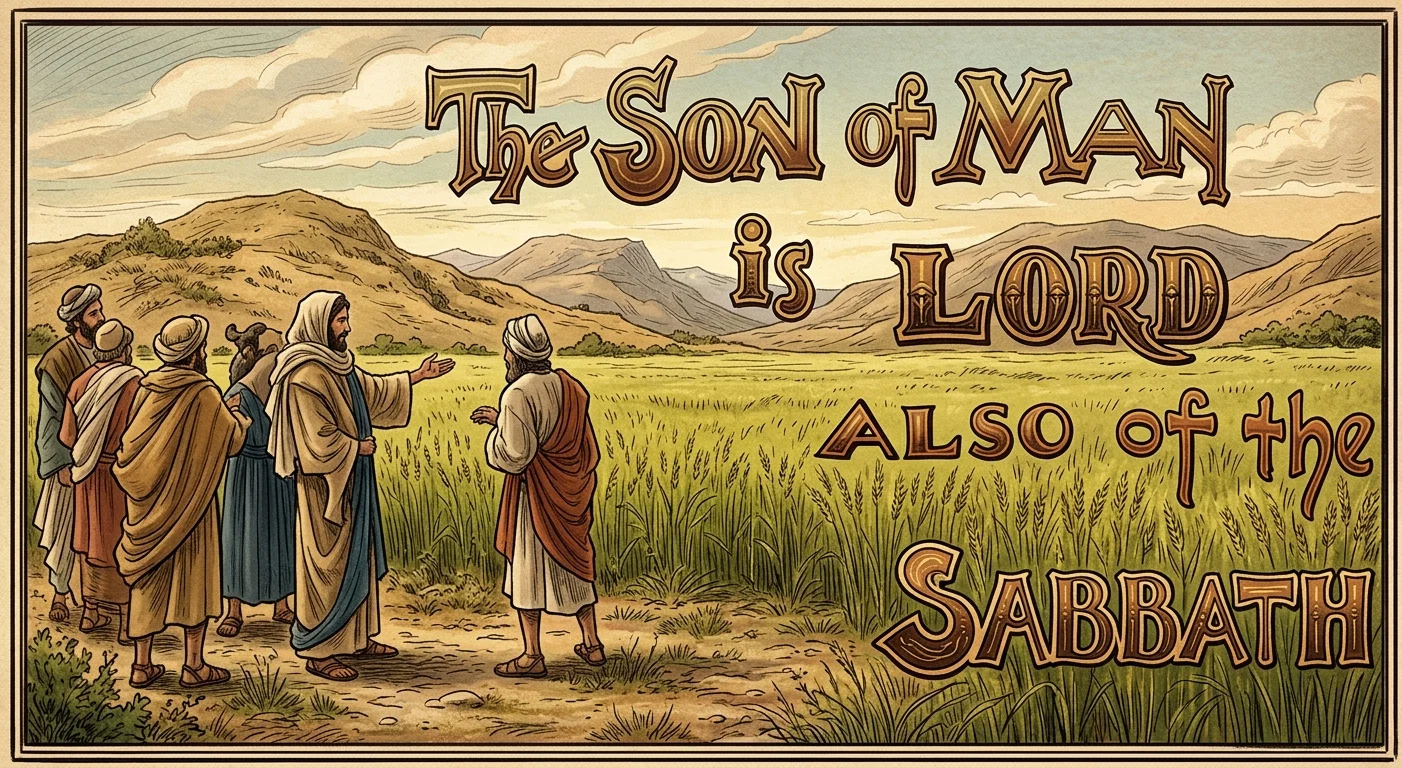
Christ taught that “the Sabbath was made for man, and not man for the Sabbath; therefore the Son of man is Lord also of the Sabbath.” Mark 2: 27, 28. The Syriac Version reads: “The Sabbath was made on man’s account, and not man for the sake of the Sabbath. Therefore also the Son of man is Lord of the Sabbath.” He, with his Father, made the Sabbath for, or on account of, man; therefore it was to be a blessing to mankind.
The Jews had, by their traditions, so hedged in the Sabbath that it was a burden. While they endeavored to legislate so as to have the Sabbath kept sacred, they only hindered those who had it in their heart to honor this institution. No part of the Jewish system was so marked as their strictures in the outward observance of the Sabbath as a day entirely free from labor. The interpreters of the law had inferred from the commandment a multitude of prohibitions and injunctions, covering everything in the social, individual, and public life. They carried many of these things to extremes that were ridiculous. Their rules extended to the kinds of knots that might lawfully be tied upon that day. A knot which could be untied with one hand might be undone. A shoe, or sandal, a woman’s cup, a wine, or oil-skin, or a flesh-pot might be tied. To write two letters with the right hand or the left, whether of the same size or different sizes, or in different languages, was considered to be a violation of the Sabbath commandment. Also, the quantity of food that might be carried on the Sabbath from one place to another was duly settled by their laws. To kindle or extinguish a fire on that day was a desecration, and even the sick must not be treated for their disease until the Sabbath sun had set. The rabbis held that whatever endangered life made the Sabbath law void, “for the commandments were given to Israel only that they might live by them.” If a man was buried under a ruin on that day, he might be dug for and taken out if alive, but if dead, he was to be left where he was until the Sabbath had passed.
A Sabbath day’s journey was prescribed as within 1,213 yards. While they had no definite distance named by Moses, yet it was commanded that no one should go outside the camp to get manna. The wise interpreters of the law had demonstrated that the Levitical towns were to have a district of 1,213 yards in breadth on all sides (Num. 35: 5), and there was to be the same distance between the ark and the people of Israel in their march behind it; therefore the conclusion that that was the distance between the tabernacle and the edge of the camp, out of which no one was to go.
When Christ came among them, he taught them that the Sabbath still occupied the place that it did at first, but it was for man rather than against him. He therefore used every opportunity to show all with whom he came in contact the true nature of the Sabbath. When he met the man with the unclean spirit whom the Jews would have passed by, he said, “Hold thy peace, and come out of him.” When questioned in regard to doing these acts of mercy on the Sabbath, he asked his accusers: “What man shall there be among you, that shall have one sheep, and if it fall into a pit on the Sabbath day, will he not lay hold on it, and lift it out? How much then is a man better than a sheep?” Then follows a declaration that teaches the true idea of sabbath-keeping: “Wherefore it is lawful to do well on the Sabbath days.” Matt. 12: 11, 12. He had given a law to govern the Sabbath as to the time it should be kept and the manner of its observance: “Remember the Sabbath day, to keep it holy; six days shalt thou labor, and do all thy work; but the seventh day is the Sabbath of the Lord thy God.” This command contained no injunctions that would forbid the caring for the sick or doing any act of mercy.
This Sabbath commandment was placed in the bosom of God’s great law, and was a part of the law of which Jesus said, “Till heaven and earth pass, one jot or one tittle shall in nowise pass from the law, till all be fulfilled.” Matt. 5: 18. In this declaration he taught the perpetuity of the law, of which the Sabbath was a part. He did not regard it as a Jewish institution or he would have accepted their regulations in regard to its observance. But as his own institution, for the good of mankind, he could have no fear in speaking in its defense.
In his discourse in regard to the awful judgment that would befall Jerusalem, after he should again ascend to his Father, he speaks of the Sabbath and its observance. “Pray ye that your flight be not in the winter, neither on the Sabbath day.” Matt. 24: 20. Jerusalem would be besieged and his people in danger of being destroyed. There would come a time when the armies would be withdrawn for a time, and all that would remember his words could flee to the mountains. Although more than thirty-five years should elapse before this should occur, yet he admonished them to pray that it might not be in the winter, for then they might perish in the mountains; neither on the Sabbath day, for then they would be obliged to desecrate it by their traveling, and providing for their comforts. Thus in his prophetic declaration, he teaches that the Sabbath should exist, and should be properly observed, at the time of the destruction of Jerusalem, which took place in A.D. 70.

His Example.

It is often said that example teaches with more power than precept. Jesus lived on the earth more than thirty years. The last three of these he was very actively engaged in the public ministry. He went about doing good as well as teaching good. In regard to his relation to the Sabbath we read, “He came to Nazareth, where he had been brought up; and, as his custom was, he went into the synagogue on the Sabbath day, and stood up for to read.” Luke 4:16. From his childhood he had been brought up by his mother to reverence the Sabbath and be present at the services in the synagogue. When he began his ministry, he did as he had been accustomed to do,—he recognized the sacredness of the day by refraining from the labor of the six days and taking a part in the Sabbath worship.
In his active ministry on the Sabbath is the best object lesson on how he regarded it. “He went about doing good.” When he met the poor, unfortunate man, possessed with an evil spirit, he regarded not the traditions of the Jews, but with a word freed him from his bondage. When he went to Peter’s house and found his wife’s mother sick with a burning fever, he stopped not to ask the rabbis whether they considered it lawful to heal, but took her by the hand, and commanded the fever to depart. When passing through the corn field with his disciples, he took another opportunity to defend this institution. His disciples took of the corn, as was lawful for one passing through the field, and did eat. The Pharisees, who were watching to bring a charge against him, remembered that all species of threshing was forbidden. They construed the act of separating the grain from the head of wheat, by rubbing it in the hands, as a kind of threshing, and accused the disciples of Sabbath breaking. He defended the act by teaching them that the Sabbath was a day for acts of humanity and mercy rather than for criticism and wicked thoughts. In every act he upheld the sacredness of the Sabbath and tore away the traditions that made its observance a hardship rather than a pleasure.
Time has sped away, and this Saviour now lives in the presence of the Father. Hehas not changed. He regards the Sabbath to-day as he did at that time. Were he here now, he would say, “The Sabbath was made for man.” He is still its Lord, and desires that it shall be kept in a manner so as to make it a pleasure. Good acts are proper, and ministering to the sick and discouraged is what he wants his people to do on the Sabbath at the present time. It is the same Sabbath and the same Saviour.
We may pile up traditions around this institution until it becomes as irksome to us as it did to them. We may make rules for its proper observance that will make it a hard yoke to bear, and thus cause the Sabbath to be trodden underfoot. But let us go to Jesus and ask him how he would have us as individuals observe the Sabbath.