Within twenty-five years of the ascension of Christ, Paul said, “The mystery of iniquity doth already work.” 2 Thess. 2:7. However, a counter influence was then checking the development of this wickedness; but when the restraint should be removed, the full-grown strength of the apostasy would appear. In the same chapter the apostle spoke of a fearful backsliding in the church, which would bring forth and foster a monster of iniquity, called the “man of sin,” who, said the apostle, “opposeth and exalteth himself above all that is called God, or that is worshiped; so that he as God sitteth in the temple of God, showing himself that he is God.” 2 Thess. 2:4.
None but a professed Christian power backslidden from God could fulfill these predictions, and that by establishing laws of its own, contrary to the laws of God, and then demanding that its laws be obeyed as of divine appointment in the place of the law of God.
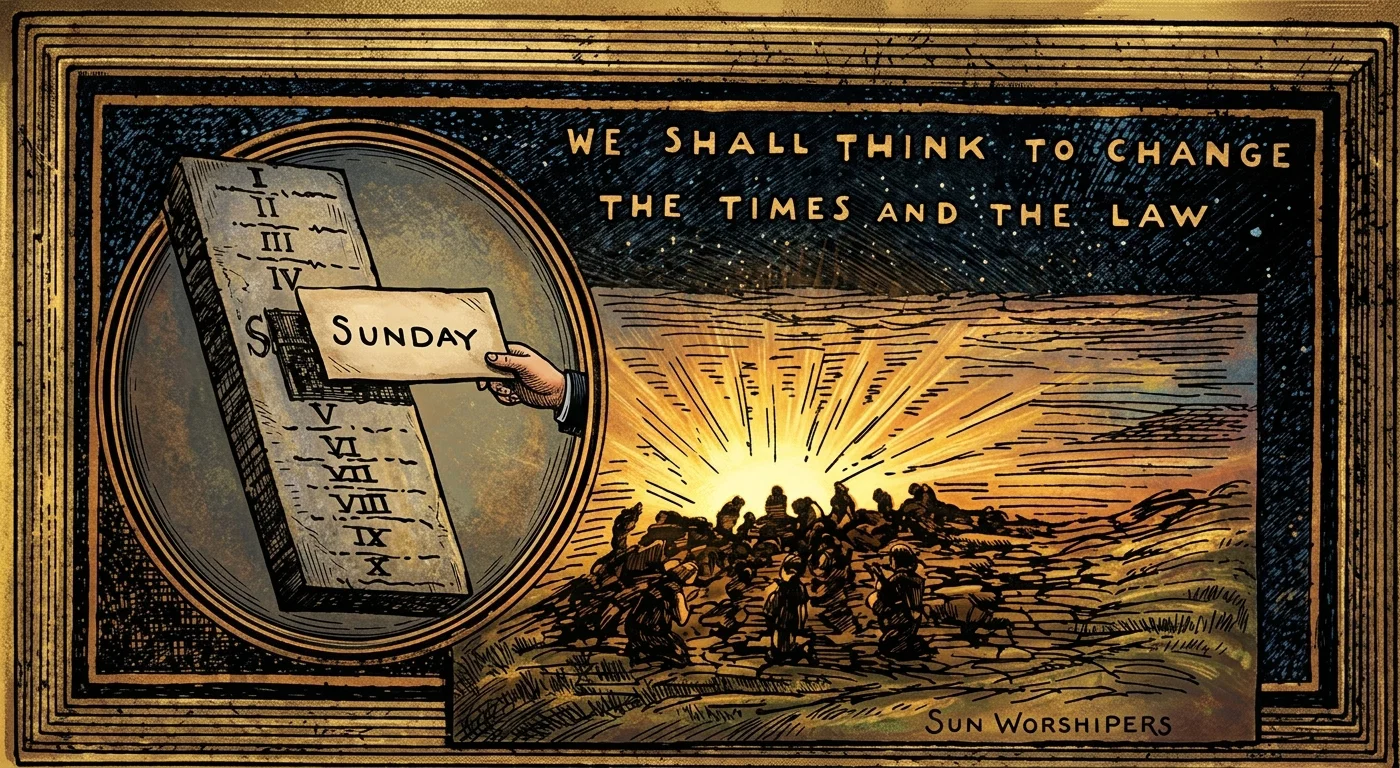
But all this was done by the apostate church, the center developed in Rome. Of this apostate power the prophet declares: “And he shall speak words against the Most High, and shall wear out the saints of the Most High; and he shall think to change the times and the law; and they shall be given into his hand until a time and times and half a time.” Dan. 7:25, R. V.
The papal church comes forward and claims to have done precisely what is predicted regarding a change in the law of God.
Her history also accords with her claim, and shows, too, that she has fulfilled all the other specifications of the prophet.
In a work entitled the “Abridgment of Christian Doctrine,” the Roman Church sets forth her claim of power to change God’s law by a series of questions and answers, one of which is as follows:—
Question—How prove you that the [Catholic] church hath power to command “feasts and holy days”?
Answer—BY THE VERY ACT OF CHANGING THE SABBATH INTO SUNDAY.
In answer to a similar question propounded in the “Doctrinal Catechism,” the answer is: “Had she not such power, she could not have done that in which all modern religionists agree with her,—she could not have substituted the observance of Sunday, the first day of the week, for the observance of Saturday, the seventh day, a change for which there is no scriptural authority.”
Here is a veritable fulfillment of the prophecy which says this power should think himself able to change the times, and the law of God. The above is a confession of the crime; and the same is argued again and again in many books of tradition written by the Roman Catholic writers. Equivalent statements are also found in most apologies and attempted defenses of their course by Catholics.
Eusebius, in writing of what had been done by Constantine, Pope Sylvester, himself, and others who lived in the early part of the fourth century, said, “All things whatsoever that it was duty to do on the Sabbath, these we have transferred to the Lord’s day,” meaning Sunday.
That which Catholics boastfully display as a badge of their authority, the Lord points out as an evidence of their apostasy, and charges it against them as a great crime committed against him and in opposition to the eternal law of his government.
What Paul classes with the “mystery of iniquity,” the papal church claims, upon the authority of the “fathers.” Those errors which to Paul showed a “falling away” the Roman Church holds sacred as “apostolic tradition.” Its rites and customs are little else than a compilation of heathen mysteries, and if these were taken away, that church would not exist.
But the most ancient of them all is the Sunday festival. The first Sunday law was issued by Constantine in A.D. 321, yet in the law he referred to the antiquity of the heathen institution of sun worship when he asked judges, townspeople, and tradesmen to “rest on the venerable day of the sun.” It was then hoar-headed with very age, having constituted a large factor of Baalism from the earliest period of authentic history. It was taught in the Babylonian system that the sun, or Baal, was the one only god, or god incarnate.8
Baal, was worshiped as the sun incarnate.
In these heathen “mysteries” the “sun” was sometimes represented as born incarnate in the person of some hero for the purpose of subduing the enemies of the gods. See “Researches of Col. Vans Kennedy,” p. 438. In these instances the mother of the incarnate “sun” usually claimed a sunbeam from the orb of day to be the father of the god. Every nation of ancient times had gods which called for the adoration of the sun.
In Egypt the sun was worshiped through a disk-crowned serpent, the bull Apis, Osiris, and many other forms. It was adored in India, Babylonia, Persia, and other places, as Mithra, Tammuz, etc.; in Greece, as Apollo; in Pagan Rome, as Jupiter and other kindred divinities. The figures representing these gods were usually adorned with a luminous circle about the head. Modern Roman idolatry still retains the disk, a sure badge of the sun divinity.
God gave the Sabbath to man as a memorial of his love to his creatures, and an ensign of his power to keep and bless them. But Satan darkened the mind of man through idolatry, and then substituted the Sunday for the Sabbath of the Lord.
Idol worship, including the Sunday festival, was the principal means of leading the children of Israel astray in all their backslidings from the time they left Egypt until their captivity by Nebuchadnezzar.
Within forty days of the making of the first covenant they had made a golden calf—an image to represent the Egyptian sun god Apis, and had worshiped it, after the rites of sun worshipers.
Jennings, in writing of the attitude of the heathen nations upon this subject, at the time Israel left Egypt, says: “The day which the heathen in general consecrated to the worship and honor of their chief God, the sun, which, according to our computation, was the first day of the week.”—Antiquities, book 3, chap. 3. Many historians and lexicons give equivalent testimony. The ten tribes of Israel were absorbed by the heathen because they had become wholly idolatrous. 2 Kings 17:15–17, 23. The people of Judah were carried into Babylon for the same offense. 2 Chron. 33:3–7, 36:14–17.
It was through these idolatrous influences that the Sabbath was transgressed by Israel even in the wilderness. “Neither did they forsake the idols of Egypt.” “Because they despised my judgments, and walked not in my statutes, but polluted my sabbaths; for their heart went after their idols.” Eze. 20:8, 16.
As with Israel in leaving Egypt, so with many professed Christians in leaving heathenism,—“they did not every man cast away his idols.” Yes, it was even worse with thousands in the early church, for they remained in the midst of an idolatrous people.
The Roman Church was established in the midst of a sun-worshiping population, who in general observed no sabbath except the weekly festival of the sun, which was celebrated on the first day of the week. As the membership of the church increased, multitudes of half-Christianized pagans came in, and with them many heathen philosophers.
Princes and politicians began to see by this time that the church could be used as a means of advancing their own interests. Therefore they united with it to control its rites, and shape it in policy to suit their own ends.
They were then in the midst of the “falling away” spoken of by the apostle. Of that time it is said that princes were anxious that politics should become questions of theology, and the clergy were equally solicitous that theology should become questions of politics. Thus it came to pass that each party sought the help of the other, and the consequence was a union of church and state.
Among the first things brought into the controversy by this church and state alliance was the Sabbath question, which in time resulted in anathematizing the Sabbath of the Lord—the memorial of what the Creator and Redeemer is to man—and putting in its place the Sunday of heathenism.
Dr. Peter Heylyn, a noted scholar of the Church of England, in speaking of how the Sunday got into the church, said it was taken up amongst them [church members] and made a day of meeting in the congregation for religious exercises; yet for three hundred years there was neither law to bind them to it, nor any rest from labor or worldly business required upon it. And when it seemed good unto Christian princes, the nursing fathers of God’s church, to lay restraints upon their people [about observing Sunday], yet at the first they were not general; but only that certain men in certain places should lay aside their ordinary and daily works, to attend God’s service in the church. Those whose employments were most toilsome were allowed to follow and pursue their labors because most necessary to the commonwealth. And in the following times, when, as the prince and prelate, in their several places, endeavored to restrain them [farmers] from that also . . . it was not brought about without much struggling and opposition of the people, more than a thousand years being past, after Christ’s ascension, before the Lord’s day had attained that state in which it now standeth.—History of the Sabbath, Part II, chap. 3, sec. 12.
The “princes and nursing fathers” referred to above were such men as Constantine, Eusebius, Pope Sylvester, etc. And such as they changed the Sabbath. The Christian(?) Prince Constantine made the first Sunday law while he was a heathen and worshiper of the sun, A.D. 321. The law reads:—
Let all the judges and townspeople, and the occupation of all trades, rest on the venerable day of the sun; but let those who are situated in the country, freely and at full liberty attend to the business of agriculture.
A little later (A.D. 323), Constantine professed the Christian religion, but made no change in the Sunday law, because he had not changed his religion. He only called his religion by another name. Sir William Domville says:—
Centuries of the Christian era passed away before the Sunday was observed as the sabbath.—Examination of Six Texts, p. 291.
“Chambers’ Encyclopedia” says:—
By none of the fathers before the fourth century is it [Sunday] identified with the Sabbath.
William Prynne, an English divine, says:—
The Council of Laodicea, A.D. 364, first settled the observance of the Lord’s day [meaning Sunday], and prohibited the keeping of the Jewish Sabbath [Sabbath of the Lord] under anathema.—Dissertation on Lord’s Day, p. 32.
“Chambers’ Encyclopedia” further says:—
It was not till 538 that abstinence from agricultural labor on Sunday was recommended rather than enjoined by an ecclesiastical authority [the third council of Orleans], and this expressly that the people might have more leisure to go to church and say their prayers; nor was it till about the ninth century that the Emperor Leo, “the philosopher,” repealed the exemption which it enjoined under the edict of Constantine.—Article Sabbath.
Neander, translated by Rose, page 186, gives this statement:—
The festival of Sunday was always only a human ordinance, and it was far from the intentions of the apostles to establish a divine command in this respect, and far from them and from the early apostolic church to transfer the laws of the Sabbath to Sunday.
It was not claimed by any one in the early part of the Christian dispensation that there was scriptural authority for Sunday observance. It was known by those who brought it forward that the Scriptures enjoined the seventh and not the first day as the Sabbath of the Lord.
What was done was enacted as a measure of policy or expediency, that large numbers of heathen might unite with the church and still retain their weekly holiday. This defense was made by one who said:—
That very day was the Sunday of their heathen neighbors and respective countrymen, and patriotism gladly united with expediency in making it at once their Lord’s day and their sabbath.—Heylyn.
Policy, expediency, patriotism, convenience, tradition, old-established custom, public favor, promise of office and position, flattery, and finally state laws and force, were the principal arguments used in establishing Sunday on its present basis.
And now the papal church comes forward and points to what it has done in bringing this about, and claims the Sunday institution as the chief ensign, badge, or mark of its authority.
Having done such a work, in the way that facts show that it has been done, the Sunday holy day may well be regarded as a mark of her power; but it is not an evidence of righteousness. It is an ensign of apostasy, and has earned for the great apostasy the titles given to it by the apostle,—“the man of sin” and “the mystery of iniquity.”