TRIBES OF SOUTH AFRICA

7%

Pacific Press Publishing Company · Oakland, California · Jan 16, 1896

FromSigns of the Times, Vol. 22, No. 3.

Read the full edition

TRIBES OF SOUTH AFRICA.

BY PROF. E. B. MILLER.
The country designated South Africa is that part of the continent which lies south of the Zambezi River. We think of Africa as a dark continent—so it is mentally—physically it is a land of great resources and pleasing prospects. For this reason, the nations are striving for possessions here, and England, Germany, and Portugal have each obtained large territories. Germany's claim lies on the western side, that of Portugal on the east, while the English bear sway over the central portion.
Two great races are found in Africa. In the northern part are the Negroes, the kindred of our American black man; in the south live the Bantus. The latter race coming in from the east divided the Negroes, sending them north and south, while they took the center for themselves.
There are two tribes of Negroes near the settlement at the Cape, the Bushmen and the Hottentots. French Huguenots came from France, driven by persecution, but were soon absorbed by the Dutch. The Dutch did no missionary work. This was left for the Rhenish missionaries, who labored with the Bushmen, and the Moravians, who tried to open the Gospel to the Hottentots. One effort was made by Schmidt, who settled about 150 miles from Cape Town, but he was obliged to return to Europe, and other missionaries coming later found his residence in ruins. Now, however, the village contains 4,000 Hottentots, their teachers being the only white inhabitants. In a hot, sandy, stony place, almost devoid of water, live these Bushmen, the lowest of the human race. In stature about four feet, their skin resembling a withered tobacco leaf, nails like claws, they remind one of an animated mummy. Their small eyes are obliquely set and cheek bones high.
The speed and endurance of this little people is remarkable, and when hungry they tighten a belt which they continually wear. Their food is roots and game, even reptiles if necessary. They seek at night some cave or tree, or with their hands dig out a place to sleep in the ground. They have no government; they repay kindness by treachery, leave the aged and infirm to die, often kill their children, and the only remedy for disease is the amputation of the little finger. Yet these people, though ignorant of perspective, have skill in drawing with clay upon the rocks, and have quite an extensive knowledge of poisonous plants.
The Hottentots are a step higher in the scale of humanity, as seen by their frame,greater stature, small hands and feet. They are more quiet, even weak under the influence of music.
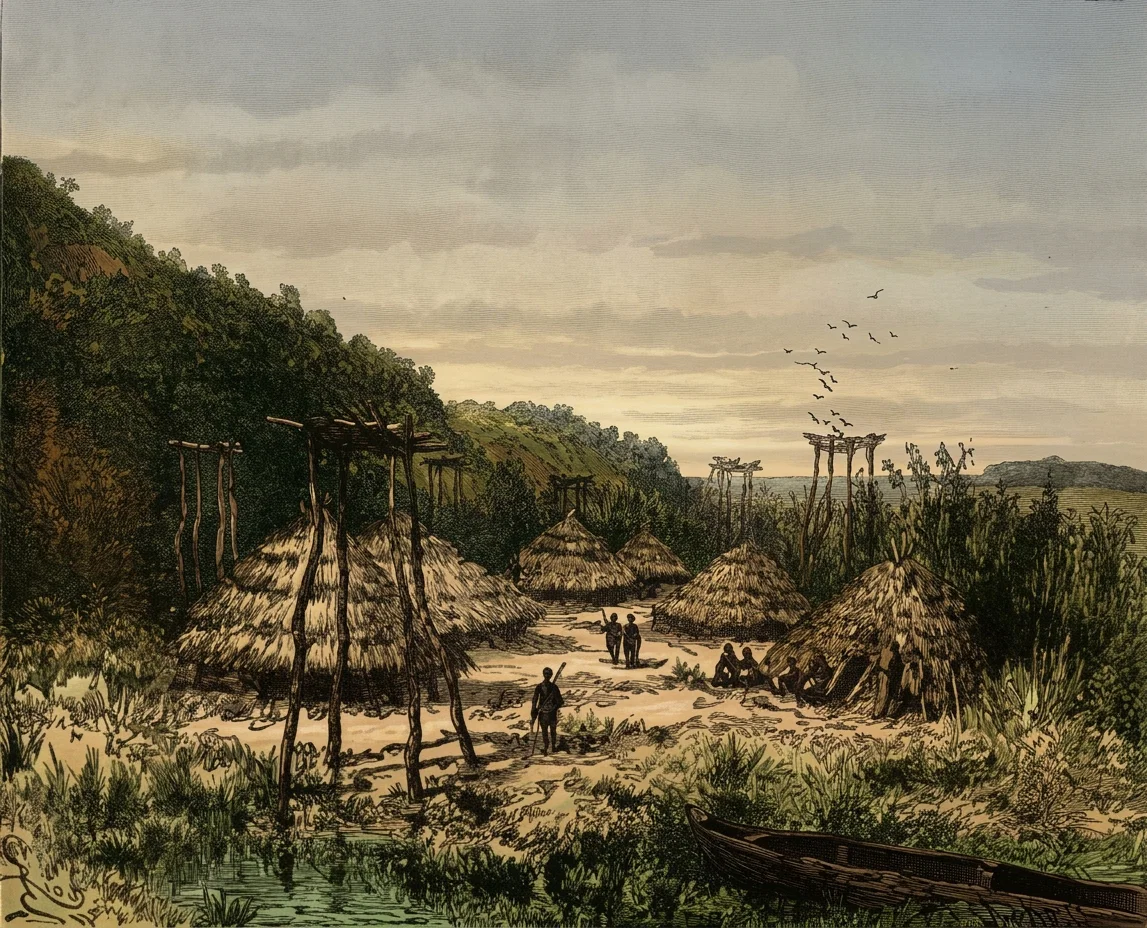
These people migrate in search of pasturage, building their huts like beehives and covering them with leaves. They live upon roots, honey, curdled milk, and locusts, which they grind and make into bread. Their language contains three click sounds, representing c, k, x. The Arabs named all the inhabitants of Africa Kafirs, meaning infidels.
The Bantu race claims descent from Ishmael. Of these there are fifty tribes, living mostly north of the Zambezi. The Bantu's six feet in height, broad shoulders, and easy carriage, place him above the other classes. His skin is dark brown or black with a reddish tinge, the last being the ideal complexion; his features may be either Roman or Grecian. The skin is kept soft and glossy by daily baths and ointments; the teeth are white, beard heavy. Their garment, of one piece, resembles the Roman toga. Except in war they use no animal food; then they use both flesh and blood to make them fierce. They distinguish between clean and unclean flesh, never using pork or fish. Usually they live upon corn, vegetables, and milk. The Bantus have crude musical instruments upon which they beat, and to the music of which they dance. They sacrifice to their deity, sometimes even taking human life. Their belief that the spirits of the dead enter the living, both persons and animals, causes them to regard the crocodile as sacred. They revere certain mountains, have a special reverence for prophets, and one tribe regards the seventh day.
A Hottentot Village. Kartagan, Africa.
A man has as many wives as he is able to buy. When he wishes one, the court assembles and decides her worth, and she is exchanged for so many cattle.
Each wife has a hut for herself and children; these have one apartment and only a door for entrance and light. This door is about four feet by eighteen inches, and through this the smoke must pass out, for the fire is built in a basin in the center of the hut.
The wealth of the Bantus is in cattle, which are so sacred that a woman is punished for touching one; the men always milk; watertight baskets are used instead of vessels of tin, etc., and are washed by the dogs. A leather strap is put through the cartilage of the cow's nose, and on the animal's back the natives speed over the hills. These useful beasts are all given names and come when called. The laziest one is named England, because of the hatred of the Bantus for that nation. The language of this race is soft and melodious; a grammatical error is not possible.
In their tribal government the king is absolute, and the chief who obtains his position by inheritance is supposed to rule by divine right; he has ten counselors.—The Reaper.