THRILLING RESCUE

5%

Pacific Press Publishing Company · Oakland, California · Jan 23, 1896

FromSigns of the Times, Vol. 22, No. 4.

Read the full edition

THRILLING RESCUE.

THE following story of German heroism was cabled to the New York Sun. The scene was laid in Schleswig-Holstein.
Early one morning, just after the loss of the Elbe, during the great gales that were devastating the shipping of two continents, a fishing village was awakened by the boom of signal guns off the coast. The beach was soon crowded, and in the dim light it was seen that a vessel was wrecked on a reef a mile away. The crew had taken refuge in the rigging. A life-boat was immediately run out, but the leader of the crew, Harro by name, was absent.
Notwithstanding, eight men manned the boat and rowed out to the wreck. The crew were taken successfully into the life-boat, with the exception of one man, who was lashed high on the mast. As he was half frozen and could not help himself, and as the storm was increasing and the life-boat was overloaded, it was decided that he could not be saved. The boat left the wreck without him. On the shore Harro awaited its return. He asked whether every one had been saved, and was told that one man remained.
“I will get him,” he said. “Will you go with me?”
His mates replied that it was a hopeless undertaking, and refused to risk their lives again to no purpose.
“Then I will go alone,” cried Harro, jumping into the life-boat.
At this moment his mother came limping down to the boat and begged him not to venture his life so madly. She pleaded:—
“Remember how your father and your younger brother, Uwe, were drowned.”
Uwe had years ago gone to sea, and as he had not been heard of, he was supposed to have been lost.
“For love of me,” cried Harro’s mother in despair, “don’t go.”
“But the man on the mast”—Harro waved his hand towards the wreck—“are you sure he has no mother to mourn his death?”
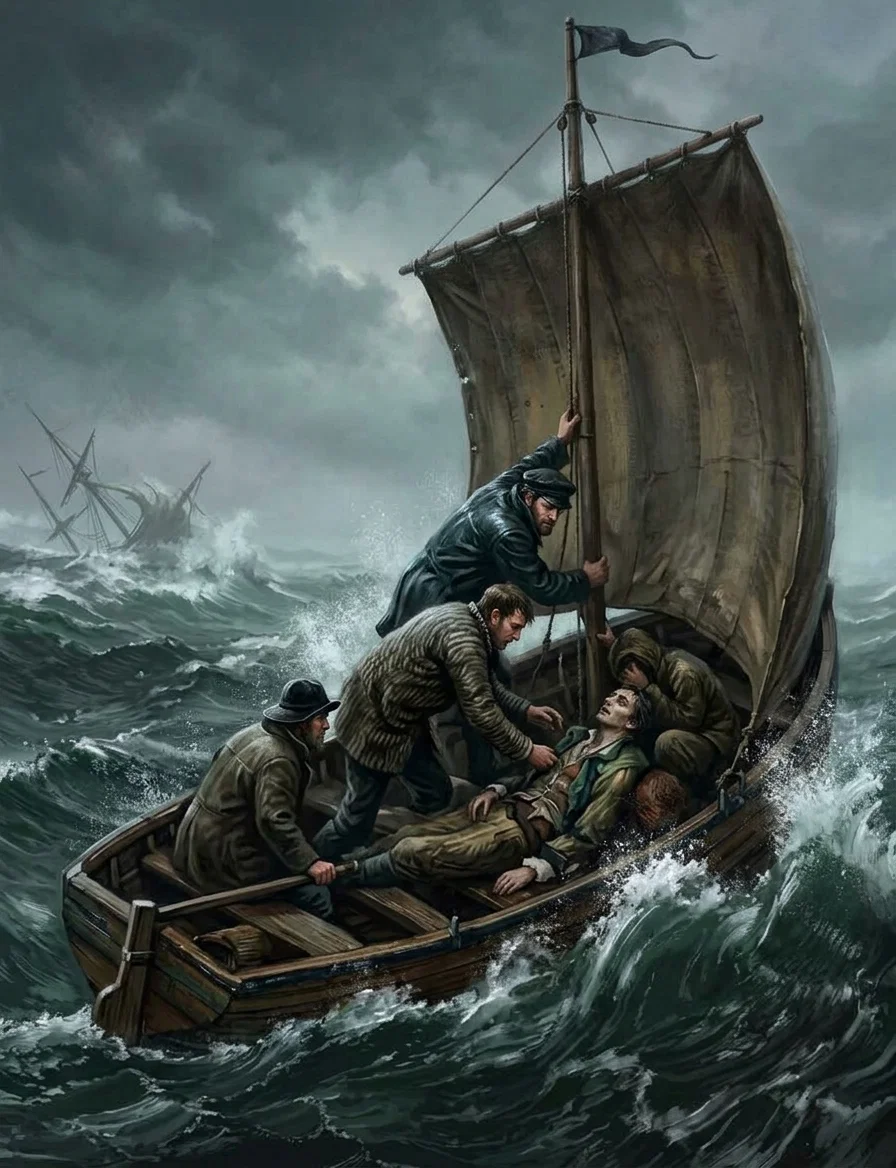
She argued no more, and Harro and four other brave men set out for the wreck, which was now fast disappearing. So furious was the sea that it was almost impossible to approach the vessel. At last the life-boat was under its lee, and Harro jumped aboard. He ran up the rigging, and after almost superhuman labor, brought the half-frozen man down. He laid him in the bottom of the life-boat at his own feet; and as he rowed back, he was seen to bend over the almost lifeless man and examine him with great attention.
When the boat was near enough to the shore for a strong voice to carry, Harro arose, waved his hat, and shouted with all his might:—
“Tell my mother we have saved Uwe!”
This was an extraordinary and immediate reward. Heroism has no right to expect anything like this. Most of us must do the generous deed for its own sake and look for little or no recognition of our sacrifice.
It is easy to be brave and noble when some great thing is to come of it—a personal delight, or personal fame. To throw away one’s life not expecting to be saved, to give one’s happiness without hoping to be comforted, to sacrifice ourselves for unknown people, not looking to be thanked—this is not easy. Christ did not seem to see consequences. Apparently he suffered and failed and nobody cared.
When we have learned to enjoy the side of unselfishness that is unrecognized, undramatic, unthanked, we have half learned the lesson of life.—Youth’s Companion.