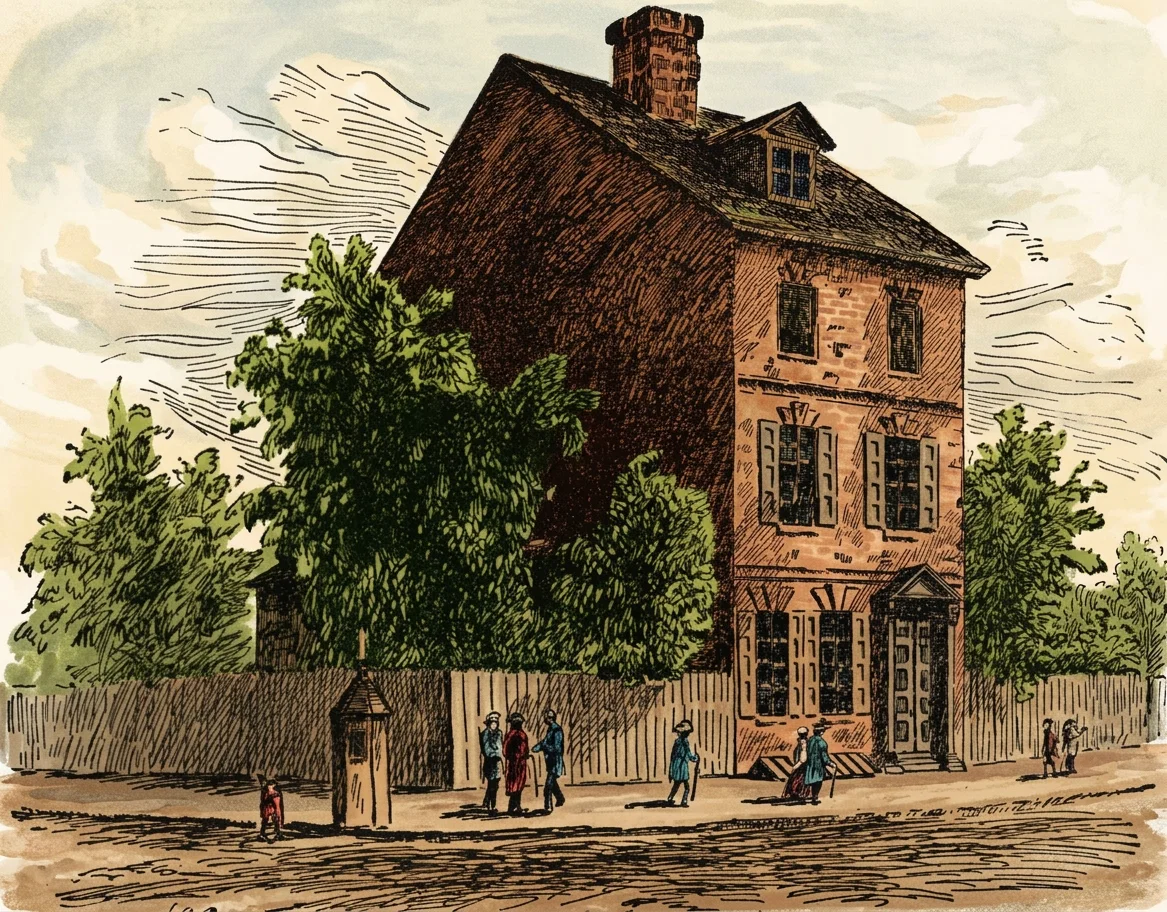
The Original House, 702 Market St., Philadelphia, in Which the Declaration of Independence Was Actually Written by Thomas Jefferson, 1776.
Thus reads the Declaration of Independence, the Charter of our liberties as citizens of America. It does not mean that all are of equal weight or size or intellect or capacity or strength. It means that all are created equal as respects the rights God has given and the free enjoyment of the same. “They are endowed by their Creator,” reads the immortal document, “with certain unalienable rights, that among these are life, liberty, and the pursuit of happiness.” In respect to these unalienable or natural rights men are equal. Man can not in the nature of the case barter them away, nor can he be justly deprived of them. Upon this foundation principle the glories of this government were founded.
Not a New Truth.
The truth that “all men are created equal” is not a new truth, nor was it a century ago, though then first for a long time definitely stated. It is a divine truth, as old as Deity, and is always due where there are men among whom it should be operative. Yet how little has the world known concerning it! Man has lorded it over his fellows. The people have been divided between the nobility and serfs, the classes and masses, the masters and servants. The same domineering spirit has been manifest in all world religions. There have been lords many and gods many, with a hierarchy all the way down to the “common people.” But this is not God’s plan. It has been manifest among his people, but it is not the Gospel as it is in Christ Jesus.
“Proclaim Liberty.”
It was a strange voice to Jew and Gentile, that trumpet-toned proclamation sounded out in Judea three and one-half millenniums ago, every half century: “Proclaim liberty throughout all the land unto all the inhabitants thereof.” Lev. 25:10. It was not a declaration of independence on the part of the people; it was God’s proclamation in their behalf in an age when men thought it right to enslave even of their own kindred. Again we are given the divine utterances: “For the Lord your God . . . regardeth not persons, nor taketh reward; he . . . loveth the stranger.” Deut. 10:17, 18. “For there is no iniquity with the Lord our God, nor respect of persons.” 2 Chron. 19:7. And the Idumean emir, speaking of those who served him, said, “Did not He that made me in the womb make him? and did not One fashion us?”
Of One Blood.
The reason of the equality lies in the fact that all are creatures of the same God, on the same plan. “The rich and poor meet together,” says the wise man, “the Lord is the Maker of them all.” “Did not One God fashion us?” says Job. But the New Testament puts it stronger still: “God that made the world . . . hath made of one blood all nations of men for to dwell on all the face of the earth.” Acts 17:24-26. And the Son of God says, “One is your Master, even Christ; and all ye are brethren.” Matt. 23:8. Thus in express terms the Gospel of God affirms the absolute equality of man as regards his rights to life, liberty, and the pursuit of happiness. This does not mean that government is to be despised, or authority of rulers ignored; not at all. In a just government every natural right of man is protected and conserved, not because the individual is stronger, but because the rights of one are the rights of each and all; and the just government will protect the rights of the weakest; in fact, it is that purpose for which it is ordained.
A Blessing in Religion.
The equality of man, proclaimed in the Gospel of the Lord Jesus Christ, came as a boon of life and hope. “The poor have the Gospel preached unto them,” was the joyful cry. Priest-ridden and oppressed thousands took heart. The spiritual slave of superstitious rites, galled by the iron chains of priestly tyranny, bowed by the heavy burden of human traditions, lifted his head, and with gladdened heart rejoiced that God recognized him and his rights. True, the supercilious wise men, the tyrannous priesthood, and the self-constituted masters in religion, spurned the glad message which broke their galling yoke and severed their chains, but the poor rejoiced and went free in the blessed freedom of the Gospel.
Religious Freedom.
This boon did not come alone. The Gospel not only recognized the equality, the worth, of the poor—of every man—as God’s creature, the purchase of2Christ’s blood, but, as essentially united with that, it recognized the man’s right to choose or reject the Gospel—or any other religion—so far as man or any set of men was concerned. That is, man, be he even an apostle, had no right to dictate religion to the humblest soul. Religion was a matter between God and himself. Even Jesus Christ did not judge or condemn the unbeliever. “If any man hear my words, and believe not, I judge him not; for I came not to judge the world, but to save the world.” John 12:47. Says the great apostle to the gentiles, God’s ambassador to a rebellious world, “Knowing therefore the terror of the Lord, we persuade men.” 2 Cor. 5:11. This is the language of the Gospel. It is the language of Infinite Love, holding out to man all the riches of infinite grace, and asking men, all men, equally, to turn, to look, to accept, and live. “Whosoever will, let him come.” No wonder that, before the strong yet loving advance of such a Gospel, unperverted with the mystery of iniquity, unadulterated with heathen tradition, as it was in the early days of the Christian era, the mighty power of Roman idolatry crumbled. Men saw in it light and life and freedom. Apart from its divine power no other principles gave the religion of Christ such prestige among the children of men. Among the perfection of principles of Christ’s government, represented by the seven horns on the head of the Lamb (Rev. 5:6), these two are prominent, equality of man and freedom of conscience in religious matters.
In a Civil Way.
These two principles of civil and religious equality are principles which may be embodied in civil government, which ought to be embodied in every civil government. But during the rolling centuries but one and only one civil government ever saw fit to adopt them, and that government was the late product of the eighteenth century. It was in America for the first time that government “dared,” in the words of George Bancroft, “to set the example of accepting in its relations to God the principle first divinely ordained in Judea.” It did this in the Declaration of Independence, which gave it birth, and later on in its Constitution, which declared its manhood.
It Is Well to Think of These Things.
It is because of the vital worth of these principles to man and government, the absolute necessity of their recognition if one would be a free child of God in these days, that we bring them again to the remembrance of our readers. They are not only mighty principles of liberty in a civil sense, but they are vital Christian truths. We print once again the Declaration of Independence, that our readers may know what civil liberty and equality meant to our fathers, together with a cut of the old house in which Thomas Jefferson wrote the original copy. We show by Holy Writ that these blessed principles of liberty are God given; and therefore, if we are Christians, they should be thrice dear, not for ourselves alone, but for the sake of others. That is to say, the principle of freedom of conscience ought to be so dear to us for our own sake that we should contend most earnestly that every one else should have the same freedom to believe or disbelieve, whether he agrees with us or not. It was for this that our government stood in its founding; it is for this in its fullness that Christianity stands.