Dinner in a Button

13%

Pacific Press Publishing Company · Oakland, California · Nov 7, 1895

FromSigns of the Times, Vol. 21, No. 44.

Read the full edition

Dinner in a Button.

BY L. A. PHIPPENY.
In these busy days, when time and space and expense are economized as never before, one is hardly surprised any more at the marvelous inventions in the way of accomplishing this end that are constantly springing into public notice. True, we often hear the remark, “No expense has been spared” in doing this or that, and sums of money are expended nowadays that would have horrified our grandfathers, but in the line of business this is all done that there may be a saving in the end. Buildings are built higher, trains and steamships are made to run faster, guns and war vessels are made more powerful, and in every imaginable trade and profession improved mechanical devices are finding their way, all to save time and labor, and to save and make money. But this is not all. With these better appliances and increased facilities come demands from other directions for improvements likewise, and a very important subject, that hardly finds a place in the mechanical list, but which, nevertheless, is necessarily dealt with, is the subject of food. What improvements can be made here? Did you ever stop to consider what a wonderfully convenient thing the art of canning fruits and other edibles is? It is so common that we rarely if ever think what a cry would ascend from the whole world if the art should suddenly be lost. Almost everything that serves for food is canned or condensed, pressed or preserved, from fruits and grains to all manner of flesh meats, and in this form is carried to hundreds of places where the fruits would not grow, or where bulky articles or animals for food could not be taken. Very convenient, indeed, these forms of food are.
But there is a place where even these helpful methods are too cumbersome for all that is desired, and that is with an army, on the march, in battle, or maybe invading a foreign land. In such cases, and at such times, it is a great hindrance—and a source of no little exercise of generalship—to an army to guard the supply trains and watch the base of supplies. Oftentimes these very essential adjuncts are cut off by the enemy, or if the invaders depend upon foraging for food, they may find only empty fields and the smoldering ruins of granaries and storehouses. Clearly, first of all the food supply must be sure, and it is equally apparent that the more compact that supply can be made, the more the men can carry, and the easier it will be handled.
And it is right here that military departments of many governments have placed much thought, and have set scientists at work, and some surprising results have been seen from their efforts. These men, skilled in the knowledge of the chemical properties and the constituent elements of different food substances, have set to work to extract the nutritive portions, and combine and concentrate these into the smallest possible space or quantity, that would at the same time be equal in nourishment to a very large quantity in its usual form. With the food stuffs made after such methods, and compressed to the smallest form possible, the soldier will be his own supply train.
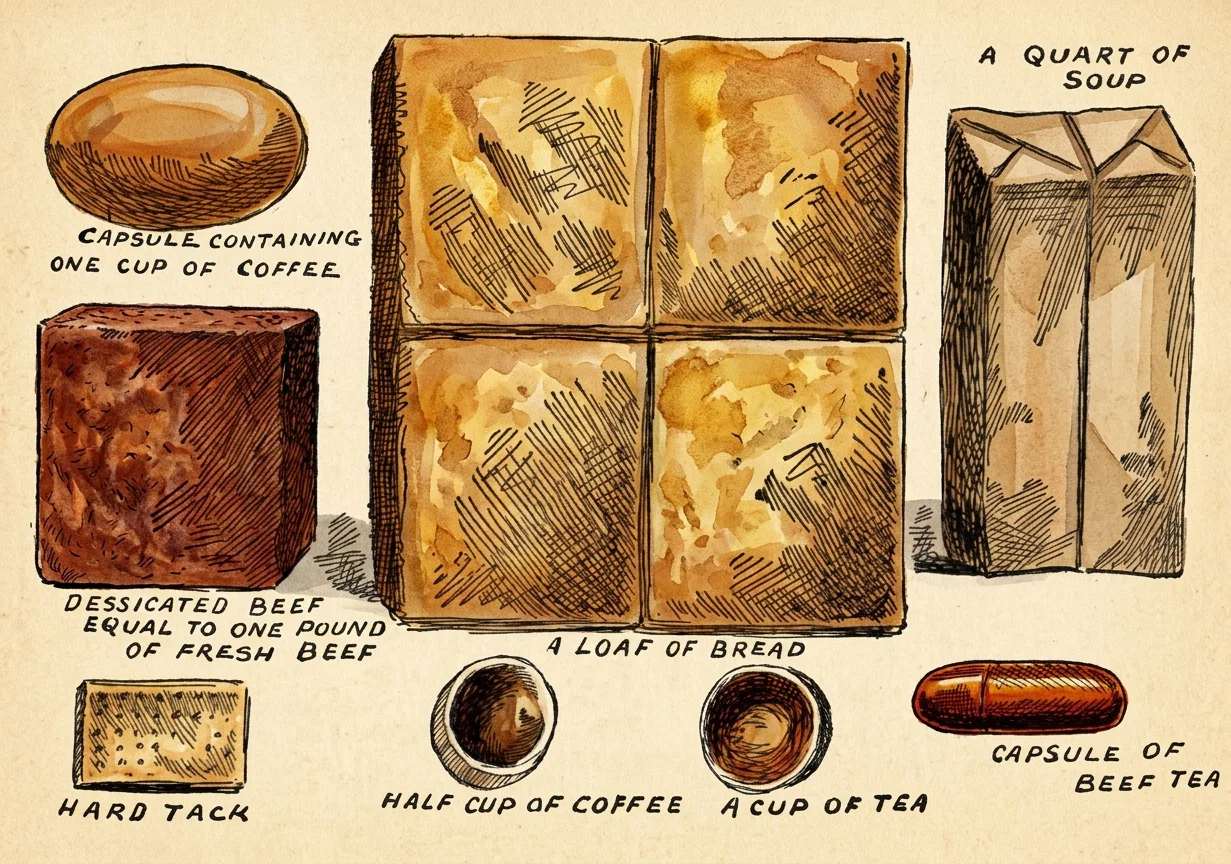
It is stated that actual tests of these new methods were made by the Japanese in their late war with China. Each soldier carried a provision belt, in which he placed the compressed food articles in the form of capsules, buttons, or small packages like cartridges, all ready to be dissolved, or easily prepared for eating when needed. There was beef condensed under enormous pressure into a small tablet, beef soup and vegetable soup in a capsule, a cup of coffee represented by a package no larger than a button, and so on. Think of the immense saving, from every point of view, possible by means of this discovery, for such it may well be called. Necessity, it is said, is the mother of invention, but it is to be observed that the so-called necessity which has brought forth these products of science, is war. A dire necessity, it may be, under the present evil condition of the world, but one that, it is hoped, will not continue much longer.
Our illustration shows the form and exact size of some of the compressed food packages now being tested by our War Department. It is hardly probable that such forms of food will ever be used outside of armies or navies, except perhaps by exploring parties and others where occasion may demand. Ordinary food will continue in demand, and it is safe to say will be fully as healthful as the concentrated article. This is, nevertheless, a wonderful achievement, a problem that, if proposed a few years ago, would have been considered a fine fable indeed. But it is an accomplished fact. This is truly the age of inventions and discoveries, and one has hardly time to ask in amazement, What next? when still more astonishing features are becoming things of the past.