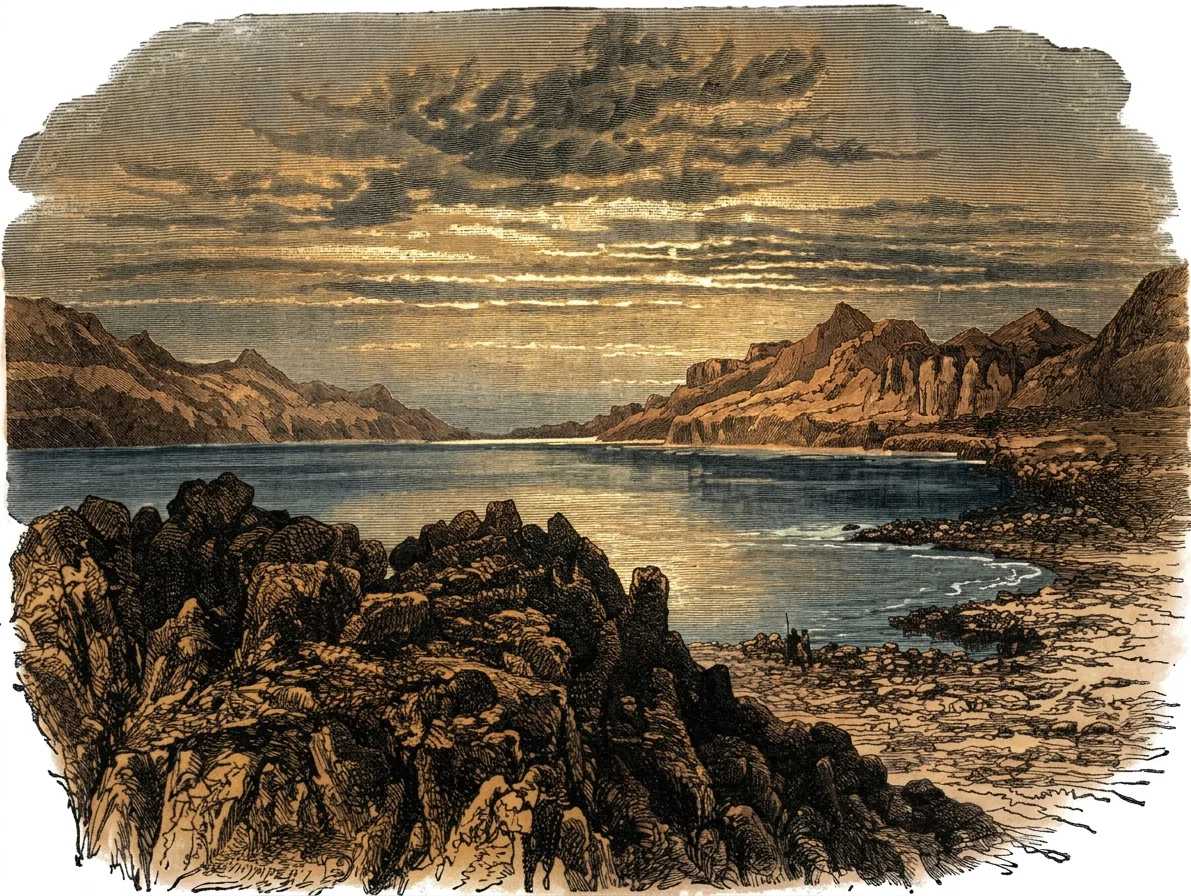
One of the most remarkable bodies of water in the world is that commonly known as the Dead Sea, called in the Scriptures the Salt Sea. The former name is most appropriate. It is not among the largest bodies of water, being about forty-five miles long by ten miles wide, situated sixteen miles southeast of Jerusalem, at the mouth of the river Jordan, whose waters it receives.
Remarkable Features
This remarkable sea lies in a deep oblong valley, the cliffs rising sheer from the water’s edge, oftentimes overhanging to the height of fifteen hundred feet. The lake has no outlet, and the surface of the water is thirteen hundred feet below the Mediterranean. The water itself contains twenty-five per cent of solids, more than eight times as much to the gallon as is found in sea water. And yet it is remarkably clear and pure in color. It is smooth and oily to the touch, salty and bitter to the taste, and causes an exceedingly prickly and smarting sensation to eyes, lips, and nostrils. Although sweet water springs flow into it constantly, and the Jordan pours into its salty depths six million tons of fresh water daily, its bitterness never grows less. Instead of banks adorned with the living green of grass, shrubbery, and forest, naught but the barren rocks and forbidding cliffs meet the eye, save where some cool spring of sweet living water brings life and nourishment to undersized and unthrifty terebinth, tamarisks, spina-christi (Christ thorn), and stunted and pale oleander, henbane, and mignonette, struggling for life in an inhospitable region of “unmixed desolation.” The few green spots serve only to make more vivid and drear the wasteness which everywhere reigns. The waters are almost wholly without life, only some of the lower forms are said to exist at all in its briny depths. Fish carried out into the sea by the turbulent Jordan immediately die, while sea fish transferred to its inhospitable waters soon perish. Truly it is the Dead Sea.
Its History
There are various theories concerning the sea and valley, as there are about every object of interest. But it is probable, as held by some travelers, that the Jordan once flowed to the Red Sea; that the Dead Sea is but an expansion of the Jordan, even as the Sea of Galilee, and that the surrounding region was teeming with animal and vegetable life, while on its southern shores, in a region of unparalleled fertility, lay the proud and wealthy cities of the plain, Sodom and Gomorrah. Thus it was on that long-ago morning when “Lot lifted up his eyes, and beheld all the plain of Jordan, that it was well watered everywhere, before the Lord destroyed Sodom and Gomorrah, even as the garden of the Lord.” Gen. 13:10. But when those cities, which with such great blessings should have been so righteous, became so wicked that it was to the credit of the mercy of God to destroy them for the sake of others who should come after, the very earth quaked with the punishment, the great valley of the Jordan was broken up, the land of fertility and sweetness became the land of salt and bitterness, and the valley of habitation that of desolation. The one weakly righteous man barely escaped with his life and loss of reputation. Since that the bleak and barren valley has been preaching unto the children of men a solemn Gospel message.
Its Lessons
One of its important lessons is God’s long-suffering and mercy. Long time had he borne with Sodom and Gomorrah. That they might have light he suffered Lot, who possessed a knowledge of the true God, to dwell among them, and who became one of their prominent men. (Gen. 19:1.) Not learning the way of righteousness in prosperity, God suffered them to be taken captive by their enemies; and their rescue came about because of the one righteous man who dwelt among them, through another righteous man who desired to save him. (Gen. 14:1-16). Right in their presence dwelt Abraham, the friend of God, and Melchizedek, the priest of God, holy men and renowned, holding up the light of the Gospel. (Gen. 14:17-24.) Yet the people of Sodom and Gomorrah turned not from their sins, but hardened their heart under the showers of God’s goodness. Of them and sinners like them the Dead Sea is a fitting type. Receiving ever the fresh, life-giving waters of many springs and the enormous outflow of the Jordan, it returns nothing for all these blessings but dreariness and desolation. So the Cities of the Plain, situated in one of earth’s fairest and best well-watered regions, receiving continually blessings from God, returned to him blasting instead of blessing, cursing instead of praises, sin instead of holiness,2famine of soul instead of fruitage. When Lot and his family, like the few green shrubs by a fresh-water spring in a Dead Sea wadi, lost in strength and life instead of winning by their example, or blessing by their fruit bearing, it became an act of God’s mercy to remove them. Five times did the Friend of God plead for the devoted cities, till the number of righteous were doubtless reduced to the number of Lot’s household, and received God’s assurance that if that number—only ten—could be found, the city would be spared; but of Lot’s family only three heeded the merciful warning the messengers of heaven bore to all, and they not because of their righteousness, but because they hoped in God’s mercy and believed God’s word.
God’s Hatred of Sin
God hates the sin, but he loves the sinner. He is not willing that any should perish, but that all should come to repentance. His presence consumes sin, and he longs that every sinner shall so separate from the sin, so choose God, that the sin may be consumed, and the sinner cleansed and saved. But if after Infinity has exhausted its resources, and the sinner still refuses to receive him, choosing rather the sin, identifying himself with the sin, God leaves him to his choice. When God’s presence is manifest, the sin is destroyed, and those who choose it perish with it, “The wages of sin is death.” We may endeavor to persuade ourselves otherwise; but “God is not mocked; for whatsoever a man soweth, that shall he also reap.” Gal. 6:7. Jehovah declares, “As I live . . . I have no pleasure in the death of him that dieth,” and he pleads with infinite love and longing, “Turn ye, turn ye from your evil ways; for why will ye die?” Yet sin is death, and the Dead Sea is a solemn witness to the fact.
Heed the Lesson
There are other lessons connected with the sad history with reference to Lot and his choice of Sodom, with reference to his wife, who longed for the city more than God, with reference to the moral condition of his family. God has lessons for us in all these; but the two great lessons are his long-suffering and tender mercy, and his hatred of sin. He tells us also that the fate of those cities and their inhabitants is “an ensample unto those that after should live ungodly.” 1 Peter 2:6. The punishment, the destruction, is not because of any vindictive wrath of God, it is in the very sin itself which the wicked have chosen. Against their own conscience, against faithful warning, against the pleading of God’s Spirit, they choose sin, and when they receive its wages, death, they are simply “filled with their own devices,” reaping the fruitage of their own sowing. These are among the useful lessons suggested by that grim preacher of the Gospel, the Dead Sea. May its lessons, through the power of God, which shall cause even the desert to blossom like the rose, bear fruit unto eternal life in hearts that are now as barren as its own desert dreariness.