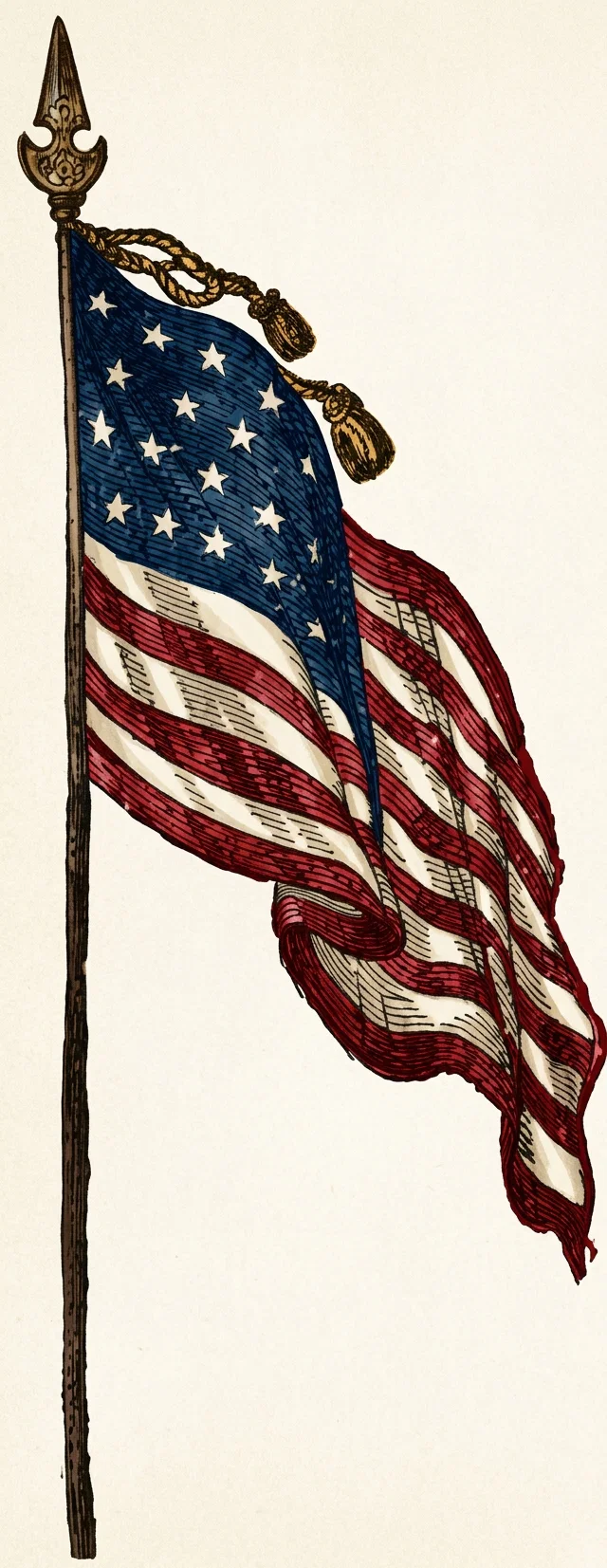
OUR COUNTRY'S FLAG

10%

Pacific Press Publishing Company · Oakland, California · Oct 24, 1895

FromSigns of the Times, Vol. 21, No. 42.

Read the full edition

OUR COUNTRY'S FLAG.

BY H. P. PHELPS.

Its Meaning.

“Unfurl the glorious banner, the banner of the free, The emblem of our country's pride, on every land and sea, The emblem of our liberty, borne proudly in the wars, The hope of every freeman, the glorious Stripes and Stars.”
Yes, unfurl it; lift it up on high; honor it; respect it; but O, do not forget the principles that it represents! To shout the praises of “Old Glory,” and at the same time ignore the very principles which brought it into existence, would be but folly. To unfurl the flag before the world, upon the capitol dome and “the little red schoolhouse,” while we forget and ignore the principles for which our fathers fought, as they followed it on to victory, would be but hypocrisy. It would be more. It would be treason to the flag itself. There is danger of exalting the symbol while trampling upon the principles represented by the symbol. What, then, are these principles which gave birth to the nation's flag?—The answer is that they are the very principles that gave birth to the nation. It was civil and religious liberty, as recognized in the nation's bill of rights as a self-evident truth.
The New York World of August 12 says: “The law of equality is the foundation of the law of liberty. It is solely because men are ‘created equal’ that they have an ‘inalienable right’ to liberty. If men were not created equal, then one man or some men would have the right to rule others, to dominate their wills, to control their conduct, to direct their consciences. Every instinct of the American people denies the existence of such a right anywhere on earth.” Indeed, such a right does not exist in the universe, for it was the eternal purpose of the Creator that man should be God's own freeman. And the Creator himself does not seek to compel, but says, “Whosoever will, let him come.” Then no men or set of men should try to compel, or rule over, others. The foundation stone of a republic is that every man should govern himself. Said Abraham Lincoln, “This is a government of the people, for the people, and by the people”—not in government of others, but in self-government, recognizing the inalienable right of all men to “life, liberty, and the pursuit of happiness,” which means the free exercise of one's own faculties. As stated by W. A. Blakely, Esq., in “American State Papers:” “Pagan and Mahometan, Gnostic and Agnostic, Jew and gentile, Catholic and Protestant, are all entitled to the unrestricted exercise of their equal rights, and to an impartial protection by the government in such exercise. These are the principles characteristic of American institutions; these were the principles of the founders of the government; these are the principles of Anglican liberty, and the ideals of Anglican philosophy.” And Bancroft, the historian, very justly remarks: “Vindicating the right of individuality even in religion, and in religion above all, the new nation dared to set the example of accepting in its relations to God the principle first divinely ordained in Judea. It left the management of temporal things to the temporal power; but the American Constitution, in harmony with the people of the several states, withheld from the federal government the power to invade the home of reason, the citadel of conscience, the sanctuary of the soul, and not from indifference, but that the infinite spirit of eternal truth might move in its freedom and purity and power.”
These are the principles for which the fathers of the republic gave their all, the very principles upon which the government itself is founded. These are the principles represented by the nation's flag; and wherever that flag is unfurled, it is as a pledge before all the world that we, their children, still remember these principles, and that they shall ever be maintained and perpetuated.
The boast of our educational principles is in this individuality of thought and action, individuality in all matters of conscience, each deciding for himself upon the great questions of the day. It will not answer, therefore, to deny the right of every man to display his loyalty to the nation's flag in his own way, whether it shall be wafted to the breeze from his own housetop, or whether he may be content to see it unfurled from the national buildings, lest in compulsion by law we deny the very principles represented by that flag. It will not answer, as is now being done in some of the states, to prohibit certain ones from the advantages of equal educational privileges because of their color. Nor will it do to allow that old spirit of religious bigotry and intolerance to so far get the better of the finer feelings of the human heart, as is now being done in some of the states, so far as to send men—good citizens, conscientious men, who were charged with no other crime than that of resting on the seventh day of the week and exercising their individual right of working six days—to jail and to the chain-gang, thus repudiating these principles, while we vainly boast of our liberties, lest we make the flag to be despised. But rather let the sons of those noble sires stand by and maintain those eternal principles; then shall “Old Glory” ever be respected.
“We'll stand by the flag of our country, Columbia's banner of glory; Her stars as they shine, Her stripes as they line, Tell liberty's grand old story. We'll stand by the flag, our beautiful flag, in union none can sever; We'll honor the flag, our liberty's flag; we'll stand by the flag forever.”