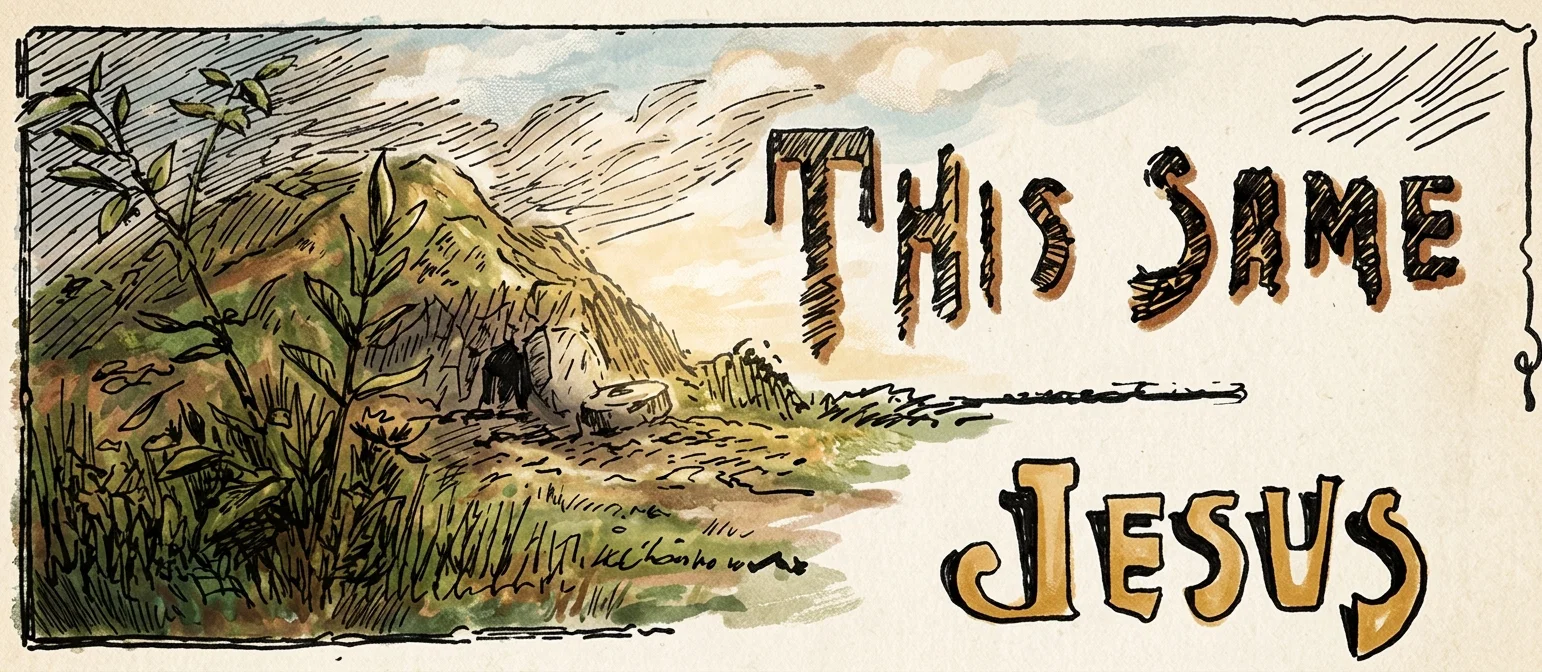
This Same Jesus

6%

Pacific Press Publishing Company · Oakland, California · Oct 31, 1895

FromSigns of the Times, Vol. 21, No. 43.

Read the full edition

This Same Jesus

The Manner of His Coming.

BY D. T. J.
After we have assured ourselves from the study of the Scriptures that Christ will come to this earth the second time, the question that next arises is, How will Christ come? Will his second coming be spiritual or literal? Will his coming be known to all who dwell on the earth at the time it takes place, or only to a favored few? Correct answers to these questions will help us much in understanding the nature and manner of Christ’s coming. Where shall we go for data? It is a field in which the human mind may theorize to almost any extent, and many pleasing pictures may be drawn, but there is only one source of reliable authority, and that is the Bible. God has given us his inspired word “for doctrine, for reproof, for correction, for instruction in righteousness; that the man of God may be perfect, thoroughly furnished unto all good works.” 2 Tim. 3:16,17. Everything, therefore, that the Bible contains is of value to the Christian. On the subject of the second coming of Christ and the manner of his coming we shall find the Scriptures very full and complete, indicating that this is a question of interest and importance to every child of God.
Let us notice a few of these texts and learn from them the nature of the second coming of Christ and

How He Will Come.

We will begin with the testimony of the heavenly beings who bear witness to the manner of Christ’s second coming. On the day of his ascension he led the disciples out as far as Bethany, on the Mount of Olives; after giving them the commission to preach the Gospel to all the world, he lifted up his hands and blessed them. While in the act of blessing them “he was taken up; and a cloud received him out of their sight. And while they looked steadfastly toward heaven as he went up, behold, two men stood by them in white apparel; which also said, Ye men of Galilee, why stand ye gazing up into heaven? this same Jesus, which is taken up from you into heaven, shall so come in like manner as ye have seen him go into heaven.” He had been taken up literally, bodily, in their sight. He is to so come again in like manner as they had seen him ascend. His coming is therefore to be a literal, personal coming. John, in speaking of his coming, in Rev. 1:7 says, “Behold, he cometh with clouds; and every eye shall see him.”
When the disciples were sorrowing because their Master had told them he was going away, he said unto them: “Let not your heart be troubled. . . . I go to prepare a place for you. And if I go and prepare a place for you, I will come again, and receive you unto myself; that where I am, there ye may be also.” John 14:1-3. A little later he said to them, “A little while, and ye shall not see me; and again, a little while, and ye shall see me, because I go to the Father.” Chapter 16:16. The context shows that he referred to his going to heaven, during which time he would not be personally and visibly present with them, and his returning to receive them to himself: “Ye now therefore have sorrow; but I will see you again, and your heart shall rejoice, and your joy no man taketh from you.” Verse 22. His personal presence would again be manifest among them; for during all the time of his absence he is but spiritually present with his people. Almost his last words to them were, “Lo, I am with you alway, even unto the end of the world.” But the time will come when he will be personally present with them again, and this will be at his second appearing, when he comes in the clouds of heaven, and all the holy angels with him, when he sends forth his angels to gather his people from the four quarters of the earth. Matt. 13:41. Says the apostle Paul, in his letter to the Thessalonians: “The Lord HIMSELF shall descend from heaven with a shout, with the voice of the archangel, and with the trump of God; and the dead in Christ shall rise first; then we which are alive and remain shall be caught up together with them in the clouds, to meet the Lord in the air; and so shall we ever be with the Lord.” Jesus himself says of his second coming:—
“And then shall they see the Son of man coming in a cloud with power and great glory.” Luke 21:27.
“And they shall see the Son of man coming in the clouds of heaven with power and great glory.” Matt. 24:30.
All these texts refer to one and the same definite event,—the second coming of Christ. They declare that he himself shall come, and that every eye shall witness that coming. In short, they teach us, unmistakably, that the second coming of Christ will be personal and visible.

The Two Advents Compared.

In his masterly letter to the Hebrews, Paul proves from the Scriptures that Jesus is the Messiah, the antitype of all the sacrifices of the old dispensation, and the great High Priest typified by Melchizedek. In concluding his argument in the ninth chapter, he uses a strong figure to illustrate the certainty of His second coming. These are his words: “As it is appointed unto men once to die, but after this the judgment; so Christ was once offered to bear the sins of many; and unto them that look for him shall he appear the second time without sin unto salvation.” Heb. 9:28. Here the two advents are brought together; in the first, he comes to offer himself as a propitiation for sin; in the second, he comes, the same Jesus, not with a sin offering, but to save those who have accepted of the propitiation that he has made for them.
In the Old Testament scriptures the two comings of Christ are very closely connected. Sometimes it is difficult to distinguish the prophecies that relate to one from those which relate to the other. By confounding them the Jews expected that their Messiah, when he should come, would take the throne of David and rule over his people as a temporal sovereign, and deliver them from their oppressors; and when he did not fulfill their expectations, they rejected him. They were not mistaken in the promises, but in the application of their fulfillment to the first advent of the Messiah instead of the second. These two important events are so intimately connected in the plan of redemption that the prophecies sometimes speak of both in the same connection, and in such a way that their words apply in part to each. For examples of this read the latter part of the third chapter of Joel and the last chapter of Malachi.
The former was applied by Peter to the pouring out of the Spirit on the day of Pentecost, and the latter by Christ to John the Baptist, but both will have a further fulfillment in connection with the second advent. This shows how closely the two are related, being the complements of each other in the divine plan of redemption. One is the sowing, the other the harvest. As there could be no harvest without the sowing, so the sowing will profit nothing without the harvest. As at the first advent Christ offered himself literally as a propitiation for sin, that men might be reconciled to God, so at his second advent he comes literally to save those who have accepted of that propitiation and become reconciled to God. Both before and after his first advent Christ is the mediator between God and man, but before his second coming his mediatorial work will cease, and he will come as king, in fulfillment of Ps. 2:8, 9 and Matt. 25:31.

Conclusions.

From the texts cited we see that when Christ comes the second time, he will come (1) personally and visibly, in the clouds of heaven, with all the holy angels; (2) that his coming will be literal; (3) that his coming will be witnessed by all who dwell on the earth.