MIRROR LAKE

7%

Pacific Press Publishing Company · Oakland, California · Oct 17, 1895

FromSigns of the Times, Vol. 21, No. 41.

Read the full edition

MIRROR LAKE.

BY L. A. PHIPPENY.
“All aboard for Mirror Lake.” It was not a summons to mount a wagon or stage—only the conventional phrase one of us shouted to the rest one early morning in June in our camp almost under the booming Yo Semite Falls, in the world-renowned Yo Semite Valley. There were three of us, Elliot, Edward, and self, and we were out this morning, if on no other, some time before day, and tramping across the valley to see the sun rise in Mirror Lake, for the guidebooks said that was the time above all others to peep in on the world upside down.
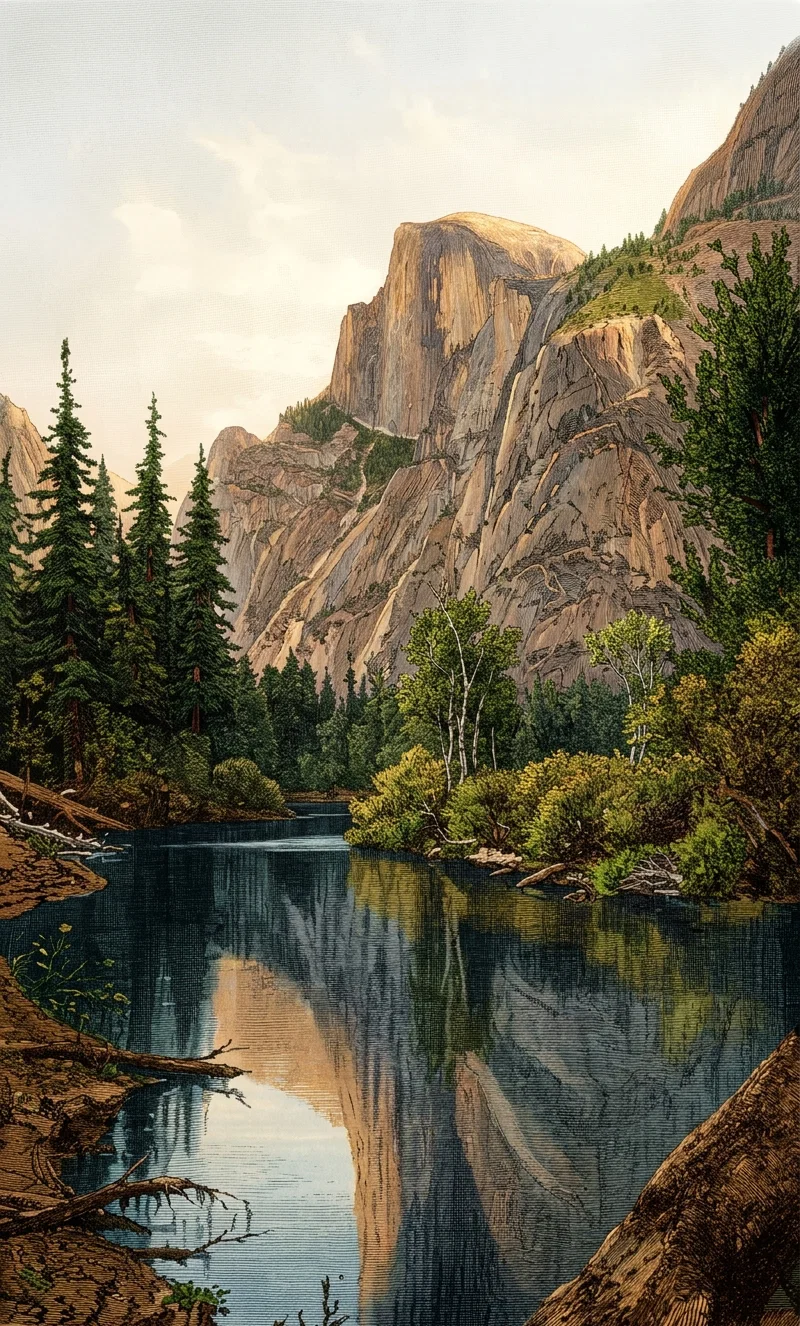
This little sheet of water, which the Indians called Ke-ko-too-yem, Sleeping Water, nestles like a fallen star in the deep rock cleft known as Ten-ie-ya cañon, in the northeastern part of the valley, which, by the way, is only about seven miles long by one-half a mile to three miles in width. It were impossible to adequately describe in cold words the stupendous and majestic guardians and settings of this watery gem. Like many another wonder of nature, surpassing art of man, they must be seen to be appreciated.
To the right, as one ascends the cañon, towers the cloud-crested Half Dome, its lofty head lifted over five thousand feet above the bed of the valley. This rock is, as its name indicates, in appearance half of a dome, one part rising in steep curves from the surrounding mountains and from the valley on one side, the other part a sheer precipice with a clear drop of a mile, with the exception of a low abutment or talus of rock débris extending in a sharp slide to the waters of the little lake.
On the left stand the noble North Dome and Mt. Watkins, whose huge fronts, forming the abrupt wall of the high Sierras to the west and north, present a spectacle only a degree less imposing and awe-inspiring than their incomparable neighbor. The approach to the lake up Ten-ie-ya cañon between these herculean pillars is a half mile of easy ascent over a rocky deposit, which appears to have been hurled to this narrow resting place at some remote age from the mountain above. At any rate, it acted as a dam to thewaters of Ten-ie-ya Creek, which spread out in a convenient but shallow hollow and formed Ke-ko-too-yem. To give variety to the scene, and serve as a softening finish to the rocky environment, from the scant soil has sprung a rather dense growth of fir, willow, and other varieties of vegetation, fringing the lake to the water’s edge, filling the cañon, and extending along the north side of the valley in a park of good-sized oak.
MIRROR LAKE.
MIRROR LAKE.
Into the mouth of this gorge, three miles from our camp, the three of us found our way, while as yet the shadows lay thick and heavy in its depths. The morning was cool, the place was ominously still, and, in spite of admiration and anticipation of a pleasurable sight soon to be beheld, a sense of gloom stole over us, and involuntarily we shuddered as we looked up at the beetling and threatening crags, which seemed ready to topple over and crush us.
A well-defined road wound in and out amongst the trees and rocks, and it was not long before a glimmer through the leaves told us that we had arrived at the center of attraction. A few steps to one side, and we emerged onto the rock-strewn margin of the Mirror. And a remarkable mirror it was, too, though we were sadly disappointed at first in its size. Indeed, we were disposed to ridicule this much-talked-of point of interest. But we could not change it, so we set ourselves to admiring it, as became dutiful sight-seers. And we succeeded admirably. Wonderful and marvelous changes swept over the sensitive face of the little body of water as the shadows slunk back to their hiding places in the crannies and caverns of the rocks, and our respect increased apace.
As the mist lifted and fled before the approach of the natural enemy of darkness, and the lights and shadows in the serene depth took on the beauteous contour and distinct features of nature above, our thoughts were instinctively turned to that wonderful mirror of nature’s God,—his word,—into which if a man look steadfastly he shall behold in ever-increasing splendor, in ever-unfolding beauty, the glory of the Lord. But in that mirror, as the mists of sin darkness are dispelled from the soul by the entry of the Sun of Righteousness, will the man himself, by beholding, be changed from glory to glory, assimilated as a part of the picture itself, retouched by the great Master, showing forth the beauties of his handiwork.
We were the first at the lake, and evidently early, and for nearly two hours we feasted our senses on the remarkably distinct and beautiful inverted picture, ere others came to enjoy it with us. And we shouted, and startled the echoes, and were startled in return, for this is a veritable lurking place of these mockers. Quick and loud they answer back, or roll away up the cañon and return with a snap, until one can well imagine a whole regiment in hiding. It is said nine distinct echoes can be counted. Perhaps we still felt like giving a covert fling at the small size of this mirror, so we concluded to toss stones to the opposite shore. Here came a real surprise, for, with our utmost efforts, the rocks fell away this side of the middle. Surely we are as strong as ever. But then we remember we are in mountain altitudes, and things are not always what they seem!
But the straggling crowd of tourists from the valley hotels came at last, in time to see the sun rise in the lake. As the morning had advanced, and the line of sunlight slid down over the brow of Mt. Watkins, another line, its exact counterpart, crept up and up from the depths below, bringing out with startling distinctness each prominence, cross-hatch, and indentation on the face of the mountain in duplicate. Opposed to this brightening and enchanting picture, hangs the bold, dark shoulder of the Half Dome, this side yet in the shadow. Below it—in the reflection of course—the sky is all rosy, and now in the hollow of the shoulder an intensely bright rim shows where the lord of day will shortly break forth. Every one is stationed at the best view point, and in breathless interest gazes down into the depths. We three were standing huddled together on a small rock, barely large enough to hold us, a dozen feet from shore, from which an excellent view was obtained. Suddenly the almost painful silence was rent by a loud, harsh, “Haw! haw! haw! Now! Look at them guides!”
We looked. Everybody turned and looked. There on the shore behind us stood a rotund, florid party with a monocle screwed in his eye, pointing directly at our reflection and our rock. Well, perhaps we did present a striking picture—we and our antipodal selves. But guides! Yes, we were roughing it, and were clad in roughing clothing, and in our hands were our home-manufactured alpenstocks. But to be called guides we resented, that is, silently! It is said there is only a step from the sublime to the ridiculous. Here it was only a tone, and as the full measure of the fall burst upon us, we shouted with the rest. The episode was hardly at an end, and the shattered reveries and soul inspirations were scarcely collected, when a brilliant burst of light from below and above proclaimed the climax of the scene. A shout of admiration greeted the two light bearers, and the party dispersed.
A few minutes later a faint puff of wind rustled the leaves near by and darted out across the water, shimmering the surface into a million tiny wavelets. The fairy picture vanished, and in its place lay an ordinary dull sheet of water. We turned with a sigh of delight and regret, and remembered suddenly that we had come away from camp before breakfast. We had been partaking of a feast, but even such a banquet will not suffice for hungry bodies.