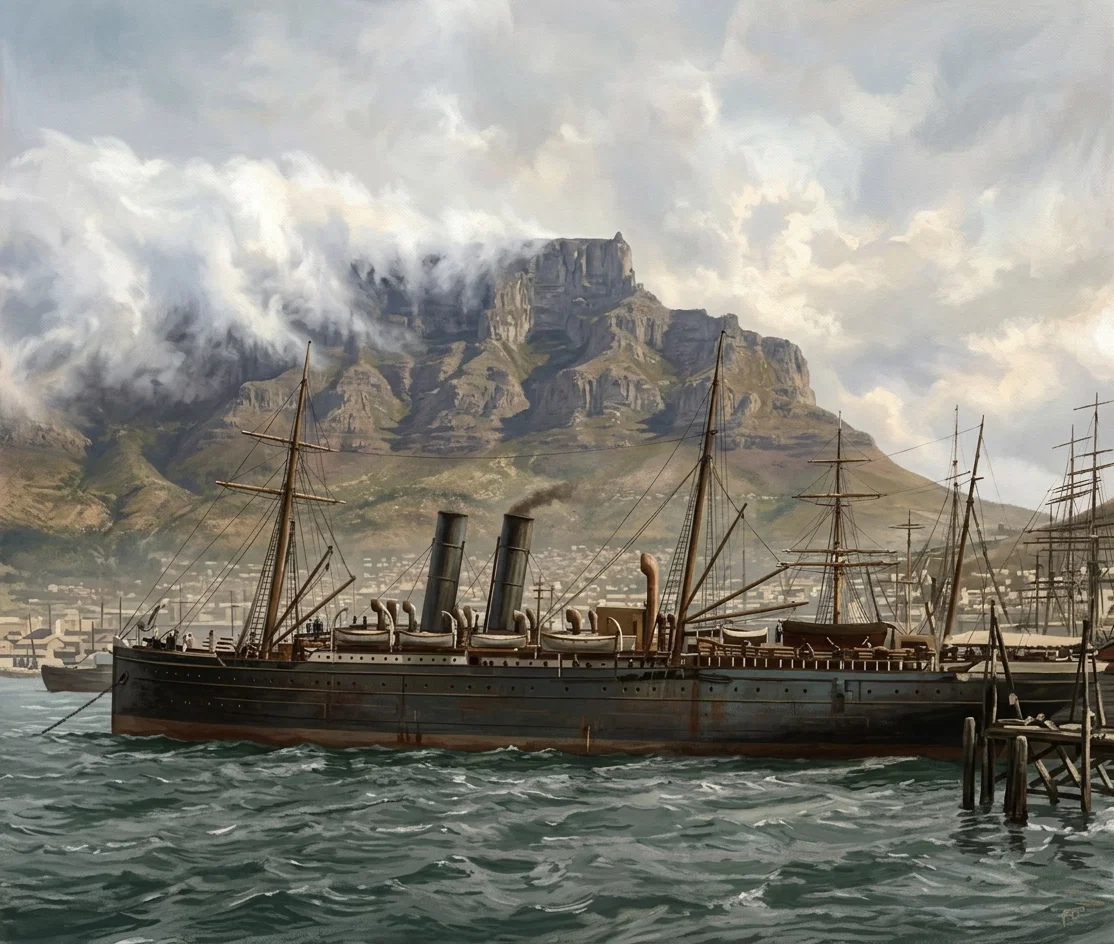
Two things are necessary if we would form correct ideas of South Africa as a missionary field. First, a geographical knowledge of the country, and, something of the general character of the various peoples who live in the country. Second, a practical knowledge of the people from personal experience. They differ from the people of Asiatic countries, especially those of China, Japan, and India. In those countries education and an Asiatic civilization exist. But among the natives of Africa where the Gospel has not left its moulding influence there is no religion only that of superstition, nor any civilization. At the present time, however, there is scarcely a tribe to whom the truths of the Gospel have not found way, and there is an open door to the interior of Africa from almost every side. The world is indebted to the Portuguese navigators of the fifteenth century for the discovery of the Cape of Good Hope. The date of the discovery is given as early as 1486 by Bartholomew Dias and Joa Infanta. During a century and a half subsequent to this discovery, the cape was used as a temporary calling place by the Portuguese, English, and Dutch, respectively, who engaged in the Eastern ocean trade. Their ships resorted to Table Bay for water and live stock, which they purchased of the natives. It was not until 1652 that any permanent attempt was made by Europeans to settle the country. Then the Dutch East India Company, under charter granted by the states general of the united provinces of Holland, took possession of Table Bay.
It was not until 1806 that the country virtually became an English colony. Previous to this for a number of years it was in the hands of the Dutch, and at times of the English. In 1815 the colony was definitely ceded to the English by the treaty of Paris. A writer in speaking of these times says, “At the beginning of the century, the cape was still a Dutch colony, but the English, fearing that Napoleon, who had just placed his brother on the throne of Holland, might make use of the cape to possess himself of India, installed themselves there in 1806 to take care of it for the prince of Orange, dethroned by Bonaparte.” Then he adds: “One of John Bull’s mottoes is, ‘Here I am and here I stay.’ He was in the cape and he stayed there. You would more easily withdraw a lump of butter from a dog’s mouth than a John Bull from territory where he has installed himself.”
At the present time South Africa is composed of two English colonies, one of which is Cape Colony on the southwest, and Natal on the southeast; there are also two Independent Dutch republics, which are watched by the English, and several territories, such as Bechuanaland (although steps have been taken by the Parliament now in session to add it to the Cape Colony), Mashonaland, Zululand, Pondoland, Basutuland, Nyassaland, Matabeleland, and a few other lands occupied by the various tribes, are under the protection of the British Government. As the English have taken possession, the active Dutch element, the farmers, have steadily retired northward. These Dutchmen, now known as Boers, have founded the Orange Free State, and the Transvaal, or South African republic, but they can not now well go any farther north, for they are completely surrounded—at the south by the Cape Colony, on the west by Bechuanaland, on the north by Mashonaland and Matabeleland, and on the east by Natal, Zululand, and the Portuguese territory, which the English will never allow them to purchase, even should the Portuguese be willing to sell it, for this territory contains Delagoa Bay, the only harbor of South Africa. All other harbors except Table Bay have a sand bar at the entrance, and Table Bay is small, while Delagoa Bay can inclose an entire fleet.
So it can be seen that the white population of South Africa are the British and the Dutch, and the colored population range from the ebony black of the Zulus to the rich olive of the Malays, Hottentots, Kaffirs, Zulus, Fingoes, Pondos, Basutos, etc. Generally, wherever the English conquer, they give the Bible in exchange for the territory they take, but the Dutch received nothing for South Africa. It is evident the Dutch could get along without the English, and the English without the Dutch, but they submit to the inevitable, living peaceably together.
It is the character of the English to be constantly living low; they give perfect freedom to all, but at the same time there they are. They advance by small but sure steps. By the English language they are gradually gaining an influence over the Dutch in South Africa. The English education makes proselytes for England in a country like this. The Dutch are quite numerous, antiquated, stubborn, but very patriotic. Mr. Krugier, the president of the South African republic, said, upon inquiry if he did not think the English would some day have his country, because of their influx in Johannesburg, “No, I have no fears; we would spill every drop of blood we have before they could take it.” This is much the sentiment of the settlers. They are strictly religious, but not enterprising. Modern improvements of agriculture have no sale with them. Their mode of threshing is with cattle tramping on the prepared threshing floor; their winnowing is shoveling the grain in the air, and the natural wind blows away the chaff.
There is no sympathy between the Dutch Boers and the aborigines. In their estimation, the aborigines “are not human beings to be conciliated, but wild animals to be tracked and exterminated whenever occasion requires.” Their former treatment of their slaves was most cruel. “Capital punishment—especially of slaves and natives—was, according to the Dutch law, carried out by the executioner, who, in the terms of the sentence, had to see that the criminals were ‘bound to a cross and broken thereon alive, from under upwards were the coupe de grace,’ or laid upon a wheel, or hung on the gallows, there to remain a prey to the birds of the air of heaven.”—Official Handbook, 1886. Says a recent writer: “When they did not kill them, they made slaves of them, and drove them to work with great leather whips that they would never have dared to use about the oxen that draw the carts. They never sought to civilize them nor convert them.” The force of circumstances has compelled a change, but how much of the old principle still lives in the hearts of some of the old settlers, only waiting for an opportunity to develop, is an open question. But this never will be as formerly. There are no slaves at present, as in former times. The introduction of English rule has worked reform in many respects. There is a large Dutch element in the Parliament in Cape Colony, and among them are the very best of men, true to their convictions of right, unflinching in their integrity, generous, and hospitable in all their relation to others.
In 1845 the Boers of the Orange Republic undertook to destroy the Griquas, an important tribe living to the west of them, but the English interfered, rescued the natives, and annexed their territory under the plausible pretext that their independence was a continual menace to the tranquillity of South Africa. It is in this country that the diamond fields of the world exist, and which have so bountifully enriched South Africa, and especially Cape Colony. People who have never visited those countries, where they have not had the benefit of Christian civilization,12know not how to appreciate the circumstances of those who settled in this land of darkness, and who like the Huguenots felt the iron heel of oppression and persecution, surrounded by every heathenish custom and system of wickedness for hundreds of years, completely severed from the civilized world. God alone knows how to judge the world and weigh unseen influences that have shaped the character.
As to the different tribes in South Africa, they are like any child of nature without hope and without God in the world. The unprincipled white man who deals in the accursed liquor traffic, and puts the bottle to the lips of his dark-skinned brother who can not control himself when once brought under its influence, those who have introduced vices the natives never knew before, will have much for which to answer in the day of judgment for the existing evils among the natives. They differ in disposition, as does the white man. But those who have given their lives for their salvation declare that the worst difficulty is to contend with the evils the natives never would have known had they not learned them from the white men. They more readily take the Gospel in their native simplicity than those who have lived in the full blaze of its light.
Such are some of the characteristics of the people and the country of South Africa.