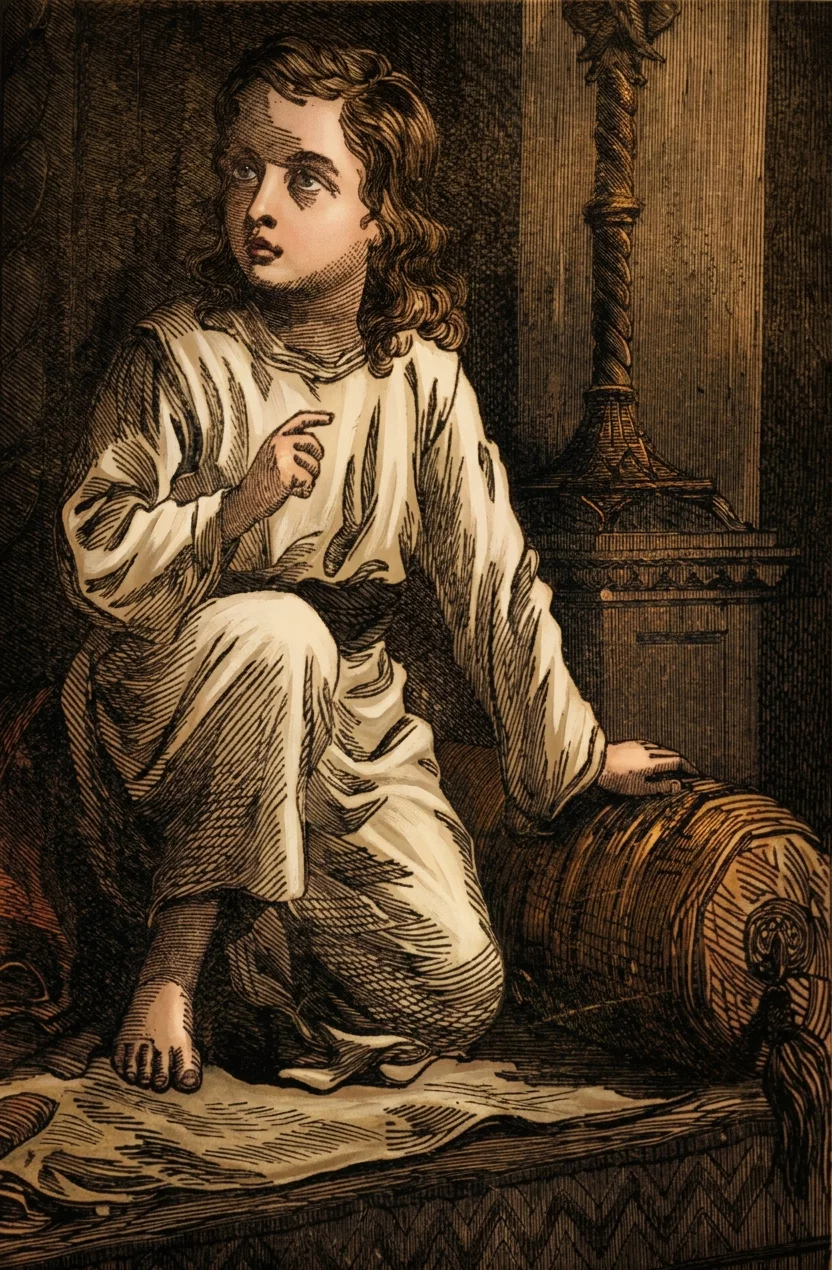
1. And the child Samuel ministered unto the Lord before Eli. And the word of the Lord was precious in those days; there was no open vision.
2. And it came to pass at that time, when Eli was laid down in his place, and his eyes began to wax dim, that he could not see:
3. And ere the lamp of God went out in the temple of the Lord, where the ark of God was, and Samuel was laid down to sleep;
4. That the Lord called Samuel; and he answered, Here am I.
5. And he ran unto Eli, and said, Here am I; for thou calledst me. And he said, I called not; lie down again. And he went and lay down.
6. And the Lord called yet again, Samuel. And Samuel arose and went to Eli, and said, Here am I; for thou didst call me. And he answered, I called not, my son; lie down again.
7. Now Samuel did not yet know the Lord, neither was the word of the Lord yet revealed unto him.
8. And the Lord called Samuel again the third time. And he arose and went to Eli, and said, Here am I; for thou didst call me. And Eli perceived that the Lord had called the child.
9. Therefore Eli said unto Samuel, Go, lie down; and it shall be, if he call thee, that thou shalt say, Speak, Lord; for thy servant heareth. So Samuel went and lay down in his place.
10. And the Lord came, and stood, and called as at other times, Samuel, Samuel. Then Samuel answered, Speak; for thy servant heareth.
11. And the Lord said to Samuel, Behold, I will do a thing in Israel, at which both the ears of every one that heareth it shall tingle.
12. In that day I will perform against Eli all things which I have spoken concerning his house; when I begin, I will also make an end.
13. For I have told him that I will judge his house forever for the iniquity which he knoweth; because his sons made themselves vile, and he restrained them not.
Golden Text: “Speak, Lord; for thy servant heareth.” Verse 9.
NOTE.—The leading characters of this lesson are Eli, the judge of Israel, and his two sons, Hophni and Phinehas; Elkanah, a Levite; his wives, Peninnah and Hannah, and Samuel, son of the latter; a man of God (chapter 2, verse 27). The first six chapters of 1 Samuel should be read in this connection. The time covered is from the birth of Samuel to the return of the ark. Eli died at the age of ninety-eight, after he had judged Israel forty years. Samuel is supposed to have been about thirty-two years old at the time of Eli’s death, and according to Josephus was twelve years old when the Lord first spoke to him. He was “asked of God” by Hannah, and devoted to the Lord’s service from birth. He entered upon active duty when a very small child. See the first two chapters.
Suggestive Questions.
(1) What were Samuel’s duties? Verse 1. Note 1. (2) How were communications from the Lord regarded? Note 2. (3) What was Eli’s condition physically? Verse 2. (4) What time did the Lord choose to call Samuel? Verses 2 and 3. Note 3. (5) What answer did Samuel make to the call? Verse 4. (6) Who did he think it was that spoke to him? Verse 5. (7) What occurred at the second call? Verse 6. (8) Why did he not recognize the voice of the Lord? Verse 7. Note 4. (9) Describe the third call. Verse 8. (10) What did Eli tell Samuel to do? Verse 9. (11) What ensued? Verse 10. Note 5. (12) What was the message of the Lord? Verses 11-13. Note 6.
Notes.
1. A Levite was not supposed to minister in the sanctuary before the age of twenty-five. But Samuel was an exception, and extraordinary trusts were imposed upon him because of his piety and faithfulness. At an early age he wore the sacred ephod. Chapter 2, verse 18. His duties were doubtless such as a child could do, attending to the lamps, curtains, and dishes, performing errands for Eli, etc.
2. The days were evil; the people had departed from the Lord and despised his word. Hence that word was precious, that is, rare, not common. There was no vision for public guidance, and “where there is no vision, the people perish.” Prov. 29:18.
3. The golden lamp in the sanctuary was lighted at night. The time was therefore near morning. The place of abode for the priest and attendants was near by, without the court.
4. Samuel did not know yet the manner in which God spoke to his prophets. This was his first experience. His obedience to the summons when as yet he believed it to be the call of man, showed his fitness to be called by the Lord. He was faithful, attentive to the wants of the aged Eli, and implicitly obedient, an example to every child, and to older ones as well. His life and its results was an illustration of Luke 16:10: “He that is faithful in that which is least is faithful also in much.”
5. Samuel was no doubt frightened when he learned that it was the Lord who had spoken to him. He forgot part of his instructions, but his motive was sincere. Would that every professed child of God were as ready as the child Samuel to say, Here am I; speak, Lord; for thy servant heareth. The wording is immaterial. The Lord knows the heart. It is the sense of discernment when the Lord calls, the ready response, and the equally important learning and receptive attitude, indicative also of action when the message is given, that is pleasing to the Lord, and which should be manifested by his servants.
6. The Lord had borne with the house of Eli and with Israel a long time, but judgment came at last. The course of Eli in not restraining his sons in their evil course, and installing them in the priestly offices, is a sad and deplorable picture. He was an overindulgent father, and in this respect the scene is a warning and a lesson to every parent. He lacked firmness, and as the result, his sons became “sons of Belial,” vile and overbearing, with neither respect for parent nor for God, an evil example, and one that was widely copied by the people. Once (chapter 2, verses 27-36) a warning came to Eli from a man of God, but was not heeded. Then his second warning came through Samuel, and, although Eli proclaimed it himself, he weakened when it came to eradicating the evil. For a long time—twenty years—the Lord delayed the threatened judgment. Then Hophni and Phinehas were slain in a battle with the Philistines, and at the news, together with the news of the taking of the ark, Eli fell and died. Chapter 4, verse 18. Nevertheless, the course of these wicked sons was not followed by Samuel, who “grew, and the Lord was with him.” Chapter 3, verse 19. Who will say that a godly mother’s early training had not much to do in securing this result?